
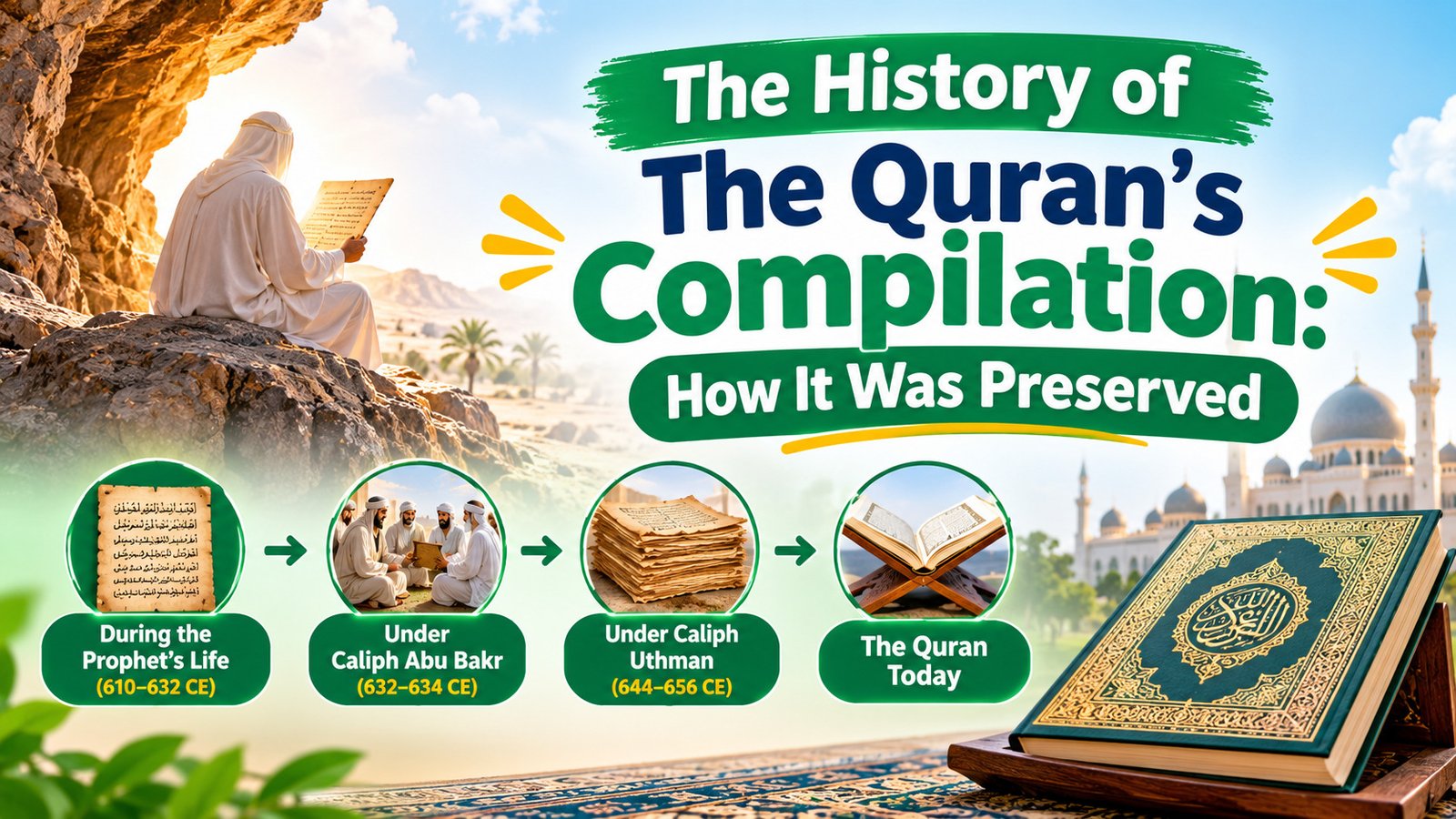
The Quran is The Holy book of Islam and the central source of guidance for Muslims around the world. Muslims believe that it is the word of Allah, revealed to Prophet Muhammad ﷺ through Angel Jibril (Gabriel) over approximately 23 years. One of the most important questions about the Quran is how its text was preserved from the time of revelation until today. The answer involves several connected methods: memorization, written records, careful teaching, recitation, and later compilation into written copies.
The Quran was not first written as a single bound book during the lifetime of Prophet Muhammad ﷺ. Instead, verses were revealed gradually, memorized by the Companions, recited in prayer and teaching, and also written down by appointed scribes. After the Prophet’s death, the Companions took further steps to gather the written material into a single collection and later produce standardized copies for the growing Muslim community. This History helps explain why Quran preservation is closely connected to both written transmission and oral recitation.
What Does Quran Compilation Mean?
The Term Quran compilation can refer to different stages in the early history of the Quran. During the lifetime of Prophet Muhammad ﷺ, the Quran was being revealed and taught. Companions memorized its verses and some also wrote the revelation on available writing materials. After the Prophet ﷺ passed away, the Quran was collected into a unified written collection during the caliphate of Abu Bakr رضي الله عنه.
Later, during the caliphate of Uthman ibn Affan رضي الله عنه, copies were prepared from the earlier collection and distributed to different regions to help prevent disagreements in Quranic recitation. Therefore, it is useful to distinguish between:
- The Revelation of the Quran
- Memorization and writing during the Prophet’s lifetime
- The first collection into a written volume
- The later standardization and distribution of written copies
These stages are part of The broader history of How The Quran was preserved.
How Was the Quran Preserved During the Prophet’s Lifetime?
The Quran was revealed to Prophet Muhammad ﷺ gradually rather than all at once. Whenever revelation came, the Prophet ﷺ recited the verses to his Companions. They learned them, memorized them, recited them in prayer, and taught them to others. Writing was also an important part of the process. The Prophet ﷺ had scribes who wrote down revealed verses. The written material was kept on the available writing materials of the time, while many Companions also committed the Quran to memory. This combination was significant. The Quran was not dependent on a single written document. It was also preserved through people who memorized and recited it.
This tradition of learning the Quran directly from a teacher and reciting it accurately continues today. For students who want to strengthen their pronunciation and recitation, Taqi Academy’s Quran Reading with Tajweed course teaches areas such as Makharij, Sifaat, Qalqalah, Madd, Ghunnah, and other Tajweed rules.
The Role of Quran Memorization
Memorization has always played an important role in the transmission of the Quran. Many Companions memorized portions or the whole Quran. The Quran was regularly recited during salah and taught to new Muslims. This created an oral tradition in which the text was learned by listening, repeating, and reciting. This method remains part of Muslim communities today. Millions of Muslims memorize portions of the Quran, while some commit the entire Quran to memory. The Arabic term Hifz refers to memorization, and a person who memorizes the entire Quran is commonly called a Hafiz. However, Hifz is not simply about remembering words. Correct pronunciation, order of verses, Regular Revision and accurate recitation are all important.
Taqi Academy’s Complete Hifz Program follows a structured approach that combines new memorization, revision, Tajweed, oral assessment, and teacher feedback. For Students who need to balance Quran memorization with school, work, or family responsibilities, the Part-Time Hifz Program focuses on manageable portions, regular revision, and a sustainable memorization routine.
Was The Quran Written Down During the Prophet’s Lifetime?
Yes. The Quran was written down during the lifetime of Prophet Muhammad ﷺ, although it was not yet gathered into one single bound Mushaf in the form familiar to Muslims today.
The Companions used various writing materials available at the time. At the same time, the Quran was being memorized and recited. This is an important point because The History of Quran preservation was not simply a process of writing the Quran down for the first time after the Prophet’s death. Instead, written and oral transmission existed together. The Companions learned the Quran directly from the Prophet ﷺ, preserved it in their memories, and recorded portions of the revelation in writing.
Why Was The Quran Collected After The Prophet’s Death?
After the death of Prophet Muhammad ﷺ, a major concern arose during the Battle of Yamama. A number of Quran reciters were killed in the battle. Umar ibn al-Khattab رضي الله عنه became concerned that continued losses among those who had memorized the Quran could create a serious preservation challenge. He therefore suggested to Abu Bakr رضي الله عنه that the Quran should be collected.
According to the account of Zayd ibn Thabit رضي الله عنه recorded in Sahih al-Bukhari, Abu Bakr initially hesitated because the Prophet ﷺ had not previously ordered such a compilation into a single collection. After discussion, Abu Bakr accepted the proposal and assigned Zayd ibn Thabit to carry out the work. This was an important historical development. The purpose was not to create a new Quran. It was to gather the existing Quranic material into a consolidated written collection.
Zayd ibn Thabit and The First Collection
Zayd ibn Thabit رضي الله عنه had served as one of the scribes who wrote revelation for the Prophet ﷺ. Abu Bakr therefore selected him to undertake the collection. Zayd described the responsibility as extremely difficult. He searched for written Quranic material and also relied on the memorization of the Companions. The account in Sahih al-Bukhari mentions written materials including date-palm stalks, pieces of leather, and other materials, as well as the memories of those who had memorized the Quran.
This illustrates an important aspect of The early preservation process: the written material and the memorized Quran were used together rather than relying on only one method. The resulting collection remained with Abu Bakr رضي الله عنه until his death. It then remained with Umar رضي الله عنه and later with Hafsa bint Umar رضي الله عنها.
What Happened to The Quran During Umar’s Caliphate?
After Abu Bakr رضي الله عنه passed away, the collected manuscripts remained with Umar رضي الله عنه. During Umar’s lifetime, the Muslim community expanded rapidly. Muslims were spreading across different regions, and Quranic teaching was also spreading with them. After Umar’s death, the collection was kept by his daughter Hafsa رضي الله عنها. These sheets later became important when Uthman ibn Affan رضي الله عنه initiated another major step in the history of Quran preservation.
Why Did Uthman Standardize Quran Copies?
As Islam spread into different regions, Muslims from different backgrounds began learning and reciting the Quran. During military campaigns involving Muslims from Syria and Iraq, Hudhaifa ibn al-Yaman رضي الله عنه became concerned about differences in recitation among Muslims. He informed Caliph Uthman رضي الله عنه and urged him to take action before disagreements concerning the Quran became more serious. Uthman then requested the manuscript collection held by Hafsa رضي الله عنها.
According to Sahih al-Bukhari, Uthman appointed Zayd ibn Thabit and several Qurayshi companions to prepare copies from those manuscripts. Where there was disagreement concerning wording or dialect, Uthman instructed the group to write according to the language of Quraysh, as The Quran had been revealed in their tongue. Copies were then sent to different regions. This process is commonly described as the Uthmanic standardization of the Quran.
Did Uthman Change The Quran?
No. The purpose of Uthman’s action was not to rewrite or create a different Quran. The goal was to provide standardized written copies for the expanding Muslim community and reduce disputes over recitation. The Sahih al-Bukhari account explains that Uthman used the manuscripts held by Hafsa as the basis for producing copies and then sent copies to different regions.
It is also important to understand the historical context of the Arabic script. Early Arabic writing did not contain all of the vowel marks and dotting systems commonly seen in modern printed Mushafs. These writing conventions developed over time to help readers pronounce Arabic correctly, especially as Islam spread to non-Arabic-speaking populations. The underlying Quranic text and the later development of reading aids should therefore not be confused with the original act of revelation and preservation.
What is The Difference Between Compilation and Standardization?
These two terms are sometimes used as if they describe the same event, but they refer to different stages.
First Collection
During Abu Bakr’s caliphate, the Quran was gathered into a consolidated written collection after the Battle of Yamama.
Standardization
During Uthman’s caliphate, copies were prepared from the earlier collection and distributed to different regions to help maintain a unified written standard and reduce disputes in recitation. Understanding this distinction makes the history much clearer. The Quran was already known, memorized, recited, and written before these later compilation efforts.
How Oral and Written Preservation Worked Together
One of the most important features of Quranic preservation is the relationship between oral and written transmission. A written text can be copied. A memorized text can be recited. When both methods are used together, each can support the other. A student may read a verse from the Mushaf, listen to a teacher recite it, repeat it, memorize it, and then recite it back to the teacher. This basic learning model has continued across generations. It also explains why Quran learning is traditionally connected with teachers rather than depending entirely on a person’s ability to read a printed page.
For Beginners, building the correct foundation matters. Taqi Academy’s Noorani Qaida & Basic Tajweed course is designed to help students learn Arabic letters, pronunciation, and basic Quran reading before moving toward more advanced study.
What Does The Quran Say About Its Preservation?
Muslims understand Quran preservation first and foremost through their faith in Allah’s promise. Allah says in Surah Al-Hijr:
“Indeed, it is We who sent down the Qur’an and indeed, We will be its guardian.”
Quran 15:9
This verse is central to the Islamic understanding of the preservation of the Quran. From the Islamic perspective, the human efforts of the Companions were part of the means through which Allah’s promise of preservation was fulfilled. This is an important distinction: Muslims believe Allah is the ultimate preserver, while the Companions played a major historical role in carefully transmitting, collecting, teaching, and distributing the Quran.
The Importance of Tajweed in Quran Preservation
Preservation is not only about having the words written on a page. Correct recitation also matters. Arabic letters have specific articulation points and characteristics. Changing the pronunciation of certain letters can change the sound and, in some cases, the meaning. This is one reason Tajweed became an important part of Quran education. The purpose of Tajweed is to help readers pronounce the Quran correctly according to established rules of recitation. Taqi Academy’s Quran Reading with Tajweed course includes practical recitation, correction of mistakes, Makharij, Sifaat, and other essential Tajweed topics.
You can also learn more from Taqi Academy’s existing article Tajweed for Beginners: 15 Rules Every Quran Reader Should Know, which introduces important rules for new Quran readers. The academy’s blog also covers Common Quran Recitation Mistakes and How to Correct Them for learners who want to improve their accuracy.
The Role of Hifz in Preserving the Quran Today
The tradition of memorizing the Quran continues to be one of the most visible examples of oral transmission. A Hafiz can recite the Quran from memory without looking at a Mushaf. At the same time, memorization is normally supported by reading from the Mushaf and regular correction by a teacher. This is why a strong Hifz program should not focus only on memorizing new verses. Students also need:
- Correct pronunciation
- Tajweed
- Daily revision
- Regular recitation
- Teacher correction
- Long-term retention
Taqi Academy’s Complete Hifz Program combines memorization with Tajweed, revision, oral testing, and progress assessment. For Students who want to understand the verses they memorize, Studying Quran translation and Tafseer alongside Hifz can also make memorization more meaningful.
Why Understanding The Quran’s History Matters
Learning about Quran compilation is not simply an exercise in history. It helps Muslims appreciate the careful effort through which the Quran was transmitted from one generation to another. It also shows why Muslims place importance on:
- Learning directly from qualified teachers
- Checking pronunciation
- Revising memorized portions
- Reading from a reliable Mushaf
- Understanding Quranic context
- Studying authentic sources
For students who want to study the meaning and historical context of Quranic verses, Taqi Academy offers a Quran Translation & Tafseer course. The course combines translation with Tafseer and explores context, themes, and practical lessons from the Quran. The academy also offers Islamic Studies, which includes Quran, Hadith, Seerah, Islamic history, worship, and other foundational subjects.
What Can We Learn From The History of Quran Preservation?
The history of the Quran’s compilation gives Muslims several important lessons.
1. Accuracy Matters
The Companions treated the Quran with great care. The collection and copying process was approached as a serious responsibility.
2. Memorization Has Always Been Important
The Quran was not preserved only through written pages. Memorization and recitation played a major role in its transmission.
3. Teachers Matter
The Quran has traditionally been learned through recitation and correction. A teacher can identify pronunciation mistakes that a learner may not notice alone.
4. Revision Is Essential
Memorizing something does not automatically mean it will never be forgotten. Regular revision has always been important for students of the Quran. This remains true for modern learners. Taqi Academy’s blog guide How to Memorize the Quran: A Step-by-Step Hifz Guide for Beginners explains the importance of manageable memorization goals, regular revision, correct Tajweed, and teacher guidance.
5. Understanding Strengthens Learning
Learning the meaning of the Quran can make recitation and memorization more meaningful. A student who understands what they are reading can reflect on the message rather than treating memorization as words without context.
Frequently Asked Questions
When was the Quran first compiled into one written collection?
According to the well-known account recorded in Sahih al-Bukhari, the Quran was collected into a consolidated written collection during the caliphate of Abu Bakr رضي الله عنه after the Battle of Yamama. Zayd ibn Thabit رضي الله عنه was assigned to collect the material.
Who collected The Quran during Abu Bakr’s caliphate?
Zayd ibn Thabit رضي الله عنه was assigned by Abu Bakr رضي الله عنه to collect the Quran into a consolidated written collection. He had previously served as a scribe of revelation.
Who standardized The Quranic Copies?
Caliph Uthman ibn Affan رضي الله عنه ordered the preparation of standardized copies after concerns arose about disagreements in recitation among Muslims in different regions. Zayd ibn Thabit and other Companions were involved in preparing the copies.
Was the Quran memorized during The Prophet’s lifetime?
Yes. The Companions learned and memorized the Quran during the Prophet’s lifetime while the revelations were being received and taught.
Was the Quran written during The Prophet’s lifetime?
Yes. Quranic revelation was written by scribes during the Prophet’s lifetime, while the verses were also memorized and recited by the Companions.
Why did Uthman رضي الله عنه produce standardized copies?
The Muslim community had expanded into different regions, and concerns arose about disagreements in recitation. Uthman’s standardization aimed to provide a common written reference and prevent disputes from becoming more serious.
How does Hifz help preserve The Quran?
Hifz maintains an oral tradition in which Muslims memorize and recite the Quran accurately. It works alongside written Mushafs, teaching, and regular recitation.
Why is Tajweed important when learning The Quran?
Tajweed helps students pronounce Arabic letters and Quranic words correctly. It is especially important for learners who want to improve their recitation and avoid pronunciation mistakes.
Conclusion: A Carefully Preserved Revelation
The history of the Quran’s compilation is a story of revelation, memorization, writing, teaching, careful collection, and standardization. During the lifetime of Prophet Muhammad ﷺ, the Quran was recited, memorized, taught, and written. After his death, Abu Bakr رضي الله عنه initiated the collection of the Quran into a consolidated written form following concerns raised after the Battle of Yamama. Later, Uthman رضي الله عنه arranged for standardized copies to be prepared and distributed as the Muslim community expanded.
For Muslims, these historical efforts are understood alongside the Quran’s own declaration that Allah will guard His revelation. Today, the same preservation tradition continues through Mushafs, memorization, recitation, Tajweed, and teaching from qualified instructors.
Learning this history can therefore deepen a student’s appreciation for every verse they read and every word they memorize. Whether you are beginning with Noorani Qaida, improving your Tajweed, working toward Hifz, or studying Quran Translation and Tafseer, learning the Quran connects you with a tradition that has been passed from generation to generation. If you want to build a stronger Quran learning routine, explore Taqi Academy’s online Quran courses for structured learning in Quran reading, Tajweed, Hifz, Arabic, Translation & Tafseer, and Islamic Studies.