
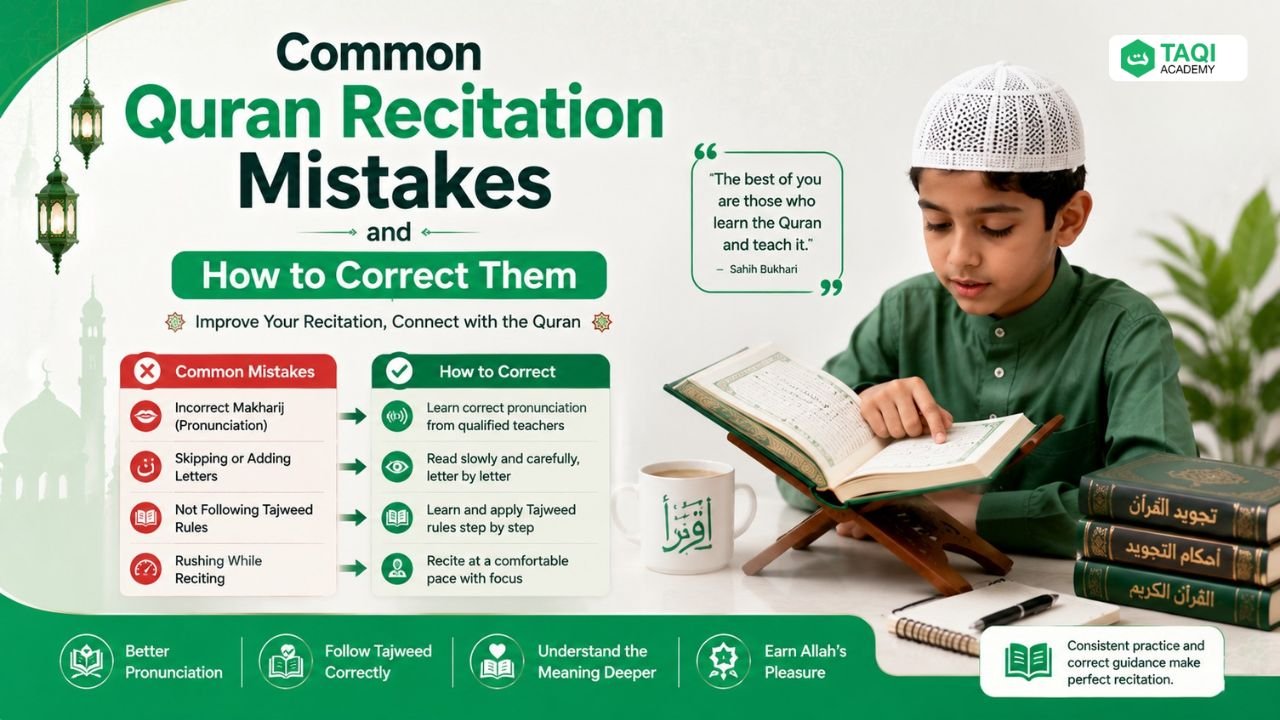
Reading the Quran is a beautiful act of worship, but reading it correctly takes practice. Many learners make small mistakes in pronunciation, letter sounds, Tajweed rules, or stopping during recitation. These mistakes are common, especially when someone is learning without regular feedback from a qualified Quran teacher. The good news is that most reading mistakes can be improved with the right guidance, careful listening, and regular practice.
At TAQI Academy, Quran learners can receive live, one-to-one instruction with qualified teachers who can listen to their recitation and correct mistakes during the lesson. This type of personal feedback is especially helpful when a learner has difficulty with Arabic pronunciation or Tajweed. In this guide, we will look at some of the most common Quran recitation mistakes and explain practical ways to correct them.
Why Correct Quran Recitation Matters
The Quran was revealed in Arabic, and Arabic letters have specific sounds and articulation points. Changing the sound of a letter, vowel, or word can affect the quality of recitation and, in some cases, the meaning. This is why learners should not depend only on reading the Arabic text silently or copying a recording. A qualified teacher can listen to the way you pronounce each letter and identify mistakes that you may not notice yourself. Tajweed provides rules that help learners pronounce Quranic letters correctly, apply appropriate characteristics to letters, and understand when to stretch, merge, hide, or pronounce certain sounds.
If you are still learning the Arabic alphabet or basic reading rules, starting with Noorani Qaida and Basic Tajweed can help build the foundation needed for better Quran reading. TAQI Academy’s foundation course covers Arabic letters, vowel signs, Makharij, basic Tajweed and reading practice.
1. Pronouncing Arabic Letters Incorrectly
One of the most common Quran recitation mistakes is confusing similar Arabic letters. For example, some learners may struggle to clearly distinguish letters such as:
- س and ص
- ت and ط
- ذ and ز
- ح and ه
- ع and ء
- ق and ك
These letters may look or sound similar to a beginner, but they are produced from different places in the mouth or throat.
How to Correct It
Start by learning Makharij al-Huruf, the articulation points of the Arabic letters. Do not try to correct every letter at once. Choose one difficult letter, learn where it comes from, listen to a qualified teacher pronounce it, and repeat it several times.
Then practice the letter:
- By itself
- With different vowel sounds
- In simple words
- In Quranic words
- During actual recitation
A teacher’s feedback is important because you may think a sound is correct even when your tongue, lips, or throat are producing it incorrectly.
2. Ignoring Harakaat
Another common problem is not paying enough attention to short vowel sounds. The main short vowels include:
- Fathah
- Kasrah
- Dammah
A learner may read a word too quickly and change the vowel sound. This can make the recitation inaccurate.
How to Correct It
Slow down. Before reading a word, look carefully at the letter and its vowel sign. Practice short Quranic words repeatedly until the sound becomes natural. Beginners can strengthen this skill through Noorani Qaida, which teaches Arabic letters, Harakaat, Sukun, Shaddah, Tanween and other basic reading skills step by step.
3. Not Giving Shaddah Its Proper Value
Shaddah indicates that a letter has a doubled sound. Some learners read the letter too lightly or move through it too quickly. This can make the word sound different from the correct recitation.
How to Correct It
When you see Shaddah, give the letter its proper emphasis. Practice words containing Shaddah slowly first. Once the pronunciation is correct, gradually increase your reading speed. Do not focus on speed before accuracy.
4. Making Mistakes With Madd
Madd means elongation. Some learners stretch a sound for too long, while others make it too short. Both problems can affect the flow and accuracy of recitation.
How to Correct It
Learn the different types of Madd from a qualified Tajweed teacher. Then practice them with examples instead of trying to memorize rules without applying them. TAQI Academy’s Quran Reading with Tajweed course includes lessons on Madd and practical recitation sessions where learners receive correction and feedback.
5. Misapplying Noon Saakinah and Tanween Rules
Noon Saakinah and Tanween have specific Tajweed rules. Depending on the following letter, the recitation may involve Izhar, Idgham, Iqlab, or Ikhfa. A common mistake is applying the wrong rule or reading every combination in the same way.
How to Correct It
First learn the four main rules separately. Then practice short examples with a teacher. Instead of trying to remember a large number of examples at once, learn one rule, practice it until you can recognize it quickly, and then move to the next rule.
6. Incorrect Meem Saakinah Recitation
Meem Saakinah also has specific rules. Learners sometimes miss the correct sound when another letter follows it. This can happen because the reader is concentrating on speed instead of the relationship between the letters.
How to Correct It
Practice Meem Saakinah examples slowly. Pay close attention to the sound of the lips and learn when the sound should be clear, hidden, or merged. Regular teacher correction can make this much easier.
7. Weak or Incorrect Qalqalah
Qalqalah is another area where beginners can struggle. Some learners make the echoing sound too weak. Others make it too strong and add an unnecessary vowel sound.
How to Correct It
Learn the Qalqalah letters and listen carefully to how a qualified Quran teacher produces the sound. Then practice the letters individually before applying the rule during full verses. TAQI Academy’s Tajweed curriculum includes Qalqalah as part of its structured Tajweed training.
8. Confusing Heavy and Light Letters
Arabic letters can have different qualities in Quranic recitation. Some letters are read with a heavier sound, while others are lighter. Learners sometimes make heavy letters too light or make light letters unnecessarily heavy.
How to Correct It
Study Tafkheem and Tarqeeq with examples. Do not depend only on English explanations. Listen to a qualified reciter and, when possible, ask a teacher to correct your pronunciation. TAQI Academy’s Tajweed course specifically covers Tafkheem, Tarqeeq, Makharij and Sifaat.
9. Incorrect Ghunnah
Ghunnah is a nasal sound used in certain Tajweed rules. One common mistake is making it too short, too long, or using it where it does not belong.
How to Correct It
Practice Ghunnah with a teacher. Pay attention to the nasal sound rather than simply trying to copy the speed of an experienced Qari. Start slowly, understand the rule, and then practice it in complete words and verses.
10. Stopping in the Wrong Place
Good Quran recitation is not only about pronunciation. Knowing where to stop and where to continue is also important. A learner may stop simply because they need to breathe, without considering the meaning or the appropriate Waqf sign.
How to Correct It
Learn the basic rules of Waqf and Ibtida. Pay attention to the stopping signs in the Mushaf and ask a qualified teacher when you are unsure. TAQI Academy’s Tajweed course includes Waqf and Ibtida as part of its advanced Tajweed lessons.
11. Reading Too Fast
Many learners believe that faster recitation means better recitation. It does not.
When you read too quickly, you may:
- Skip sounds
- Miss Tajweed rules
- Shorten Madd
- Mispronounce letters
- Forget stopping rules
- Lose control of your breathing
How to Correct It
Reduce your reading speed. Focus on accuracy first. Once your pronunciation and Tajweed become more consistent, you can gradually improve your fluency. A good practice session should focus on correct reading before fast reading.
12. Copying a Reciter Without Understanding the Rules
Listening to skilled Qaris is an excellent way to improve. However, simply copying the sound may not be enough. A learner may copy the rhythm but still pronounce some letters incorrectly.
How to Correct It
Use a simple three-step method:
Listen → Read → Get Corrected
Listen to a reliable recitation. Then read the same passage yourself. Finally, ask a qualified teacher to listen and point out your mistakes. This approach helps you understand why a particular sound is being made instead of only copying it.
13. Practicing Without Teacher Feedback
One of the biggest challenges for self-learners is not knowing which mistakes they are making. You may repeat the same pronunciation many times and assume it is correct.
A qualified teacher can identify problems with:
- Makharij
- Letter characteristics
- Tajweed rules
- Madd
- Ghunnah
- Qalqalah
- Waqf
- Reading fluency
For learners who want focused correction, Quran Reading with Tajweed at TAQI Academy provides one-to-one live sessions and practical recitation correction. The course also includes oral assessment and personalized feedback.
How to Improve Your Quran Recitation Step by Step
If you want to improve your Quran recitation, follow a simple routine.
Step 1: Identify Your Main Mistakes
Do not try to fix everything at once.
Ask a qualified teacher to listen to your recitation and identify your most important mistakes.
Step 2: Work on Makharij
Correct letter pronunciation should come first. If the basic letter sounds are wrong, learning advanced Tajweed rules will be much harder.
Step 3: Review Basic Tajweed
Study rules such as:
- Noon Saakinah and Tanween
- Meem Saakinah
- Qalqalah
- Madd
- Ghunnah
- Tafkheem and Tarqeeq
- Waqf and Ibtida
Step 4: Read Slowly
Choose a short passage and read it carefully. Do not worry about speed.
Step 5: Get Regular Corrections
Regular feedback helps prevent small mistakes from becoming permanent habits.
Step 6: Practice Every Day
Even a short daily practice session can be useful when it is consistent.
Step 7: Track Your Progress
Keep a simple list of the mistakes you are working on.
For example:
| Mistake | Correction | Practice |
| ق pronunciation | Correct Makharij | 10 minutes daily |
| Madd | Correct elongation | Selected verses |
| Ghunnah | Correct nasal sound | Tajweed examples |
| Waqf | Learn stopping signs | Reading practice |
What Should Beginners Do If They Cannot Read the Quran Correctly?
Do not feel embarrassed. Many learners start from the beginning, and that is completely normal. If you are still struggling with Arabic letters, vowel signs, joining letters, or basic pronunciation, a foundation course is usually a better starting point than jumping directly into advanced Tajweed. TAQI Academy’s Quran Foundation Course – Noorani Qaida & Basic Tajweed is designed for beginners and children and covers Arabic letters, pronunciation, vowel signs, basic Tajweed and reading practice. If you already read Arabic but want to correct your pronunciation and Tajweed, The Quran Reading with Tajweed course is the more relevant next step.
How Tajweed Helps Prevent Recitation Mistakes
Tajweed gives learners a structured way to improve Quran recitation. Instead of guessing how a letter should sound, students learn:
- Where each letter comes from
- How letters should sound
- When sounds are merged
- When sounds are hidden
- When sounds are clear
- How long certain sounds should be stretched
- How to stop and start correctly
For learners who are also memorizing the Quran, correct Tajweed is especially important because repeated recitation can strengthen both correct and incorrect habits. TAQI Academy’s Hifz programs combine memorization with Tajweed practice, revision and teacher correction.
Common Quran Recitation Mistakes: Quick Checklist
Before finishing your practice session, ask yourself:
- Am I pronouncing each Arabic letter correctly?
- Am I reading the vowel signs accurately?
- Am I giving Shaddah its proper value?
- Am I applying Madd correctly?
- Am I following Noon Saakinah and Tanween rules?
- Am I applying Meem Saakinah rules correctly?
- Am I using Qalqalah properly?
- Am I keeping heavy and light letters distinct?
- Am I applying Ghunnah correctly?
- Am I stopping at appropriate places?
- Am I reading slowly enough to maintain accuracy?
- Has a qualified teacher checked my recitation?
If you can answer these questions honestly, you will have a clearer idea of what you need to improve.
Final Thoughts
Quran recitation is a journey. Making mistakes does not mean you cannot become a good reciter. What matters is recognizing your mistakes, learning the correct rules, and practicing consistently. Start with the basics if necessary. Work on Makharij, improve your Tajweed, read slowly, listen carefully, and seek feedback from a qualified teacher.
If you are a beginner, start with Noorani Qaida and Basic Tajweed. If you can already read Arabic but want to improve your pronunciation and Tajweed, consider Quran Reading with Tajweed. Learners working toward memorization can also explore TAQI Academy’s Complete Hifz Program or Part-Time Hifz Program. The goal is not simply to finish a page. The goal is to build a habit of reading the Quran carefully, correctly, and with respect.
Frequently Asked Questions
What are the most common Quran recitation mistakes?
Common mistakes include incorrect Arabic letter pronunciation, weak understanding of Makharij, incorrect Madd, mistakes in Noon Saakinah and Tanween, Meem Saakinah, Qalqalah, Ghunnah, and inappropriate stopping during recitation.
How can I correct my Quran pronunciation?
Start by identifying your mistakes with a qualified Quran teacher. Then practice the relevant Makharij and Tajweed rules slowly and consistently.
Can I learn Tajweed if I cannot speak Arabic?
Yes. Tajweed mainly focuses on correct Quranic pronunciation and recitation rules. You do not need to be fluent in conversational Arabic to begin learning Quran recitation with Tajweed. TAQI Academy’s Tajweed course is available to learners at different levels.
How long does it take to improve Quran recitation?
There is no single timeline. Progress depends on your current reading level, practice routine, teacher feedback, and consistency. TAQI Academy notes that dedicated learners may begin developing proper Tajweed within several months, although mastering recitation is an ongoing process.
Should beginners learn Noorani Qaida before Tajweed?
For learners who are not comfortable with Arabic letters, vowel signs, or basic Quran reading, Noorani Qaida provides a useful foundation before moving into more advanced Tajweed study.
Can a Quran teacher correct my recitation online?
Yes. Live one-to-one classes allow a teacher to hear your recitation and provide immediate feedback. TAQI Academy uses live one-to-one Quran classes with real-time Tajweed correction and personalized learning support.