
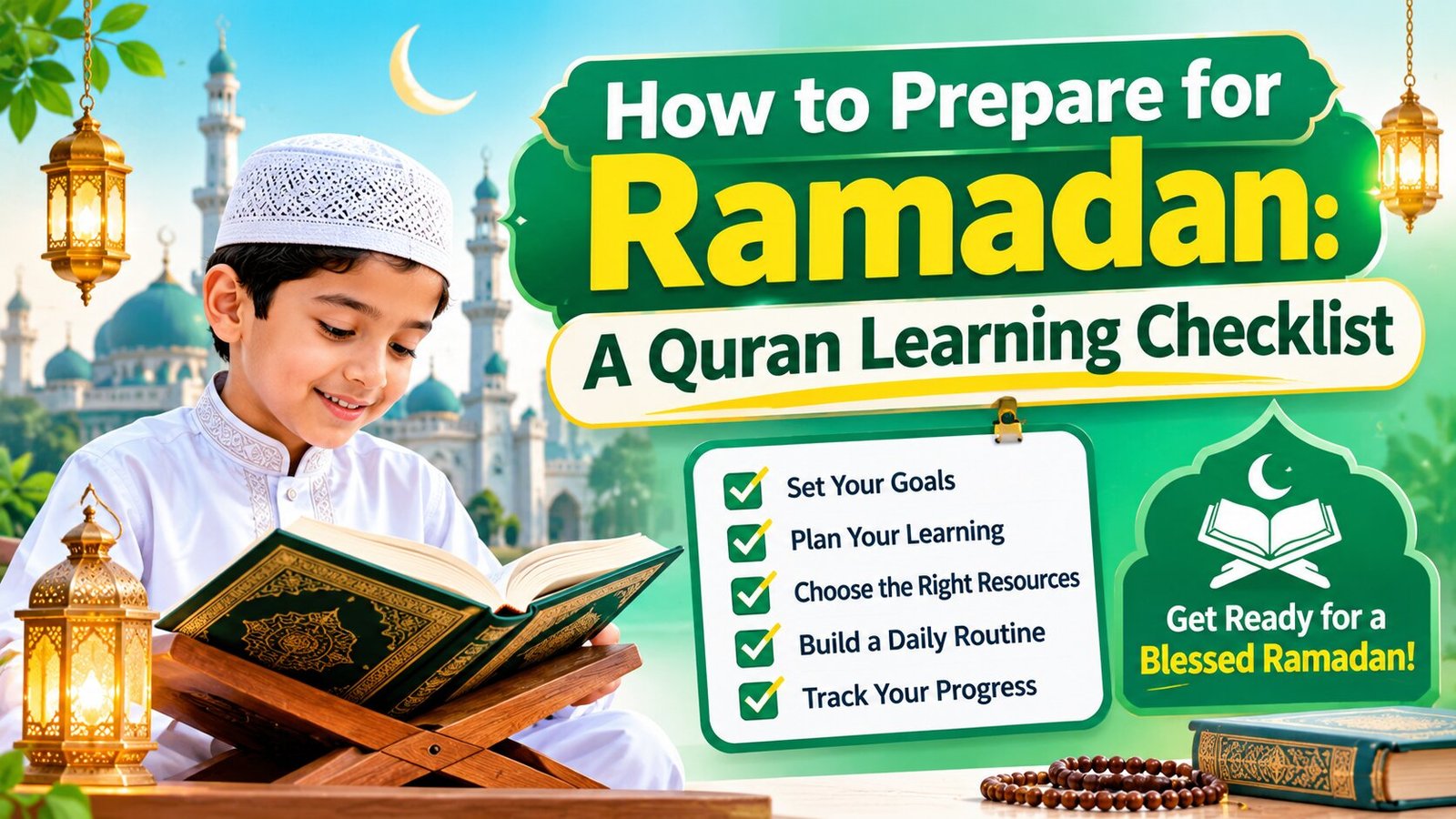
Ramadan is a special time for Muslims to increase their worship, strengthen their connection with Allah, and spend more time with the Quran. For many people, however, the first days of Ramadan can become busy quickly. Fasting, Salah, work, school, family responsibilities, and other acts of worship can make it difficult to create a consistent Quran routine. That is why preparing before Ramadan can make a real difference. You do not need to set unrealistic goals or plan to read the entire Quran overnight. A better approach is to create a simple Quran learning plan that matches your ability, available time, and personal goals. This Ramadan Quran learning checklist can help children, adults, beginners, and regular Quran readers prepare before the month begins.
Why Prepare For Quran Learning Before Ramadan?
Ramadan itself is the time for worship, not a deadline for creating a perfect routine. If you wait until the first day of Ramadan to decide when and how you will read the Quran, your schedule may quickly become difficult to manage. Preparing beforehand gives you time to establish realistic habits. A good preparation plan can help you:
- Set a realistic daily Quran goal
- Improve your Quran reading before Ramadan
- Identify Tajweed mistakes
- Choose which Surahs or Juz to study
- Make time for revision
- Prepare children for a Ramadan Quran routine
- Decide whether you need a teacher’s guidance
- Balance Quran learning with work, school, and family responsibilities
The most important goal is consistency. A manageable Quran routine that you can maintain throughout Ramadan is usually more useful than an ambitious plan that becomes difficult after a few days.
Ramadan Quran Learning Checklist
Before Ramadan begins, work through this simple checklist:
- Check your current Quran reading level
- Set a realistic daily Quran goal
- Choose a convenient learning time
- Review basic Tajweed rules
- Identify difficult pronunciation areas
- Prepare your Quran and learning materials
- Create a reading and revision schedule
- Set a separate plan for children
- Choose whether you want to study Quran meaning
- Plan your Hifz revision if you are memorizing
- Reduce unnecessary distractions
- Track your progress without becoming overly focused on numbers
Let’s look at each step in more detail.
1. Check Your Current Quran Reading Level
Start by being honest about your current ability. Can you read Arabic letters confidently? Do you struggle to join letters? Can you read Quranic verses but make pronunciation mistakes? Are you comfortable applying Tajweed rules? Your answers will help determine what kind of preparation you need. For Complete Beginners, Starting with The basics is often more useful than immediately trying to read large portions of The Quran. Taqi Academy’s Quran Foundation Course – Noorani Qaida & Basic Tajweed is designed around foundational skills such as Arabic letters, vowel signs, pronunciation, reading practice, and basic Tajweed. If you already know how to read but want to improve your pronunciation and application of Tajweed, a structured Tajweed course may be more appropriate.
2. Set A Realistic Daily Quran Goal
One Common mistake is setting a goal that is too difficult to maintain. For Example, someone who normally reads for 10 minutes a day may suddenly plan several hours of Quran study every day during Ramadan. That may work for a short period, but it can become difficult when combined with fasting, work, school, Taraweeh, sleep, and family responsibilities. Instead, consider:
- How much time do I normally have?
- When am I most focused?
- What amount can I maintain throughout Ramadan?
- Do I want to focus on reading, memorization, understanding, or all three?
Your goal can be measured by time, pages, verses, or another practical method. The goal should encourage consistency rather than create unnecessary pressure.
3. Choose The Best Time For Quran Learning
Your schedule matters. Some people prefer reading after Fajr because the environment is quiet. Others may prefer before or after Isha, while parents may find a suitable period for their children during the afternoon or early evening. There is no single schedule that is perfect for everyone. When choosing your time, consider your:
- Work schedule
- School timetable
- Sleep routine
- Salah schedule
- Family responsibilities
- Energy level while fasting
If you are learning with a teacher, an online Quran class can also be scheduled around your daily routine. Taqi Academy provides flexible online learning options for students in different locations and time zones.
4. Review Basic Tajweed Before Ramadan
Ramadan is not only about Reading more Quran. Reading correctly also matters. If you already know some Tajweed, use the weeks before Ramadan to review the rules you commonly forget. Pay attention to areas such as:
- Makharij
- Sifaat
- Madd
- Waqf
- Noon Saakinah and Tanween
- Meem Saakinah
- Qalqalah
You do not need to memorize every Tajweed rule in one sitting. Focus on understanding the rules that directly affect your recitation. Taqi Academy’s Quran Reading with Tajweed Course covers areas including Makharij, Sifaat, Madd, Waqf, and practical recitation, with teacher feedback and correction. You can also read Tajweed for Beginners: 15 Rules Every Quran Reader Should Know before Ramadan as a simple refresher.
5. Identify Your Common Quran Reading Mistakes
Before Ramadan, Ask a Qualified Quran Teacher to listen to your recitation if possible. You may be surprised by mistakes that you do not notice yourself. For Example, you might:
- Pronounce a letter incorrectly
- Extend a Madd incorrectly
- Stop at an unsuitable place
- Confuse similar Arabic letters
- Miss a Tajweed rule
- Read too quickly
Self-study can be useful, but teacher feedback can help identify pronunciation issues that are difficult to recognize on your own. If you want to improve your recitation before Ramadan, consider reading Common Quran Recitation Mistakes and How to Correct Them as part of your preparation.
6. Decide Whether Your Goal Is Reading, Understanding or Memorization
“Learn more Quran” can mean different things. Your Ramadan goal might be:
Quran Reading
You want to become more fluent and complete a consistent amount of reading each day.
Quran Understanding
You want to understand the meaning and lessons of the verses you read.
Quran Memorization
You want to memorize new Surahs or revise previously memorized portions.
Tajweed Improvement
You want to improve pronunciation and recite more accurately. It is fine to have more than one goal, but avoid creating too many competing targets. For Example, You could make your main goal daily Quran reading while adding a smaller goal of studying the meaning of selected verses.
7. Add Quran Translation and Tafseer to Your Routine
Reading the Arabic Quran is essential, but understanding its message can also deepen your learning. If you are comfortable reading Arabic but struggle to understand the meaning, consider adding translation and Tafseer to your Ramadan routine. You could read a small amount of translation after completing your daily recitation and write down one lesson that you want to remember. Taqi Academy’s Quran with Translation & Tafseer course focuses on understanding Quranic meanings, context, lessons, and practical application. The course is available for learners at different levels and includes structured study of selected Surahs and verses. This can be especially useful if your Ramadan goal is not only to finish more pages but also to understand and reflect on what you are reading.
8. Prepare A Hifz Revision Plan
If you are memorizing the Quran, Ramadan can be a valuable opportunity to strengthen your revision routine. However, do not focus only on memorizing new verses. A balanced Hifz routine should include:
- New memorization
- Previous memorization
- Recitation to a teacher
- Correction of mistakes
- Regular revision
Students with busy schedules may need a different approach from those studying Hifz full-time. Taqi Academy’s Part-Time Hifz Program uses manageable memorization portions and regular revision for students who have other responsibilities. Students following a more intensive memorization plan can also explore The Complete Hifz Program, which includes structured memorization, Tajweed, revision, and progress assessment. Before Ramadan, decide exactly when you will revise your previous memorization. This is often more important than simply increasing your new memorization target.
9. Create A Quran Plan For Children
Children may need a different Ramadan Quran routine from Adults. Parents should consider the child’s:
- Age
- Reading ability
- Attention span
- School schedule
- Existing Quran knowledge
- Learning goals
A young beginner may need short and consistent sessions rather than long lessons. If your child is still learning Arabic letters or basic Quran reading, it may be better to strengthen the foundation before expecting them to read large portions. Our Guide How to Teach Kids Quran at Home: A Practical Guide for Parents explains the importance of building a structured foundation and creating a fixed Quran learning routine for children. During Ramadan, parents can also make Quran learning positive by listening to their child’s recitation, encouraging effort, and celebrating progress without turning every session into a test.
10. Prepare Your Quran Learning Materials
Do not wait until Ramadan starts to organize everything. Prepare what you need beforehand, such as:
- A physical Quran
- Quran translation if needed
- Tajweed learning materials
- Notebook for difficult words or rules
- Hifz revision notes
- Audio resources from reliable sources
- A Quran learning app or online class if appropriate
Keep your materials in one convenient place. The easier it is to begin your lesson, the less likely you are to postpone it.
11. Create A Simple Ramadan Quran Schedule
A simple schedule may look like this:
| Time | Activity |
| After Fajr | Quran reading |
| During the day | Short revision or listening |
| After Asr | Children’s Quran practice |
| After Isha | Translation, Tafseer, or revision |
| Before sleeping | Review memorized Surahs |
This is only an example. You should adjust the schedule according to your own responsibilities and energy levels. The purpose of a schedule is to make Quran learning easier, not to create additional stress.
12. Reduce Distractions Before Ramadan
One of the easiest ways to create more Quran time is to identify where your existing time goes. Look at how much time you spend on:
- Social media
- Short videos
- Unnecessary browsing
- Gaming
- Entertainment
- Unplanned phone use
You do not have to eliminate everything. Instead, decide which activities you can reduce during Ramadan and use some of that time for Quran reading, reflection, or revision. Small changes can create meaningful space in your day.
13. Practice Before Ramadan Begins
Do not wait until Ramadan to start your new routine. If your goal is to read for 30 minutes every day during Ramadan, start practicing that routine before Ramadan. If your goal is to memorize a certain number of verses, begin building the habit beforehand. If your goal is to improve Tajweed, start correcting your common mistakes before Ramadan. This gives your mind and schedule time to adjust.
A 7-Day Quran Preparation Plan
If Ramadan is approaching and you want a simple starting point, try this seven-day preparation plan.
Day 1: Assess Your Level
Read a few pages and identify your strengths and weaknesses.
Day 2: Set Your Goal
Decide whether your main focus will be reading, Tajweed, understanding, memorization, or a combination.
Day 3: Build Your Schedule
Choose a realistic daily Quran time.
Day 4: Review Tajweed
Work on the rules and pronunciation points you commonly struggle with.
Day 5: Prepare Your Materials
Organize your Quran, notebook, translation, revision material, and other resources.
Day 6: Practice the Routine
Follow your planned schedule for one full day.
Day 7: Adjust
Ask yourself what worked and what did not. Make the routine easier if necessary. This approach is better than creating a complicated Ramadan timetable that is difficult to follow.
How Much Quran Should You Read During Ramadan?
There is no single number of pages that every Muslim must read each day. Your Quran reading target should depend on your circumstances and ability. Someone who reads fluently may choose a larger target. A beginner may need more time to read a smaller amount correctly. Someone working full-time may have less available time than a student. Do not compare your personal Quran journey with someone else’s.
Instead, focus on:
Consistency + Correct Recitation + Understanding + Reflection
If you are able to increase your reading gradually, do so. But avoid sacrificing correct pronunciation simply to reach a page target.
What If I Am A Complete Beginner?
Do not feel discouraged. You do not need to be an advanced Quran reader before Ramadan. Start with the basics.
Learn:
- Arabic letters
- Letter sounds
- Harakat
- Joining letters
- Simple Quranic words
- Basic pronunciation
- Gradual Quran reading
- Essential Tajweed
This foundation can make future Quran learning easier. Taqi Academy’s Noorani Qaida course follows a beginner-focused structure covering Arabic letters, vowel marks, pronunciation, reading practice, and basic Tajweed. You can also read How Long Does It Take to Learn to Read the Quran? to understand why learning time varies between students.
What If I Already Read The Quran Fluently?
If you already read fluently, use your preparation time to improve quality rather than simply increasing quantity. You might focus on:
- Tajweed
- Correct pronunciation
- Reading fluency
- Quran meaning
- Tafseer
- Memorization
- Revision
- Reflection
You can also set a goal of learning the meaning of selected Surahs rather than trying to study everything at once.
A Balanced Ramadan Quran Checklist For Adults
For busy adults, this simple checklist may be easier to maintain:
Daily
- Read a realistic amount of Quran
- Practice correct pronunciation
- Review memorized Surahs
- Read some translation
- Reflect on one lesson
Weekly
- Review your progress
- Identify difficult verses
- Revise Tajweed rules
- Adjust your schedule if necessary
The objective is to build a routine that works alongside your responsibilities.
A Balanced Ramadan Quran Checklist For Parents
Parents can use a separate checklist for children:
- Set a fixed Quran time
- Keep sessions age-appropriate
- Encourage regular reading
- Listen to the child’s recitation
- Avoid excessive pressure
- Help with homework and revision
- Praise consistent effort
- Keep learning positive
- Adjust the schedule when the child is tired
A child’s Ramadan experience should help them develop positive feelings toward Quran learning.
Common Mistakes To Avoid During Ramadan
Trying to Do Too Much
A huge reading target can become difficult to maintain.
Ignoring Tajweed
Reading quickly should not come at the cost of correct pronunciation.
Focusing Only on Completion
Finishing a certain number of pages is useful as a personal goal, but understanding and reflection also matter.
Forgetting Revision
Hifz students should not focus only on new memorization.
Comparing Yourself With Others
Every learner has different abilities, responsibilities, and starting points.
Changing Your Schedule Every Day
A stable routine is easier to maintain than constantly deciding when to study.
Final Ramadan Quran Learning Checklist
Before Ramadan starts, ask yourself:
Quran Reading
- Can I read the Quran comfortably?
- What amount can I realistically read each day?
Tajweed
- Which pronunciation mistakes do I make?
- Which Tajweed rules need review?
Understanding
- Will I read translation?
- Do I want to study Tafseer?
Memorization
- Do I have a Hifz goal?
- When will I revise previously memorized portions?
Children
- Does my child have an age-appropriate routine?
- Does the schedule fit school and family life?
Schedule
- What time will I read?
- What could interfere with that time?
- How can I reduce distractions?
Consistency
- Can I maintain this plan throughout Ramadan?
If you can answer these questions before Ramadan begins, you will have a much clearer starting point.
Prepare Your Quran Routine Before Ramadan
Ramadan does not require a complicated Quran learning plan. Start with your current level, set a realistic goal, choose a consistent time, and focus on correct reading and meaningful learning. If you are a beginner, build your foundation with Noorani Qaida. If you already read the Quran, consider improving your Tajweed. If you want to understand the message, add translation and Tafseer. And if Hifz is your goal, create a balanced memorization and revision routine. Most Importantly, do not measure your Ramadan only by how many pages you finish.
Use the month as an opportunity to strengthen your relationship with the Quran through regular recitation, understanding, reflection, and sincere effort. If you need structured guidance, Taqi Academy provides online Quran learning for children and adults, including Noorani Qaida, Quran Reading with Tajweed, Hifz, Quran Translation & Tafseer, and Islamic Studies. Its online classes are designed around individual learning needs and flexible schedules. Start preparing now, keep your goals realistic, and make your Quran routine something you can continue throughout Ramadan and beyond.