
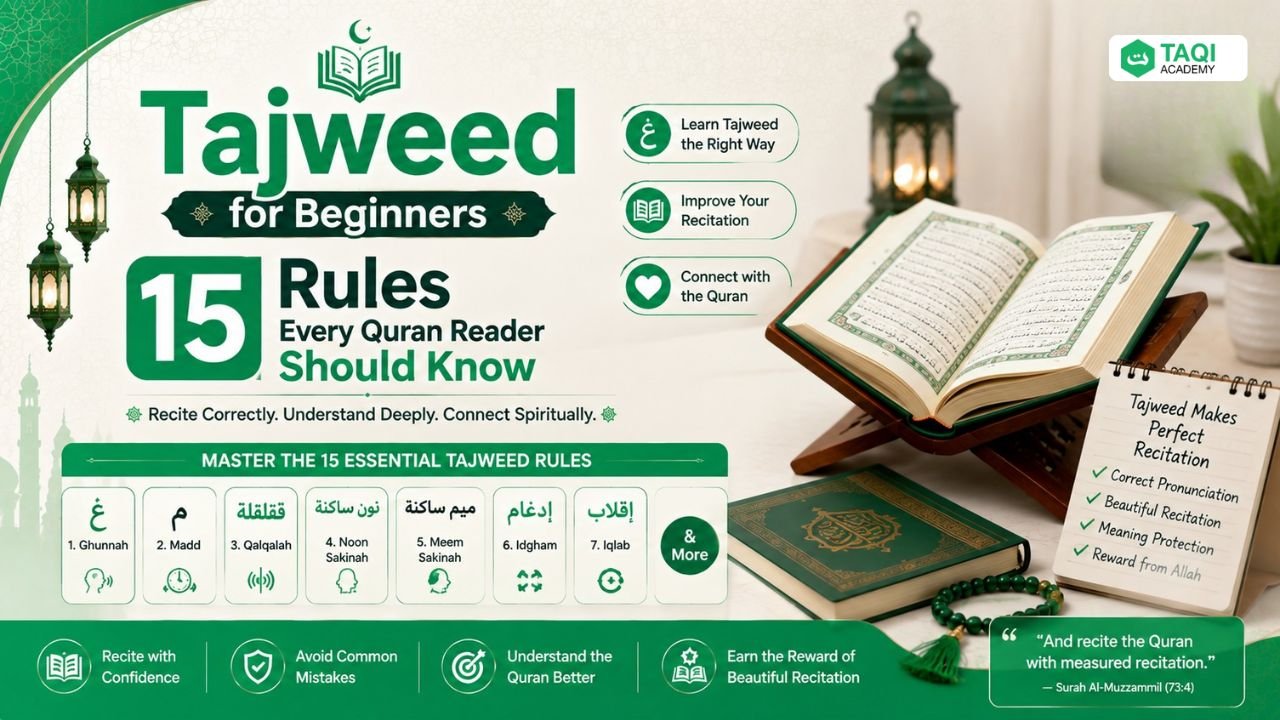
Learning to read the Quran is a beautiful journey. But reading Arabic words is only one part of Quran recitation. To recite the Quran correctly, learners also need to understand how Arabic letters and sounds should be pronounced. This is where Tajweed becomes important.
Tajweed is the set of rules that helps a Quran reader pronounce letters correctly, give each sound its proper quality, and apply the correct rules while reciting. For beginners, Tajweed may seem difficult at first. However, when the rules are learned step by step and practiced with a qualified teacher, they become much easier to understand.
At TAQI Academy, the Quran Reading with Tajweed program covers areas such as Makharij, Sifaat, Noon Sakinah, Meem Sakinah, Qalqalah, Madd, Ghunnah, Tafkheem, Tarqeeq, Waqf, and Ibtida. The course also includes practical recitation and teacher feedback. If you are new to Tajweed, you do not need to master everything in one day. Start with the basic rules, practice regularly, and improve one step at a time.
What Is Tajweed?
Tajweed refers to the rules used to recite the Quran with correct pronunciation and proper articulation. The word is connected to the idea of making something better or more precise. In Quran recitation, Tajweed helps the reader give Arabic letters their correct sounds and qualities. For example, some Arabic letters come from the throat, some from the tongue, and others from the lips. Two letters may look or sound similar to a beginner but have different articulation points. Learning Tajweed helps you understand these differences.
It also teaches you how to handle things such as:
- Short and long vowel sounds
- Letter merging
- Nasal sounds
- Echoing sounds
- Heavy and light letters
- Stopping and starting
- Noon Sakinah and Tanween
- Meem Sakinah
If you are still learning Arabic letters or basic Quran reading, it is often better to build your foundation first. TAQI Academy’s Noorani Qaida and Basic Tajweed course starts with Arabic letters, vowel marks, Makharij, basic Tajweed, and reading practice.
15 Tajweed Rules Every Beginner Should Know
1. Makharij al-Huruf
Makharij means the articulation points of the Arabic letters. Every Arabic letter has a specific place from which its sound comes. Some letters are produced from the throat, some from the tongue, and some from the lips. This is one of the first things a Quran learner should study. For example, ق and ك can sound similar to a beginner, but they are not pronounced from exactly the same place.
How to practice
Take one difficult letter at a time. Listen to a qualified Quran teacher pronounce it. Then repeat the sound slowly. After that, practice the letter inside simple Quranic words. Do not rush this step. Correct pronunciation is the foundation for everything that comes later.
2. Sifaat al-Huruf
While Makharij focuses on where a letter comes from, Sifaat focuses on the qualities of the letters. These qualities help distinguish letters that may have similar articulation points. For a beginner, this topic can feel technical. You do not need to memorize every detail immediately. Instead, learn how the qualities affect the actual sound of the letter. A qualified teacher can demonstrate these differences much better than written explanations alone. TAQI Academy’s Tajweed curriculum includes detailed study of both Makharij and Sifaat with pronunciation exercises.
3. Fathah, Kasrah and Dammah
These are the basic short vowel sounds in Arabic. They are commonly known as:
- Fathah – a short “a” sound
- Kasrah – a short “i” sound
- Dammah – a short “u” sound
A beginner who ignores these marks can easily pronounce a Quranic word incorrectly.
Simple practice
Do not look only at the Arabic letters. Look at the letter and the vowel mark together. Practice short combinations until you can recognize them without hesitation. If you are starting from the very beginning, Noorani Qaida can help you develop this foundation before moving into more advanced Tajweed.
4. Sukun
Sukun shows that a letter does not carry a short vowel. Beginners sometimes add an extra vowel sound after a letter with Sukun. This can change the way the word is recited.
How to practice
Read the letter slowly. Then connect it with the letter before it. Your goal is to make the sound clear without adding an unnecessary vowel. Regular reading practice with a teacher can help you hear and correct this problem.
5. Shaddah
Shaddah indicates a doubled letter. A common beginner mistake is to pass over the letter too quickly. When you see Shaddah, give the letter its proper emphasis. This becomes especially important when Shaddah appears with other Tajweed rules.
Practice tip
Find a few short Quranic words containing Shaddah. Read them slowly several times. Then read them inside the full verse.
6. Noon Sakinah and Tanween
This is one of the most important areas of beginner Tajweed. Noon Sakinah is a Noon with Sukun, while Tanween refers to the double vowel signs. Depending on the letter that follows, different rules apply.
The main rules include:
- Izhar
- Idgham
- Iqlab
- Ikhfa
These rules tell you how the Noon sound or Tanween should be pronounced.
Why beginners struggle
The rules can look confusing when studied only as definitions. The easier approach is to learn one rule, listen to examples, and then practice those examples aloud. TAQI Academy’s foundation course introduces Noon Sakinah and Tanween rules as part of its basic Tajweed curriculum.
7. Meem Sakinah
Meem Sakinah refers to a Meem with Sukun. It has its own rules depending on the letter that comes after it. The main areas include:
- Ikhfa Shafawi
- Idgham Shafawi
- Izhar Shafawi
Because Meem is produced with the lips, paying attention to lip movement is important.
Beginner tip
Practice slowly and watch how your lips move. If possible, practice with a teacher who can observe your pronunciation and correct it immediately.
8. Qalqalah
Qalqalah is a slight echoing or bouncing quality that occurs with certain letters when they have Sukun. The five commonly recognized Qalqalah letters are:
ق ط ب ج د
A common mistake is making the echo too strong or adding an unwanted vowel.
How to improve
Start by practicing the letters individually. Then practice them inside Quranic words. Finally, read them in complete verses. The TAQI Academy foundation course introduces Qalqalah, while the Tajweed course covers it more fully.
9. Idgham
Idgham means merging one sound into another according to specific Tajweed rules. It appears in different parts of Tajweed, including Noon Sakinah and Tanween. For beginners, the important point is that Idgham does not mean simply reading two letters quickly. The correct sound and conditions must be followed.
How to learn it
First understand which letters trigger the rule. Then listen to several examples. After that, practice the examples with a qualified teacher.
10. Ikhfa
Ikhfa involves partially hiding a sound according to specific Tajweed conditions. It is commonly studied with Noon Sakinah and Tanween. For beginners, the easiest way to understand Ikhfa is through listening and repetition. Do not rely only on a written definition. A teacher can demonstrate the correct sound and help you compare it with your own recitation.
11. Izhar
Izhar means making a sound clear or apparent. In the rules of Noon Sakinah and Tanween, Izhar occurs before specific throat letters. The Noon or Tanween sound should be pronounced clearly rather than merged or hidden.
Practice tip
Learn the letters associated with Izhar. Then practice short examples until you can identify the rule while reading naturally.
12. Iqlab
Iqlab is another rule related to Noon Sakinah and Tanween. It occurs when Noon Sakinah or Tanween is followed by the letter ب. The sound changes according to the rule and is accompanied by Ghunnah. This rule may feel unusual when you first encounter it. The best way to learn it is to listen to correct examples and repeat them under teacher guidance.
13. Madd
Madd means elongation. Some Quranic sounds need to be extended for a specific duration. Beginners may either shorten them too much or stretch them longer than required. This is why Madd should be learned carefully. TAQI Academy’s Tajweed curriculum includes the different types of Madd and practical exercises for correct elongation.
Beginner practice
Do not try to guess the length. Learn the rule first. Then listen to a qualified reciter and practice with your teacher. Accuracy is more important than speed.
14. Ghunnah
Ghunnah is a nasal sound used in certain Tajweed situations. It is especially important with some forms of Noon and Meem. A beginner may make Ghunnah too short, too long, or use it where it does not belong.
How to practice
Try to feel the nasal quality of the sound. Then listen to a correct recitation. Repeat the same example slowly. A teacher can tell you whether the sound is too weak, too strong, or being applied at the wrong time. TAQI Academy includes Ghunnah and its duration in the Tajweed curriculum.
15. Tafkheem, Tarqeeq, Waqf and Ibtida
This final section combines several important areas that every developing Quran reader should learn.
Tafkheem
Tafkheem refers to giving certain letters a heavy or full sound.
Tarqeeq
Tarqeeq refers to reading certain letters with a lighter quality.
Knowing the difference helps improve the accuracy and beauty of Quran recitation.
Waqf
Waqf relates to stopping during recitation. A reader should understand the stopping signs and avoid stopping in places that can disrupt the intended meaning.
Ibtida
Ibtida relates to starting or continuing the recitation appropriately after a stop. These topics become especially important as your Quran reading develops. TAQI Academy’s Tajweed course includes Tafkheem, Tarqeeq, Waqf, and Ibtida as part of its structured curriculum.
How Should Beginners Learn Tajweed?
Trying to learn all 15 rules at the same time can be overwhelming. A better approach is to follow a simple learning order.
Step 1: Learn Arabic Letters
Make sure you can recognize and pronounce the Arabic letters.
Step 2: Learn Basic Vowel Signs
Practice Fathah, Kasrah, Dammah, Sukun, Shaddah, and Tanween.
Step 3: Work on Makharij
Correct the way you pronounce difficult letters.
Step 4: Learn Basic Tajweed
Start with Noon Sakinah, Tanween, Meem Sakinah, and Qalqalah.
Step 5: Learn Madd and Ghunnah
Once your basic pronunciation is stronger, move into elongation and nasal sounds.
Step 6: Study Heavy and Light Letters
Learn Tafkheem and Tarqeeq with examples.
Step 7: Improve Waqf and Ibtida
Finally, learn how to stop and start your recitation correctly. This step-by-step approach is also consistent with TAQI Academy’s learning pathway, where beginners can build Arabic reading skills before progressing into structured Quran Reading with Tajweed.
Why is a Quran Teacher Important When Learning Tajweed?
Tajweed is not only a theory subject. It is a practical skill. You can read a rule in a book and still pronounce it incorrectly. For example, you may know the definition of Qalqalah but still make the echo too strong. You may understand Madd but still stretch a sound for the wrong length. This is why teacher feedback matters.
A qualified Quran teacher can:
- Listen to your recitation
- Identify pronunciation problems
- Correct your Makharij
- Demonstrate Tajweed rules
- Help you practice difficult letters
- Monitor your progress
- Give you specific exercises
TAQI Academy’s Tajweed program includes live one-to-one learning, practical recitation, real-time correction, oral assessment, and personalized feedback. Its instructor profiles also provide information about teachers’ Quranic and Islamic education backgrounds. If you are comparing online Quran academies, you can also read TAQI Academy’s guide on how to choose the best online Quran academy in Bangladesh. It discusses teacher qualifications, curriculum structure, interactive teaching, and one-to-one learning.
Common Tajweed Mistakes Beginners Should Avoid
Even after learning the rules, beginners often make a few common mistakes.
Trying to Learn Too Fast
Tajweed takes time. Do not move to advanced rules before your basic pronunciation is stable.
Focusing Only on Theory
Knowing the name of a rule does not mean you can apply it correctly. Always combine study with recitation practice.
Practicing Without Feedback
Self-practice is useful, but it cannot always show you your own pronunciation mistakes. Try to get regular teacher feedback.
Reading Too Quickly
Speed can hide mistakes. Start slowly and increase your pace only when your pronunciation is consistent.
Copying a Reciter Without Understanding
Listening to skilled Qaris can help your ear, but you should also understand why a particular Tajweed rule is being applied.
A Simple Daily Tajweed Practice Routine
You do not need a very long practice session to start improving.
Try this simple routine:
5 minutes: Review Arabic letters or difficult sounds.
10 minutes: Study one Tajweed rule.
10 minutes: Practice examples.
10 minutes: Read a short Quran passage.
5 minutes: Review mistakes from your teacher.
The exact time can be adjusted according to your schedule and learning level. Consistency matters more than trying to study for many hours once a week.
Can Children Learn Tajweed?
Yes. Children can start learning basic Tajweed when they have the right level of support and instruction. The key is to keep lessons suitable for their age.
Children often benefit from:
- Short lessons
- Repetition
- Visual examples
- Patient correction
- Regular practice
- Positive encouragement
TAQI Academy’s Noorani Qaida course is designed for beginners and children, and the academy states that its classes are available for children as young as five. Parents who want to understand the wider online learning process can also read How to Get Started with Online Quran Learning in 3 Easy Steps. The article recommends starting with basic Arabic and Noorani Qaida for beginners before focusing on Tajweed.
What If I Cannot Read Arabic Yet?
You do not need to feel discouraged. If you cannot recognize Arabic letters or read simple Quranic words, start with the foundation.
TAQI Academy’s Quran Foundation Course – Noorani Qaida & Basic Tajweed begins with Arabic letters, vowel signs, connected letters, pronunciation, basic Tajweed, and reading practice. Once you develop basic reading skills, you can move into a more complete Tajweed program.
Tajweed and Quran Memorization
Tajweed is also important for students who want to memorize the Quran. When you memorize a passage, you repeat it many times. If your pronunciation is incorrect during memorization, that mistake can become a repeated habit. For this reason, students should work on accurate recitation while memorizing.
TAQI Academy’s Complete Hifz Program includes Tajweed within the memorization process, along with daily revision, teacher feedback, oral tests, and progress assessment. For students who have school, university, or work commitments, the Part-Time Hifz Program uses smaller portions, flexible scheduling, regular revision, and Tajweed application during memorization.
When Should You Start Learning Tajweed?
The best time to start is when you are ready to improve your recitation. You do not need to wait until you are an advanced Quran reader. Beginners can start with basic pronunciation and simple Tajweed rules. More experienced readers can work on advanced areas such as Madd, Tafkheem, Tarqeeq, Ghunnah, Waqf, and Ibtida. The important thing is to learn at the right level. TAQI Academy’s Tajweed course is designed for both beginners and more advanced learners, with lessons adjusted to the student’s current ability.
Final Thoughts
Tajweed may seem like a large subject when you first see all its rules. But you do not need to learn everything at once. Start with correct Arabic pronunciation. Learn the basic vowel signs. Then move into Noon Sakinah, Tanween, Meem Sakinah, Qalqalah, Madd, Ghunnah, and the other rules step by step. Most importantly, practice what you learn. A qualified teacher can help you hear mistakes that you may not notice on your own and give you a clear path for improvement. If you are completely new to Quran reading, begin with Noorani Qaida and Basic Tajweed. If you can already read Arabic and want to improve your recitation, Quran Reading with Tajweed is the more suitable next step. TAQI Academy offers both pathways with live instruction and teacher feedback. The goal of Tajweed is not simply to memorize a list of rules. It is to use those rules correctly while reciting the Quran.
Frequently Asked Questions
What are the basic Tajweed rules for beginners?
Important beginner topics include Makharij, Sifaat, vowel signs, Noon Sakinah and Tanween, Meem Sakinah, Qalqalah, Idgham, Ikhfa, Izhar, Iqlab, Madd, Ghunnah, Tafkheem, Tarqeeq, Waqf, and Ibtida.
Can I learn Tajweed without knowing Arabic?
Yes. You can learn Quranic pronunciation and Tajweed without being fluent in conversational Arabic. TAQI Academy states that prior Arabic knowledge is not required for its Tajweed course.
How long does it take to learn Tajweed?
There is no fixed time for everyone. Progress depends on your current reading level, practice, teacher guidance, and consistency. TAQI Academy’s Tajweed course is structured around a 4–5 month course duration, depending on the student’s pace.
Should I learn Noorani Qaida before Tajweed?
If you are still learning Arabic letters, vowel signs, or basic Quran reading, Noorani Qaida is a useful starting point. It builds the reading foundation needed for more advanced Tajweed study.
Can children learn Tajweed online?
Yes. Children can learn Tajweed online when lessons are suitable for their age and include regular teacher interaction and correction. TAQI Academy offers Quran learning for children and states that its Noorani Qaida classes are available for children as young as five.
Is Tajweed necessary for Quran memorization?
Tajweed is an important part of accurate Quran recitation, so students who memorize should practice their memorized portions with correct pronunciation. TAQI Academy’s Hifz curriculum integrates Tajweed into memorization and revision.