
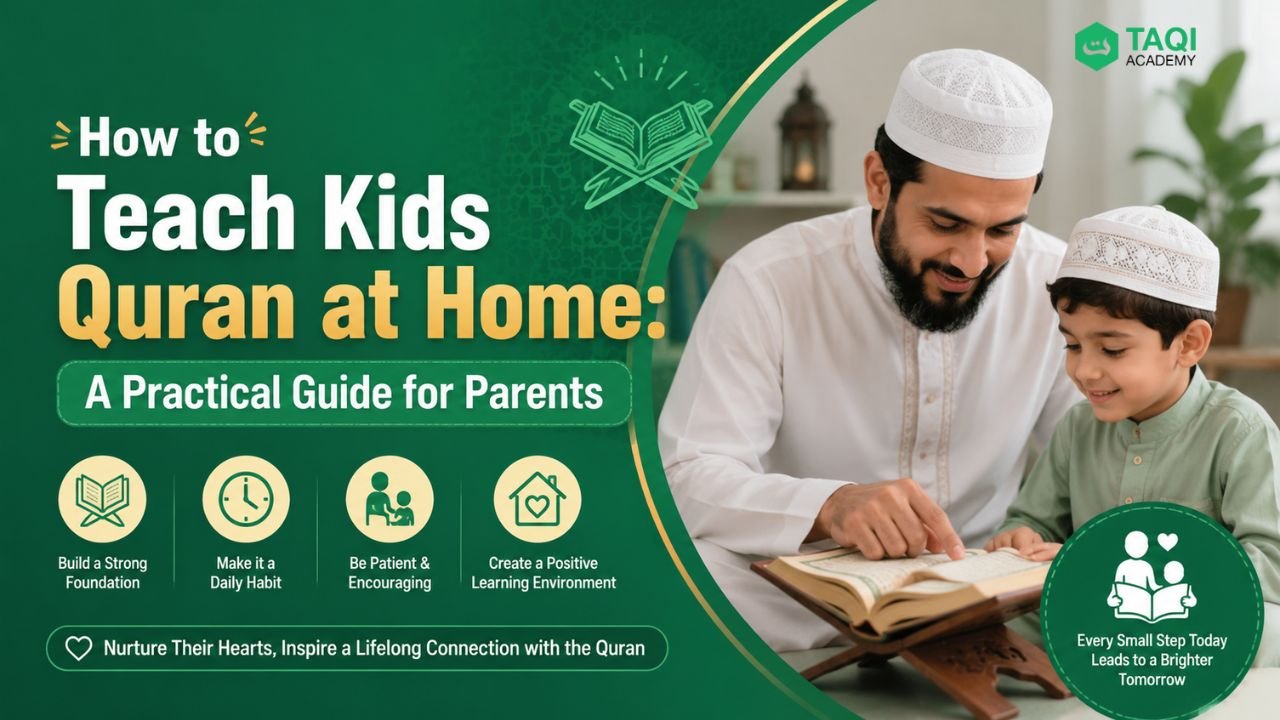
Teaching your child the Quran at home can become one of the most meaningful parts of family life. But for many parents, the practical side can feel challenging. You may wonder:
- What should my child learn first?
- How long should a Quran lesson be?
- Should I start with Arabic letters or Noorani Qaida?
- How can I teach correct pronunciation?
- How do I keep my child interested?
- When should I consider a qualified Quran teacher?
The good news is that parents do not need to turn the home into a formal classroom. A consistent routine, age-appropriate lessons, encouragement, and proper guidance can create a positive Quran-learning environment.
At the same time, parents should recognize when a child needs instruction from someone trained in Quran recitation and Tajweed. Reading the Quran correctly involves pronunciation and recitation rules that can be difficult for a parent to evaluate without sufficient knowledge. This guide explains how parents can teach kids Quran at home, what to teach at different stages, common mistakes to avoid, and when online Quran classes may be a useful option.
Why Should Children Learn Quran at Home?
Home is often the first place where children develop their relationship with the Quran. When children regularly see their parents reading the Quran, listening to recitation, and making time for Islamic learning, Quran study becomes part of everyday family life rather than something limited to a classroom.
Parents can help children develop:
- Familiarity with the Quran
- Respect for the Quran
- Regular reading habits
- Basic Arabic recognition
- Quran recitation skills
- Memorization habits
- Interest in Islamic knowledge
- A consistent daily routine
The goal should not be to make every lesson long or difficult. For young children, regular short practice is usually more manageable than occasional long sessions.
At What Age Should Children Start Learning Quran?
There is no single age that works for every child. Some children are ready to begin recognizing Arabic letters at a young age, while others need more time to develop attention and language skills. Taqi Academy’s Noorani Qaida course, for example, accepts children as young as 5 and is designed to build foundational Quran-reading skills.
Parents should consider the child’s:
- Age
- Attention span
- Ability to follow instructions
- Interest in learning
- Existing Arabic knowledge
- Ability to recognize letters
- Emotional readiness
The objective at an early age should be to create familiarity and love for Quran learning rather than putting unnecessary pressure on the child.
Start With the Right Foundation
One of the most important decisions parents make is choosing what their child should learn first. If your child cannot recognize Arabic letters or read simple Quranic words, jumping directly into Quran recitation may create confusion. A structured foundation normally begins with:
- Arabic letters
- Letter sounds
- Harakat
- Joining letters
- Simple words
- Basic pronunciation
- Gradual Quran reading
- Basic Tajweed
Noorani Qaida is commonly used as a foundation for Quran reading. Taqi Academy describes its Noorani Qaida & Basic Tajweed course as a beginner-level program covering Arabic letters, vowel signs, joining letters, pronunciation, and basic Tajweed. For a child starting from zero, building this foundation properly can make later Quran reading much easier.
Step 1: Create a Fixed Quran Learning Routine
Children generally respond better to routines than unpredictable lessons. Instead of saying, “We will study Quran whenever we have time,” choose a regular period.
For example:
After Fajr: 15–20 minutes
After school: 20–30 minutes
After Maghrib: 20 minutes
The exact time is less important than consistency. Try to choose a period when your child is:
- Awake
- Comfortable
- Not hungry
- Not overly tired
- Free from other distractions
A short daily lesson that actually happens is more useful than a long lesson that is repeatedly postponed.
Step 2: Keep Lessons Short for Younger Children
Young children may struggle to concentrate for extended periods. A 5-year-old and a 12-year-old should not necessarily have the same lesson structure. For younger children, you might divide the session into small activities:
5 minutes: Review previous letters
5 minutes: New letters or sounds
5 minutes: Reading practice
5 minutes: Revision or listening
As the child grows and develops stronger concentration, the lesson can gradually become longer. Watch your child’s behavior rather than focusing only on the clock. If the child becomes frustrated or mentally exhausted, ending the session positively may be better than forcing another 20 minutes.
Step 3: Teach Arabic Letters Correctly
If your child is a complete beginner, start with the Arabic alphabet. Do not rush through all the letters simply to finish the alphabet. The child should gradually learn to:
- Recognize each letter
- Distinguish similar letters
- Understand basic sounds
- Recognize letters in different forms
- Join letters
- Read simple combinations
Some Arabic letters can sound unfamiliar to Bengali or English-speaking children. This is one reason pronunciation deserves attention from the beginning. If you are not confident about teaching Arabic pronunciation yourself, a qualified Quran teacher can provide more reliable correction.
Step 4: Introduce Harakat and Basic Reading
After learning the letters, children can begin learning basic vowel signs and how they affect pronunciation. Depending on the curriculum, this may include:
- Fathah
- Kasrah
- Dammah
- Sukun
- Shaddah
- Tanween
- Madd
The child can then progress from individual letters and sounds to connected words. Avoid moving ahead simply because the child has memorized the names of the signs. The real goal is to help the child read them correctly.
Step 5: Teach Pronunciation Before Speed
A common mistake parents make is encouraging children to read faster before they can read accurately. Speed should not be the main target for a beginner. Instead, focus on:
Correctness → Confidence → Fluency → Speed
If a child develops incorrect pronunciation habits early, those habits can become difficult to change later. This is especially important for letters with similar sounds. A qualified Quran teacher can listen to the child’s recitation and identify pronunciation problems that may not be obvious to a parent.
Step 6: Introduce Tajweed Gradually
Children do not need to memorize a long list of Tajweed terminology on their first day. Tajweed should be introduced gradually according to their level. As their reading develops, they can learn rules involving:
- Makharij
- Noon Sakinah
- Tanween
- Meem Sakinah
- Qalqalah
- Madd
- Ghunnah
- Waqf
- Other recitation rules
The important point is to apply the rules during recitation, not simply memorize their names. Taqi Academy’s Quran Reading with Tajweed course includes practical recitation, Makharij, Tajweed rules, and real-time correction. The course is designed for children as well as adults at different learning levels.
Step 7: Use Listening as Part of Home Quran Learning
Listening can complement reading practice. Parents can play a clear Quran recitation while the child follows along with the Mushaf. This can help children become familiar with:
- Correct pronunciation
- Rhythm of recitation
- Verse structure
- Surah sequence
- Regular Quran listening
However, listening should not replace the child’s own reading practice. A child can imitate a reciter while still making mistakes. This is another reason teacher feedback becomes valuable as the child progresses.
Step 8: Teach Children Short Surahs Gradually
Once the child has developed basic reading ability, you can introduce memorization according to their age and ability. Start with manageable portions rather than setting unrealistic daily targets. A simple routine can include:
- Listen to the Surah.
- Read it with the Mushaf.
- Repeat short portions.
- Recite from memory.
- Correct mistakes.
- Review previously memorized portions.
Revision is just as important as new memorization. Without regular revision, children may quickly forget previously memorized portions.
Step 9: Make Quran Memorization a Positive Experience
Parents should be careful about turning Quran memorization into a source of fear. If every mistake results in anger, the child may begin associating Quran lessons with stress.
Instead:
- Praise genuine effort.
- Correct mistakes calmly.
- Celebrate milestones.
- Keep expectations realistic.
- Avoid comparing siblings.
- Allow appropriate breaks.
- Encourage regular revision.
The purpose is not simply to make a child finish a certain number of pages. The child should gradually develop the ability and motivation to continue learning.
Step 10: When Your Child Is Ready, Consider Hifz
Some families eventually decide to pursue Quran memorization more systematically. Hifz requires considerably more structure than simply memorizing a few short Surahs. A child working toward Hifz needs:
- A realistic memorization schedule
- Regular revision
- Recitation correction
- Teacher supervision
- Consistency
- Parental support
Taqi Academy offers a Complete Quran Hifz Program for students working toward memorizing the Quran. The academy also provides a Part-Time Hifz Program for learners who need to balance memorization with school, work, or other responsibilities. Parents should avoid deciding on an intensive Hifz schedule simply because another child is progressing quickly. Each child’s capacity, school commitments, motivation, and learning pace are different.
Step 11: Teach the Meaning Alongside Recitation
Quran learning does not have to stop at pronunciation and memorization. As children grow older, parents can gradually introduce age-appropriate explanations of Quranic meanings and Islamic lessons. For example, you can discuss:
- Honesty
- Patience
- Kindness
- Respect for parents
- Helping others
- Gratitude
- Responsibility
- Good character
The explanation should be appropriate for the child’s age and based on reliable Islamic sources. For more structured study, Taqi Academy offers a Quran Translation & Tafseer Course focused on Quranic translation and Tafseer. Parents should be particularly careful with online Islamic content because not every video or social media explanation comes from a qualified or reliable source.
Step 12: Teach Through Your Own Example
Children learn from what parents do as much as from what parents say. If parents tell children to read the Quran but rarely make time for Quran themselves, the lesson may feel like another household rule. Instead, let your child occasionally see you:
- Reading the Quran
- Listening to recitation
- Reviewing Surahs
- Learning Islamic knowledge
- Making time for prayer and worship
You do not need to turn every moment into a formal lesson. A child who grows up seeing Quran as a normal and valued part of family life may develop a stronger long-term connection with it.
Step 13: Use Rewards Carefully
Small encouragement can help younger children stay motivated. You might use:
- Verbal praise
- Stickers
- A progress chart
- A special family activity
- Recognition after completing a milestone
But try not to make every Quran lesson dependent on a material reward. The long-term objective is to help children understand the value of Quran learning itself.
Step 14: Avoid Comparing Your Child With Other Children
Children develop at different speeds. One child may learn Arabic letters quickly but struggle with pronunciation. Another may read fluently but need more time to memorize. Comparing siblings or classmates can create unnecessary pressure. Instead, compare the child with their own previous progress.
Ask:
“What can my child do today that they could not do a month ago?”
That is a much more useful measure of progress.
Step 15: Correct Mistakes Without Discouraging the Child
Correction is necessary, but the way you correct a child matters.
Instead of:
“You always make this mistake.”
Try:
“Let’s read this part again together.”
Then demonstrate the correct pronunciation and let the child repeat it. If you are not certain whether your own correction is accurate, do not guess. A qualified Quran teacher can assess the child’s recitation and provide appropriate guidance.
How Long Should Kids Study Quran Each Day?
There is no universal number of minutes that works for every child. Age, learning level, attention span, school schedule, and course goals all matter. A practical starting point for many young children may be a short, consistent session rather than an extended lesson.
For example:
| Age/Stage | Possible Starting Routine |
|---|---|
| Young beginner | 10–15 minutes |
| Early reader | 15–20 minutes |
| Developing reader | 20–30 minutes |
| Older child | 20–45 minutes depending on goals |
| Hifz student | Structured schedule with dedicated revision |
These are general starting points, not strict rules. If your child’s teacher recommends a different schedule based on the child’s ability, follow that individualized guidance.
What If Parents Do Not Know Tajweed?
This is a common situation. You can still support your child’s Quran education without pretending to be the child’s Quran teacher. Parents can:
- Create the study routine.
- Listen to the child’s homework.
- Encourage practice.
- Help with scheduling.
- Monitor progress.
- Make Quran reading part of family life.
A qualified teacher can handle technical areas such as pronunciation and Tajweed correction. This division of responsibility can work very well. The parent provides support and consistency, while the teacher provides specialized instruction and assessment.
When Should Parents Consider an Online Quran Teacher?
Home teaching may be enough for basic encouragement and early practice, but professional instruction can become important when:
- You are not confident about Arabic pronunciation.
- Your child repeatedly makes the same recitation mistakes.
- Your child needs systematic Tajweed instruction.
- You want a structured Hifz program.
- You struggle to teach consistently.
- Your child needs individual attention.
- You want an objective assessment of progress.
- You need a flexible schedule around school and family life.
Live online Quran classes can allow children to learn from home while still receiving direct teacher guidance. Taqi Academy provides one-to-one live Quran lessons, male and female tutors, flexible timings, and courses for children and adults. Its Noorani Qaida course specifically states that classes are available for children as young as five.
Home Learning vs Online Quran Classes
Parents do not necessarily have to choose one or the other. A combination can be effective.
At Home
Parents can:
- Review previous lessons.
- Listen to memorization.
- Encourage daily practice.
- Play Quran recitation.
- Create a consistent routine.
With a Quran Teacher
The teacher can:
- Teach new material.
- Correct pronunciation.
- Teach Tajweed.
- Assess recitation.
- Guide memorization.
- Answer questions.
- Track progress.
This approach allows the parent to remain actively involved without having to handle every technical aspect of Quran education. If you are comparing different approaches to Quran education, our guide on Online Quran Learning vs Traditional Madrasa can help you understand the differences between the two learning environments.
How to Choose an Online Quran Teacher for Your Child
If you decide to enroll your child in online Quran classes, do not choose a teacher based only on price.
Consider:
1. Quranic Knowledge
Ask about the teacher’s Quranic education, Tajweed knowledge, Hifz background, or relevant Islamic studies.
2. Experience With Children
Teaching children requires patience and a different communication style from teaching adults.
3. Pronunciation Correction
The teacher should actively listen to your child’s recitation rather than simply explaining lessons.
4. Communication
For Bangladeshi families, being able to communicate in Bengali or English may make lessons easier for children and parents.
5. Schedule
The class time should fit naturally into your child’s daily routine.
6. Progress Monitoring
Parents should have a reasonable way to understand whether their child is progressing.
7. Trial Class
A trial class can help you assess whether the teacher and child are a good fit. Our detailed guide on How to choose the best online Quran academy in Bangladesh covers additional factors parents should consider.
How Taqi Academy Can Support Your Child’s Quran Learning
Taqi Academy offers several Quran and Islamic education programs that can match different stages of a child’s learning journey. For a complete beginner, the Noorani Qaida & Basic Tajweed Course provides foundational instruction in Arabic letters, vowel signs, pronunciation, connected reading, and basic Tajweed. Once a child develops basic reading skills, The Quran Reading with Tajweed Course can help develop more structured Tajweed and recitation skills through practical lessons and teacher feedback.
For children ready to pursue memorization, families can explore the Complete Hifz Program or Part-Time Hifz Program. As children grow in their Islamic education, parents can also consider:
These courses can support learning beyond basic Quran reading. Taqi Academy’s current course listings include all of these learning paths.
A Simple Weekly Quran Routine for Children
Parents looking for a practical starting point can use a simple weekly structure.
Sunday
Review previous lessons and practice difficult letters.
Monday
Learn new reading material.
Tuesday
Practice pronunciation and basic Tajweed.
Wednesday
Review the week’s material.
Thursday
Practice a short Surah or memorization portion.
Friday
Keep the session lighter and focus on listening, recitation, or Islamic stories.
Saturday
Review everything learned during the week.
The exact schedule should be adjusted according to your child’s age and learning goals.
Common Mistakes Parents Should Avoid
Starting Too Fast
Do not rush children through Noorani Qaida simply to reach Quran reading.
Focusing Only on Memorization
Memorization without proper pronunciation and regular revision can create problems later.
Ignoring Pronunciation
Small pronunciation mistakes should be corrected early.
Making Lessons Too Long
Long sessions can create frustration, especially for younger children.
Using Fear as Motivation
Fear may produce short-term compliance but can negatively affect a child’s attitude toward learning.
Comparing Children
Every learner has a different pace.
Skipping Revision
New lessons should not completely replace revision.
Relying on Random Online Videos
For Quran recitation and Islamic education, use reliable educational sources and qualified teachers rather than assuming every online explanation is accurate.
Frequently Asked Questions
How can I start teaching my child Quran at home?
Start by creating a consistent routine and identifying your child’s current level. Complete beginners can start with Arabic letters and Noorani Qaida before moving into Quran reading and Tajweed.
What should children learn first when studying Quran?
Children who cannot yet read Arabic should generally begin with foundational skills such as Arabic letters, sounds, vowel marks, joining letters, and basic pronunciation before progressing to Quran reading.
Can parents teach Quran without knowing Tajweed?
Parents can support their child’s learning, but if they are not confident about Tajweed and pronunciation, it is better to seek guidance from a qualified Quran teacher rather than teaching technical rules incorrectly.
How long should a child study Quran each day?
There is no universal duration. Younger children may benefit from short sessions, while older children can gradually handle longer lessons. Consistency and age-appropriate instruction are more important than forcing a fixed number of minutes.
What age can children start learning Quran?
Children can begin developing familiarity with Arabic letters and Quran learning at a young age when they are ready to follow simple instructions. Taqi Academy’s Noorani Qaida course accepts children as young as five.
How can I make Quran learning enjoyable for my child?
Keep lessons age-appropriate, praise genuine effort, use repetition, avoid unnecessary pressure, and connect Quran learning with positive family routines.
Should my child learn Quran through an online teacher?
Online Quran classes can be useful when parents want structured instruction, direct recitation correction, flexible scheduling, and professional teacher guidance while allowing the child to learn from home.
Is Noorani Qaida necessary for every child?
It depends on the child’s existing Arabic reading ability. A child who cannot confidently recognize and pronounce Arabic letters may benefit greatly from a structured Noorani Qaida foundation.
When should a child start Hifz?
There is no single correct age. The child should have an appropriate Quran reading foundation, sufficient interest and maturity, and a realistic routine that allows for both memorization and revision.
Can children learn Tajweed online?
Yes. Children can learn Tajweed online when lessons are appropriately structured and the teacher can listen to their recitation and provide corrections. Taqi Academy offers a live Quran Reading with Tajweed course for children and adults.
Final Thoughts: Make Quran Learning a Part of Family Life
Teaching kids Quran at home does not mean parents have to become professional Quran teachers. Your most important role is to create an environment where Quran learning is consistent, respectful, encouraging, and meaningful. Start with your child’s current ability. Build the foundation gradually. Keep lessons manageable. Practice regularly. Correct mistakes gently. And as the child’s needs become more advanced, consider support from a qualified Quran teacher.
For beginners, a strong foundation through Noorani Qaida can prepare children for Quran reading. As their skills develop, Tajweed, Hifz, Translation & Tafseer, Arabic, and Islamic Studies can provide additional learning paths.
If you want to understand how online Quran education works before enrolling your child, read How to Get Started With Online Quran Learning in 3 Easy Steps and How to Learn Quran Online. Parents can also explore The best online Quran courses in Bangladesh for kids and adults when comparing suitable learning options. The goal is not simply to finish a book, complete a course, or memorize a certain number of Surahs. The goal is to help your child develop the knowledge, skills, confidence, and lifelong habit to engage with the Quran correctly and consistently.