
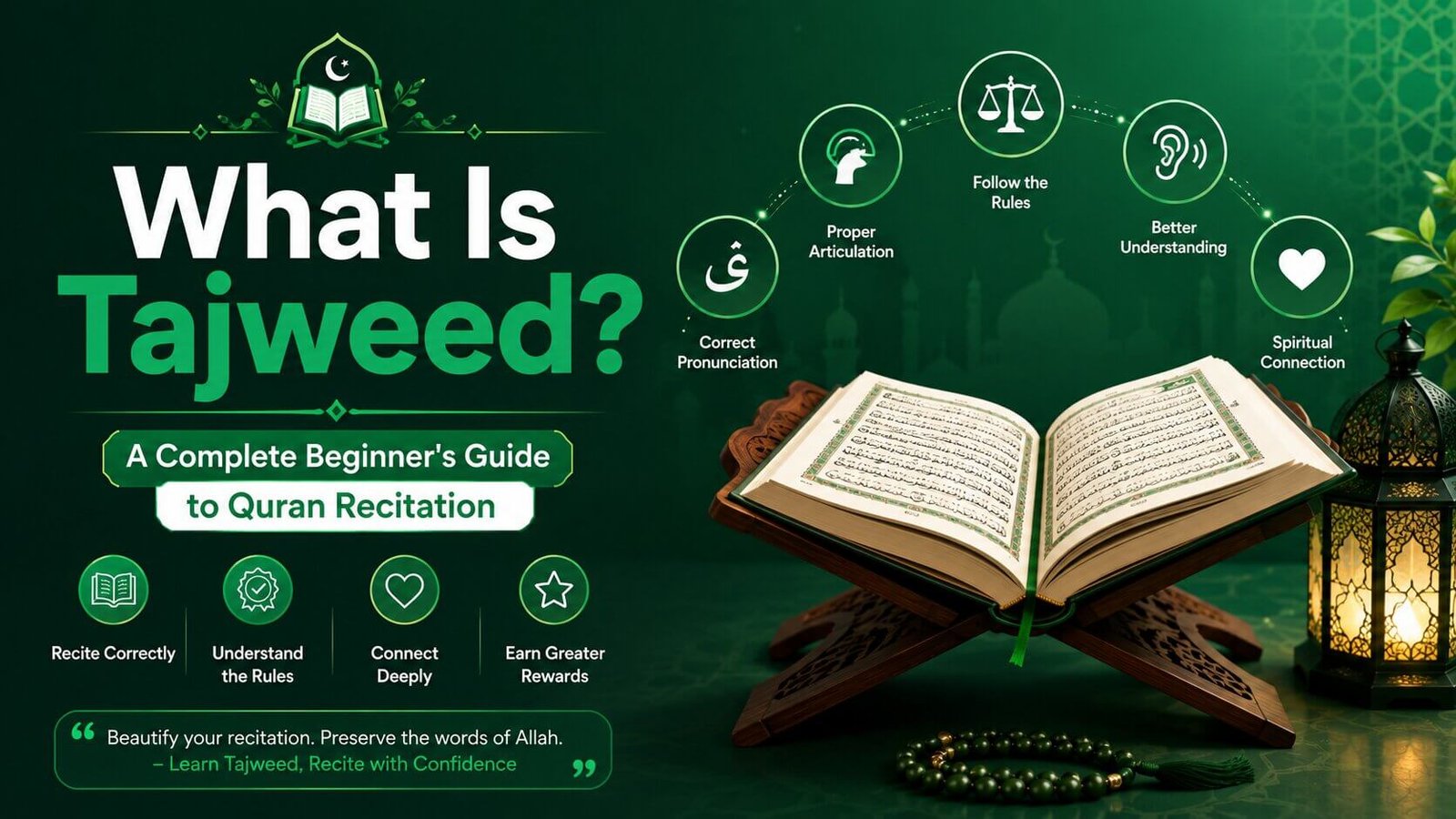
Reading the Quran is a beautiful part of a Muslim’s life. But learning to read the Arabic words is only one part of developing good Quran recitation. Tajweed is the set of principles used to help recite the Quran correctly, including the proper pronunciation of Arabic letters, their characteristics, elongation, nasal sounds, and rules for stopping and continuing during recitation.
For a beginner, the word “Tajweed” can sound complicated. It does not have to be. You can learn Tajweed step by step, starting with basic pronunciation and gradually moving toward more advanced rules. This guide explains what Tajweed is, why it matters, the main Tajweed rules beginners should know, how to start learning, common mistakes, and how a qualified teacher can help you improve your Quran recitation.
What is Tajweed?
The word Tajweed comes from the Arabic root related to making something good or doing it well. In Quran recitation, Tajweed refers to applying the rules that help a person pronounce the Quranic letters and words correctly.
These rules deal with areas such as:
- Where each Arabic letter is pronounced
- The characteristics of each letter
- How certain letters interact with others
- When a sound is extended
- When a sound is nasal
- How to stop at the correct places
- How to begin recitation correctly
The purpose is not simply to make recitation sound beautiful. Correct pronunciation and careful application of recitation rules help protect the wording and meaning of the Quran during recitation. Because pronunciation can be difficult to judge by yourself, learning with a qualified Quran teacher can be especially useful.
Why is Tajweed Important When Reading the Quran?
Tajweed matters because Quranic Arabic has sounds and pronunciation features that may not exist in a learner’s first language. A small pronunciation difference can sometimes change the sound of a word and, in some cases, its meaning. For this reason, learners should avoid assuming that reading Arabic letters correctly automatically means they are reciting with proper Tajweed. A qualified teacher can listen to your recitation and identify problems that you may not notice yourself.
Taqi Academy’s Quran Reading with Tajweed course focuses on pronunciation, Makharij, Sifat, Madd, Waqf, and practical recitation with teacher correction.
What Is the Difference Between Quran Reading and Tajweed?
These two ideas are closely related, but they are not exactly the same.
Quran Reading
Quran reading means being able to recognize Arabic letters and words and read the Quranic text. A beginner may first learn:
- Arabic letters
- Vowel signs
- Connected letters
- Basic words
- Short Quranic passages
Tajweed
Tajweed focuses on how those letters and words should be pronounced during Quran recitation. For Example, a student may be able to read a word but still need help with:
- Letter articulation
- Letter characteristics
- Elongation
- Nasal sounds
- Heavy and light letters
- Stopping and starting
This is why beginners often benefit from building their reading foundation first and then developing their Tajweed skills step by step.
What Are Makharij in Tajweed?
Makharij al-Huruf refers to the articulation points of Arabic letters. In simple terms, it explains where a letter comes from when it is pronounced.
Arabic letters are produced from different areas of the mouth and throat, including areas related to:
- The throat
- The tongue
- The lips
- The nasal passage
- The mouth
Understanding articulation points is important because some Arabic letters can sound very similar to learners. For example, a student may confuse letters that have different articulation points or characteristics. A teacher can demonstrate the correct sound and listen to the student’s pronunciation. Taqi Academy’s Noorani Qaida course introduces Arabic letters, pronunciation, and Makharij before progressing toward more advanced Quran reading and Tajweed. If you are completely new to Arabic reading, the Noorani Qaida & Basic Tajweed Course may be a better starting point than jumping directly into advanced Tajweed.
What Are Sifat in Tajweed?
Sifat refers to the characteristics or qualities of Arabic letters. These characteristics help distinguish letters from one another. Two letters may come from similar areas but have different qualities that affect how they sound. Learning Sifat helps students understand why certain letters should be pronounced in different ways. This is one reason Tajweed should be learned gradually. A beginner does not need to memorize every rule at once. Start with the sounds and rules that apply to your current level, then build from there.
Basic Tajweed Rules Beginners Should Know
Tajweed includes many rules. Beginners do not need to master everything in their first lesson. Here are some of the important areas you will eventually encounter.
1. Noon Saakinah and Tanween
Noon Saakinah is a noon with no vowel sound, while Tanween refers to the double vowel signs. Depending on the letter that follows, different recitation rules apply.
The main rules include:
- Izhar
- Idgham
- Iqlab
- Ikhfa
These rules affect how the sound is pronounced when moving from one letter to another.
2. Meem Saakinah
Meem Saakinah also has specific rules depending on the letter that follows it. These include:
- Ikhfa Shafawi
- Idgham Shafawi
- Izhar Shafawi
The exact pronunciation should be learned through examples and listening rather than memorizing names alone.
3. Qalqalah
Qalqalah is a noticeable echoing or bouncing quality that occurs with certain letters when they have sukoon. The commonly recognized Qalqalah letters are:
ق، ط، ب، ج، د
A common way to remember them is through the word:
قطب جد
Beginners should learn the correct sound from a teacher rather than simply adding an extra vowel sound. Taqi Academy introduces basic Qalqalah as part of its Noorani Qaida foundation course and covers it in greater depth in its Tajweed curriculum.
4. Madd
Madd refers to elongation during Quran recitation. Some letters and combinations require the sound to be extended for a specific duration. Different types of Madd have different rules. For beginners, it is better to learn the basic concept first and then study the different categories with examples. Taqi Academy’s Tajweed course includes the study of Madd and practical exercises for correct elongation.
5. Ghunnah
Ghunnah is a nasal sound associated with certain Tajweed rules. It is especially important in areas involving Noon and Meem. The length and quality of the nasal sound depend on the particular rule being applied. This is difficult to learn from written explanations alone, so listening to a qualified teacher and practicing aloud can be very helpful.
6. Tafkheem and Tarqeeq
These terms describe whether certain letters are pronounced with a heavier or lighter quality. Tafkheem is generally associated with a heavier sound. Tarqeeq refers to a lighter sound. Learning these correctly can improve the accuracy of Quran recitation.
7. Waqf
Waqf refers to stopping during Quran recitation. Knowing where and how to stop is an important part of proper recitation. A learner should not stop randomly simply because they need to take a breath. The Quran contains stopping signs that help guide reciters. Taqi Academy’s Tajweed curriculum includes Waqf and Ibtida, along with practical recitation sessions.
8. Ibtida
Ibtida relates to beginning or restarting recitation after a stop. A student should learn how to resume recitation appropriately rather than starting from an unsuitable point. This becomes more important as a learner develops stronger Quran recitation skills.
Do You Need to Know Arabic to Learn Tajweed?
No. You do not need to be fluent in Arabic before learning Tajweed. Tajweed is primarily concerned with correct Quran recitation and pronunciation, while Arabic language study focuses more broadly on vocabulary, grammar, sentence structure, and communication. A beginner can learn Tajweed while gradually developing their understanding of Arabic. Taqi Academy’s Tajweed course states that prior Arabic knowledge is not required, although learning Arabic can help with broader understanding. If your goal is to understand Quranic Arabic as well as improve recitation, Taqi Academy also offers an Arabic Language Course.
Can a Complete Beginner Learn Tajweed?
Yes, but the starting point matters. If you cannot recognize Arabic letters yet, beginning with advanced Tajweed rules may make learning unnecessarily difficult.
A better path is usually:
Arabic letters → Basic reading → Noorani Qaida → Quran reading → Basic Tajweed → More advanced Tajweed
The exact path can change according to the student’s current ability. Taqi Academy’s homepage similarly recommends Noorani Qaida for students who cannot recognize Arabic letters and Quran Reading with Tajweed for students who can already read but need help with pronunciation and Tajweed.
Should You Learn Noorani Qaida Before Tajweed?
For many complete beginners, yes. Noorani Qaida helps establish the reading foundation needed before working through more advanced Tajweed concepts.
A foundation course can cover:
- Arabic letters
- Vowel signs
- Connecting letters
- Basic pronunciation
- Reading simple words
- Basic Tajweed rules
- Reading practice
Taqi Academy’s Noorani Qaida course includes basic Tajweed topics such as Noon Saakinah, Tanween, Meem Saakinah, and Qalqalah. Once your basic reading is stronger, you can move into a dedicated Quran Reading with Tajweed Course.
How Long Does It Take to Learn Tajweed?
There is no fixed amount of time that applies to every student.
Your learning time can depend on:
- Your current Quran reading level
- Your age
- Your previous Arabic education
- Class frequency
- Practice outside class
- Pronunciation difficulties
- Teacher guidance
- Consistency
Taqi Academy currently lists its dedicated Tajweed course as approximately 4–5 months, depending on the student’s pace. That should be treated as a course-duration estimate, not a promise that every student will master Tajweed within that period. Learning Tajweed is not just about finishing lessons. The real goal is to apply the rules correctly during recitation.
Can You Learn Tajweed Online?
Yes. Online Tajweed classes can work well when students receive live instruction and direct feedback. This is important because Tajweed involves sound and pronunciation. Reading a rule on a screen does not tell you whether you are applying it correctly.
A live teacher can:
- Listen to your recitation.
- Identify a pronunciation problem.
- Demonstrate the correct sound.
- Ask you to repeat it.
- Correct the mistake.
- Give you practice material.
Taqi Academy’s Tajweed program uses live one-to-one lessons, real-time correction, practical recitation, and personalized feedback. You can also read Online Quran Classes in Bangladesh: Complete Guide for Beginners if you want to understand how live online Quran learning works more broadly.
Live vs Recorded Quran Learning for Tajweed
Recorded lessons can be useful for reviewing concepts. However, recorded videos cannot listen to your recitation and tell you exactly where your pronunciation needs correction. For Tajweed, live teacher feedback can be particularly valuable.
Recorded Lessons
Useful for:
- Reviewing a rule
- Listening to examples
- Repeating a lesson
- Studying at your own time
Live Lessons
Useful for:
- Real-time pronunciation correction
- Asking questions
- Individual practice
- Teacher assessment
- Personalized lesson pacing
For a detailed comparison, read Live vs Recorded Quran Classes: Which Is Better for Learning Quran?. The best approach may include both live instruction and personal review.
One-to-One vs Group Tajweed Classes
Both formats have advantages. Group classes can provide interaction with other learners. One-to-one classes give the teacher more time to focus on one student’s pronunciation and mistakes. For learners who need detailed correction, individual instruction can be especially helpful. Taqi Academy’s Tajweed course is built around one-to-one live sessions and personalized feedback. If you are deciding between the two formats, see One-to-One vs Group Quran Classes: Which Learning Method Is Best?.
How to Practice Tajweed at Home
Class time alone is not enough. Regular practice helps you remember the rules and improve your recitation. Try this simple routine.
Step 1: Review One Rule
Choose one Tajweed rule from your current lesson.
Step 2: Listen to Examples
Listen carefully to a reliable Quran recitation.
Step 3: Read Aloud
Read the same verses yourself.
Step 4: Record Your Recitation
If your teacher recommends it, record yourself and listen back.
Step 5: Compare and Correct
Note the areas your teacher has asked you to improve.
Step 6: Repeat
Practice the difficult section several times without rushing. Short, regular practice is often more useful than studying many rules in one sitting.
Common Tajweed Mistakes Beginners Make
Mistake 1: Learning Rules Without Practicing Them
Knowing the name of a rule does not mean you can apply it correctly. Practice is essential.
Mistake 2: Rushing Through the Quran
Reading quickly can make pronunciation problems harder to notice. Slow down and focus on accuracy.
Mistake 3: Ignoring Makharij
If the articulation point of a letter is wrong, learning other Tajweed rules will not fully solve the problem.
Mistake 4: Adding Extra Vowels
Beginners sometimes add an unintended vowel sound after a letter. A teacher can help identify this problem.
Mistake 5: Stretching Every Madd the Same Way
Different Madd rules have different requirements. Do not assume every long sound should have the same duration.
Mistake 6: Stopping Without Understanding Waqf
Stopping at an unsuitable place can affect the flow and sometimes the intended meaning.
Mistake 7: Copying Sounds Without Understanding the Rule
Listening is useful, but students should also understand what they are practicing.
How to Improve Your Quran Pronunciation
Improving pronunciation takes repeated practice. Start with the letters you find difficult.
Ask your teacher to identify:
- Which letters you pronounce incorrectly
- Where the sound is produced
- Which letters you confuse
- What exercises can help
- Which Quranic words you should practice
Do not try to fix every pronunciation problem at once. Work on one or two areas, practice them consistently, and then move to the next.
How a Quran Teacher Can Help With Tajweed
A qualified teacher provides something that a textbook cannot: direct observation of your recitation. A teacher can hear whether:
- A letter is coming from the correct articulation point
- A sound is too heavy or too light
- A Madd is too short or too long
- Ghunnah is being applied correctly
- A Qalqalah sound is correct
- A stopping point is appropriate
Taqi Academy states that its Tajweed instructors are selected based on Quranic knowledge, Tajweed proficiency, teaching ability, communication skills, and professionalism. Its Tajweed course also lists instructors with backgrounds including Al-Azhar University and recognized Islamic institutions. For a learner, the important thing is not simply having a teacher with a good title. The teacher should have suitable knowledge, teaching ability, and the ability to correct your recitation carefully.
What Should You Look for in a Tajweed Teacher?
Before joining a course, consider these points.
Quranic Knowledge
Ask about the teacher’s relevant Quranic and Islamic education.
Tajweed Knowledge
The teacher should understand the rules and be able to apply them during recitation.
Teaching Experience
Knowing Tajweed and teaching Tajweed are not exactly the same thing.
Pronunciation Correction
The teacher should listen carefully and provide specific feedback.
Patience
Beginners may need to repeat the same sound many times.
Communication
Choose a teacher who can explain difficult concepts in a language you understand. Taqi Academy provides male and female Tajweed teachers and states that support is available in Bengali or English.
Is Tajweed Only for Adults?
No. Children can learn Tajweed too. The method should be appropriate for their age and reading level.
Young learners may begin with:
- Arabic letters
- Basic pronunciation
- Noorani Qaida
- Simple Tajweed rules
- Short Quranic passages
Older children can gradually move toward more detailed Tajweed and Quran recitation. Taqi Academy’s Tajweed course states that classes are available for children as young as five, as well as adults and advanced learners. Parents who want to understand the broader process can also read How to Teach Kids Quran at Home: A Practical Guide for Parents.
Tajweed for Quran Memorization
Tajweed is also important for students who want to memorize the Quran. Memorizing a passage with incorrect pronunciation can make the mistake harder to correct later. For this reason, Hifz students should work on accurate recitation while memorizing. Taqi Academy’s Complete Hifz program includes Tajweed alongside memorization and emphasizes regular revision and teacher feedback. You can learn more about the Complete Hifz Program if your goal is Quran memorization. For students who need a more flexible schedule, Taqi Academy also offers a Part-Time Hifz Program, where Tajweed is taught alongside memorization and revision.
Can You Learn Tajweed Without Understanding the Quran’s Meaning?
Yes. Tajweed focuses on correct recitation, while understanding the Quran involves translation, Tafseer, Arabic vocabulary, and other areas of study. They are connected but different skills. A person can work on correct recitation while also studying the meaning of the verses. If you want to deepen your understanding of what you recite, Taqi Academy offers a Quran Translation & Tafseer Course. The course covers Quranic vocabulary, translation, Tafseer methodology, context, and selected Surah study.
Tajweed and Quranic Arabic: What Is the Difference?
Tajweed and Arabic language learning should not be confused.
Tajweed
Focuses mainly on:
- Pronunciation
- Articulation
- Letter qualities
- Recitation rules
- Elongation
- Stopping and starting
Arabic Language
Can include:
- Vocabulary
- Grammar
- Sentence structure
- Speaking
- Reading comprehension
- Writing
You can study both, but they have different learning goals. If you want to understand Quranic Arabic more deeply, an Arabic Language Course can complement your Quran recitation studies.
A Simple Tajweed Learning Plan for Beginners
If you are starting from the beginning, avoid trying to learn every rule at once.
A simple progression could look like this:
Stage 1: Arabic Letters
Learn to recognize and pronounce the letters.
Stage 2: Basic Reading
Learn vowel signs and how letters connect.
Stage 3: Noorani Qaida
Build basic Quran reading skills.
Stage 4: Basic Tajweed
Learn simple rules such as Qalqalah and basic Noon and Meem rules.
Stage 5: Makharij and Sifat
Work on precise pronunciation and letter characteristics.
Stage 6: Madd and Ghunnah
Learn elongation and nasal sounds.
Stage 7: Waqf and Ibtida
Learn how to stop and start appropriately.
Stage 8: Practical Recitation
Apply the rules while reading actual Quranic passages.
Stage 9: Correction and Assessment
Have a qualified teacher evaluate your recitation and identify areas for improvement. Taqi Academy’s Tajweed curriculum follows a structured progression that includes Tajweed basics, advanced rules, Makharij and Sifaat, practical recitation, and assessment.
How Often Should You Practice Tajweed?
Consistency matters more than trying to study for long hours once in a while. A beginner could start with a short daily practice period.
For example:
10 minutes: Review the rule
10 minutes: Practice examples
10 minutes: Read Quran aloud
5 minutes: Review teacher feedback
The exact routine should be adjusted according to your age, level, schedule, and teacher’s advice. If you are learning Tajweed through a course, ask your teacher how much practice is appropriate for your level.
How Do You Know If Your Tajweed Is Improving?
Look for practical changes rather than simply counting completed lessons.
Signs of improvement may include:
- Better pronunciation
- Fewer repeated mistakes
- More accurate articulation
- Better control of Madd
- Improved use of Ghunnah
- Better understanding of Tajweed rules
- More appropriate stopping
- Greater confidence during recitation
A teacher’s assessment is particularly useful because some pronunciation problems are difficult to identify on your own. Taqi Academy’s Tajweed course includes oral assessment, recorded recitation, teacher evaluation, and personalized improvement feedback.
Is It Too Late to Learn Tajweed?
No. Adults can begin Tajweed at any age. You may feel embarrassed if you have been reading the Quran for years without studying Tajweed. There is no need to let that stop you. Start from your current level. If you already read fluently, you may need focused correction rather than a beginner course. If your reading is weak, you may need to strengthen the basics first. The right learning path depends on your current ability.
What If You Have Been Making Tajweed Mistakes for Years?
Do not become discouraged. Long-standing pronunciation habits can take time to change. Start by asking a qualified teacher to assess your recitation. Then focus on the most important corrections first.
A useful process is:
Assessment → Identify mistakes → Practice → Teacher feedback → Repeat
Do not try to correct everything in one day. Consistent improvement is more realistic.
How to Start Learning Tajweed Online
If you want to study Tajweed online, follow these steps.
Step 1: Check Your Current Level
Can you recognize Arabic letters?
Can you read Quranic words?
Can you already read fluently?
Do you make pronunciation mistakes?
Your answers will help determine the right starting point.
Step 2: Choose the Right Course
Complete beginners may need Noorani Qaida first.
Students who already read Quran may be ready for a dedicated Tajweed course.
Step 3: Meet the Teacher
Use a trial or assessment class to understand the teaching method.
Step 4: Create a Consistent Schedule
Choose class times you can maintain.
Step 5: Practice Between Classes
Review the rules and recitation exercises regularly.
Step 6: Track Your Progress
Keep notes about the pronunciation areas your teacher wants you to improve. Taqi Academy offers a free trial class and initial assessment to help students identify a suitable learning path. You can explore the complete Taqi Academy Courses page to compare the available Quran and Islamic education programs.
Frequently Asked Questions About Tajweed
What is Tajweed in simple words?
Tajweed is the set of Quran recitation rules that helps a person pronounce Arabic letters and Quranic words correctly.
Is Tajweed necessary for Quran reading?
Tajweed helps learners improve accurate Quran pronunciation and recitation. Because pronunciation can be difficult to judge alone, studying with a qualified teacher is useful.
Can beginners learn Tajweed?
Yes. Beginners can learn Tajweed gradually. If you cannot read Arabic yet, it is usually better to build your basic reading foundation first.
Do I need to know Arabic to learn Tajweed?
No. You do not need to speak or understand Arabic fluently to study Tajweed.
Should I learn Noorani Qaida before Tajweed?
For many complete beginners, Noorani Qaida is a useful foundation because it teaches Arabic letters, basic reading, pronunciation, and introductory Tajweed.
How long does it take to learn Tajweed?
It varies by student. Your previous knowledge, practice, class frequency, pronunciation, and learning goals all affect the timeline.
Can children learn Tajweed?
Yes. Children can learn Tajweed when lessons are matched to their age and reading level.
Can adults learn Tajweed online?
Yes. Adults can study Tajweed online through live classes and receive individual pronunciation feedback.
Can I learn Tajweed by watching YouTube videos?
Videos can help you review concepts and listen to examples, but they cannot replace individual feedback. A teacher can identify pronunciation problems that you may not notice yourself.
What are the main Tajweed rules?
Important areas include Makharij, Sifat, Noon Saakinah and Tanween, Meem Saakinah, Qalqalah, Madd, Ghunnah, Tafkheem, Tarqeeq, Waqf, and Ibtida.
What is the best way to learn Tajweed?
A structured approach with a qualified teacher, regular recitation practice, correction, revision, and gradual study of the rules is a strong way to develop Tajweed skills.
Can I learn Tajweed and Hifz together?
Yes. Tajweed can be learned alongside Quran memorization. Accurate recitation should be practiced during memorization so that mistakes do not become habits. Taqi Academy’s Hifz program includes Tajweed as part of memorization.
Final Thoughts
Tajweed may seem difficult when you first hear names such as Makharij, Sifat, Qalqalah, Madd, Ghunnah, Waqf, and Ibtida. You do not need to learn everything at once. Start with your current level. Build your pronunciation foundation, learn one rule at a time, practice regularly, and get your recitation checked by someone qualified.
For complete beginners, Noorani Qaida can provide the foundation needed before moving into more detailed Tajweed study. For students who already read the Quran, a dedicated Quran Reading with Tajweed course can provide structured practice and correction. Tajweed is not simply about memorizing rule names. The real goal is to understand the rules well enough to apply them during Quran recitation. If you want structured guidance, you can explore the Taqi Academy Courses and choose a program according to your current Quran reading level and learning goals. Take your time, practice consistently, and allow a qualified teacher to correct what you cannot identify yourself. With steady effort, your Quran recitation can become more accurate and confident over time.