
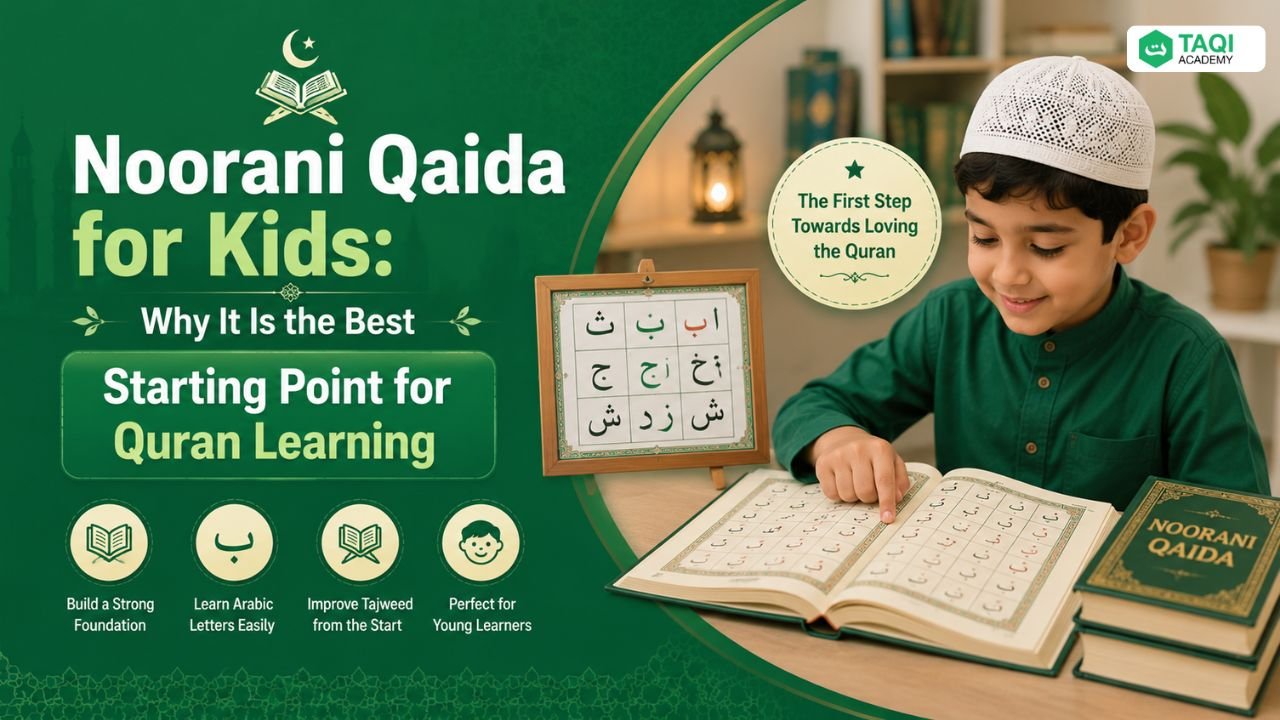
Teaching a child to read the Quran is a meaningful responsibility for every Muslim parent. But one common question comes up at the beginning: Where should my child start? Many parents want their children to read the Quran fluently, pronounce Arabic letters correctly, and eventually recite with proper Tajweed. However, starting directly with Quranic verses can be difficult for a child who is still learning the Arabic alphabet and basic vowel signs. This is where Noorani Qaida for kids can make a big difference.
Noorani Qaida gives children a step-by-step introduction to the letters, sounds, vowel marks, joining rules, and basic pronunciation needed for Quran reading. Instead of asking a beginner to memorize complicated rules all at once, it builds skills gradually through repetition and guided practice.
At Taqi Academy, the Noorani Qaida course is designed for beginners, including children and adults with no previous Quran-reading experience. The course covers Arabic letters, Harakaat, Sukun, Shaddah, Tanween, Madd, connected letters, basic Tajweed rules, reading practice, revision, and assessment.
If you are a parent wondering whether your child should begin with Noorani Qaida, this guide explains what it is, why it matters, what children learn from it, and how parents can make Quran learning a positive part of everyday life.
What Is Noorani Qaida?
Noorani Qaida is a beginner’s learning book used to teach the basic skills needed for reading the Quran. A child normally learns to recognize Arabic letters first. Then the child learns how letters sound with different vowel marks, how letters connect, and how words are formed. Gradually, the learner becomes familiar with the reading patterns that appear in the Quran. The goal is not simply to finish a Qaida book.
The real goal is to help a child develop the foundation needed for accurate and confident Quran reading. A structured Noorani Qaida course may cover:
- Arabic letters and their sounds
- Different forms of connected letters
- Fatha, Kasra, and Damma
- Sukun
- Shaddah
- Tanween
- Madd letters
- Joining letters to form words
- Basic Makharij
- Common pronunciation mistakes
- Selected introductory Tajweed rules
- Reading practice
- Revision and assessment
This foundation can make the transition from beginner lessons to Quran reading much smoother.
Why is Noorani Qaida Important for Kids?
Children are still developing their reading habits. When they learn something incorrectly at the beginning, correcting the same mistake later can take more time. For this reason, a strong foundation matters. Noorani Qaida gives children an opportunity to learn the basic building blocks before they are expected to read longer Quranic passages.
1. It Helps Children Recognize Arabic Letters
Before a child can read the Quran, they need to recognize Arabic letters. For a young learner, some letters can look or sound similar. Regular practice helps children become familiar with the letters and their correct pronunciation. A teacher can also listen to the child and correct mistakes immediately rather than allowing an incorrect pronunciation to become a habit.
2. It Builds Correct Pronunciation
Quran reading is not only about recognizing written words. Correct pronunciation is an important part of learning to recite the Quran properly. Noorani Qaida introduces children to the sounds of Arabic letters and gives them repeated opportunities to practice. A qualified teacher can demonstrate the sound and listen to the child’s response. This is one reason live instruction can be particularly useful for beginners.
3. It Introduces Basic Tajweed Concepts
Children do not necessarily need to learn every Tajweed rule on their first day. Instead, they can begin with simple concepts and gradually apply them during reading practice. The Taqi Academy Noorani Qaida curriculum introduces basic rules such as Noon Saakinah and Tanween, Meem Saakinah, and Qalqalah after the learner has developed the basic reading foundation. This step-by-step approach helps prevent beginners from feeling overwhelmed.
4. It Makes Quran Reading Less Difficult
Imagine asking a child to read a paragraph in a language they have never studied. It would naturally feel difficult. The same can happen when children are given Quranic verses before they understand Arabic letters, vowel signs, and basic reading patterns. Noorani Qaida breaks the learning process into smaller steps.
Instead of thinking:
“I have to learn the whole Quran.”
The child can focus on:
one letter → one sound → one pattern → one word → one reading skill at a time.
That can make the learning experience more manageable.
Why Start Quran Learning With Noorani Qaida Instead of Jumping Straight Into the Quran?
Parents sometimes want their children to start reading Quranic Surahs immediately. The intention is good, but beginners often need foundational instruction first.
A child who has not learned Arabic letters properly may struggle with:
- Recognizing letters
- Understanding vowel signs
- Joining letters
- Pronouncing similar sounds
- Reading words smoothly
- Applying basic Tajweed
- Correcting repeated mistakes
Starting with a foundation course allows these skills to develop before the child moves into longer Quranic passages. This does not mean every learner must follow exactly the same path. A child who already recognizes Arabic letters and can read basic words may need a different starting point. A teacher can assess the child’s current ability and recommend the appropriate level.
What Do Kids Learn in a Noorani Qaida Course?
A well-structured course should move progressively from simple concepts to more practical reading. At Taqi Academy, the Noorani Qaida course is organized into six broad learning stages.
Stage 1: Arabic Letters and Sounds
Children learn the Arabic letters and practice their correct sounds. The teacher can pay attention to difficult letters and help the child distinguish between similar sounds.
Stage 2: Vowel Marks and Diacritics
Children learn common vowel signs and other marks used in Arabic reading.
These include:
- Fatha
- Kasra
- Damma
- Sukun
- Shaddah
- Tanween
- Madd
Understanding these signs is important because they affect how Arabic words are read.
Stage 3: Joining Letters
Children begin combining individual letters. This is an important transition because Arabic letters can appear in different forms when connected. The learner gradually moves from isolated letters to syllables, words, and short reading patterns.
Stage 4: Basic Tajweed
After the basic reading skills become stronger, children can begin learning selected Tajweed rules. The purpose is not to make the child memorize complicated terminology. The focus should be on helping the child hear, understand and apply correct pronunciation during recitation.
Stage 5: Reading Practice
Practice turns knowledge into a usable skill. Children read words and short passages while the teacher listens and corrects mistakes. Regular correction is especially important because children may not notice their own pronunciation errors.
Stage 6: Revision and Assessment
Revision helps children retain what they have already learned. A good teacher should not simply move from one lesson to the next. Previous lessons should be reviewed regularly. Taqi Academy’s course description includes regular reading practice, teacher feedback, oral recitation assessment, and a final reading assessment on basic Quranic passages.
How Long Does It Take for a Child to Complete Noorani Qaida?
There is no single answer. Every child learns at a different pace. Taqi Academy currently states that its Noorani Qaida course generally takes around 2–3 months, with the duration adjustable according to the student’s pace. However, parents should not treat the number of months as the main goal. A child who finishes quickly but continues making pronunciation mistakes may need more revision. Another child may take longer but develop a much stronger foundation.
The better question is:
Can my child recognize the letters, read the patterns correctly, pronounce them properly, and apply the skills independently?
Progress matters more than speed.
What Age Should a Child Start Noorani Qaida?
Children can start Quran learning at different ages depending on their development, attention span, and previous exposure to Arabic. Taqi Academy states that its Noorani Qaida classes are available for children as young as 5 years old. For a younger child, lessons may need to be shorter, more interactive, and more repetitive.
Parents should consider whether the child can:
- Sit and focus for a short lesson
- Recognize basic shapes or letters
- Repeat sounds after a teacher
- Follow simple instructions
- Practice for a few minutes outside class
There is no need to pressure a child simply because another child started earlier.
How Can Parents Help Kids Learn Noorani Qaida at Home?
A teacher can guide the child during class, but parents play an important role between lessons. You do not need to become a Quran teacher yourself. Your role can simply be to create a supportive learning routine.
Keep Practice Short and Consistent
Children usually respond better to regular short practice than occasional long sessions. For example, a child may review for 10–15 minutes after school or before another regular family activity. The exact duration should depend on the child’s age and ability to focus.
Review What the Teacher Taught
Ask your child:
- What did you learn today?
- Which letters did you practice?
- Can you show me the lesson?
- Which part was difficult?
This makes the child feel that parents are interested in their progress.
Do Not Turn Every Mistake Into a Scolding Session
If a child makes a mistake, correction should be calm. Repeated criticism can make Quran learning feel stressful. Instead, praise effort and encourage another attempt.
You can say:
“Let’s try that letter one more time.”
That small change in tone can make practice feel much more positive.
Create a Regular Quran Time
Children benefit from routines. Choose a time when your child is usually alert and relaxed.
It might be:
- After Fajr
- After school
- Before Maghrib
- After homework
- During a quiet weekend period
The best time is the one your family can maintain consistently.
Noorani Qaida vs. Learning Quran Directly: Which Is Better for Beginners?
For a child who has never learned Arabic reading, starting with a foundation such as Noorani Qaida is usually more practical than expecting the child to read complete Quranic passages immediately.
| Noorani Qaida Foundation | Direct Quran Reading |
|---|---|
| Starts with basic letters | Starts with Quranic words and verses |
| Builds reading skills gradually | Requires some existing reading ability |
| Introduces vowel signs | Applies vowel signs in Quranic text |
| Allows focused pronunciation practice | Requires reading while managing multiple elements |
| Can introduce basic Tajweed step by step | May be challenging for complete beginners |
The important point is that the right starting level depends on the child. If your child already reads Arabic well, they may be ready for Quran Reading with Tajweed rather than beginning from the first Qaida lesson. A proper assessment can help determine this.
How Does Noorani Qaida Prepare Kids for Tajweed?
Noorani Qaida is not a replacement for a full Tajweed course. Instead, it can prepare the learner for more advanced Quran reading. Once children understand basic Arabic reading patterns, they can focus more effectively on:
- Makharij
- Letter characteristics
- Rules of Noon Saakinah and Tanween
- Meem Saakinah
- Qalqalah
- Madd
- Rules of stopping and starting
- Fluency and accuracy
Taqi Academy also offers a separate Quran Reading with Tajweed course for learners who want to improve their recitation beyond the foundation stage.
This creates a natural learning pathway:
Noorani Qaida → Quran Reading → Tajweed → Hifz or deeper Quran study
Not every student needs to follow the exact same sequence, but a structured progression can make learning easier.
Why One-to-One Noorani Qaida Classes Can Help Kids
Children do not all learn at the same speed. One child may understand a lesson after a few repetitions. Another may need several classes. In a group classroom, the teacher has to divide attention among several students. In a one-to-one class, the lesson can focus directly on the child’s needs.
Taqi Academy describes its Noorani Qaida program as live, one-to-one learning with male and female tutors, flexible scheduling, learning materials, and progress-focused instruction.
For parents, this can be useful when a child:
- Needs extra repetition
- Has difficulty with certain Arabic letters
- Learns faster than other beginners
- Needs regular pronunciation correction
- Has an unusual school or family schedule
What Should Parents Look for in a Noorani Qaida Teacher?
Choosing the right teacher is one of the most important decisions. Do not judge a teacher only by how friendly they are or how quickly they finish lessons.
Look for a teacher who can:
Explain Clearly
The teacher should be able to explain Arabic sounds in a way a child understands.
Correct Pronunciation
The teacher should listen carefully rather than simply asking the child to repeat the page.
Be Patient
Young children need repetition. A good teacher should not become frustrated when a child needs additional practice.
Follow a Structured Curriculum
The course should have clear learning stages rather than random lessons.
Track Progress
Parents should know what the child has learned, what needs improvement, and what comes next. Taqi Academy’s wider online Quran learning model also emphasizes live one-to-one instruction, real-time correction, personalized pacing, and progress tracking.
Common Mistakes Parents Should Avoid
Even with a good course, parents can accidentally make Quran learning harder.
Mistake 1: Focusing Only on Speed
Finishing the Qaida quickly is not the same as learning it well.
Mistake 2: Comparing Siblings or Classmates
Every child has a different learning pace.
Mistake 3: Skipping Revision
Children can forget earlier lessons if they only focus on new material.
Mistake 4: Correcting Without Understanding the Problem
If your child repeatedly mispronounces a letter, ask the teacher what is causing the difficulty.
Mistake 5: Making Quran Lessons a Punishment
Quran learning should be associated with respect, encouragement, and a positive learning environment.
Mistake 6: Choosing a Course Based Only on Price
A low-cost course is not necessarily the best value, and a high-cost course is not automatically better. Parents should compare teacher qualifications, curriculum, class format, feedback, scheduling, and student support before deciding. For more guidance, read our article on How to Choose the Best Online Quran Academy in Bangladesh.
How to Keep Kids Motivated During Noorani Qaida Lessons
Motivation is especially important for young children. Try these simple approaches.
Celebrate Small Improvements
If your child learns five letters correctly today, recognize that progress.
Use Positive Encouragement
Simple words such as “Good job,” “Keep practicing,” or “You improved today” can encourage children.
Let Children See Their Progress
You can keep a simple progress chart at home.
Give Them Time
Some lessons may take longer than expected.
Keep Quran Learning Consistent
Missing one day is not the end of the world. The goal is to return to the routine instead of giving up. Our guide on How to Teach Kids Quran at Home also covers practical ways parents can build a healthy Quran-learning routine at home.
When Should a Child Move From Noorani Qaida to Quran Reading?
A child does not need to move forward simply because they have completed a certain number of pages. Look for practical signs of readiness.
Your child may be ready to progress when they can:
- Recognize Arabic letters confidently
- Understand common vowel signs
- Join letters correctly
- Read basic Arabic words
- Pronounce common letters accurately
- Apply the basic rules they have learned
- Read simple Quranic words with teacher guidance
A teacher should assess the child’s reading before recommending the next stage. After Noorani Qaida, many learners can move into a dedicated Quran Reading with Tajweed program. Taqi Academy offers this as a separate course within its broader Quran learning pathway.
What Comes After Noorani Qaida?
Noorani Qaida is a foundation, not the end of Quran education. Depending on the child’s goals, the next step may include:
Quran Reading With Tajweed
For children who want to improve pronunciation, fluency, and recitation.
Hifz
For students who want to memorize the Quran. Taqi Academy offers both a Complete Hifz Program and a Part-Time Hifz Program.
Quran Translation and Tafseer
For learners who want to understand the meanings and lessons of the Quran. Taqi Academy also offers a Quran Translation & Tafseer course covering selected Surahs, Quranic meanings, context, reflection, and application.
Islamic Studies
Children can also develop broader Islamic knowledge through subjects such as Aqeedah, worship, Seerah, manners, Quran and Hadith studies, and Islamic history. You can explore all available learning options on the Taqi Academy Online Quran Courses.
Why Taqi Academy’s Noorani Qaida Course May Be a Good Option for Beginners
Parents should always evaluate an academy based on their child’s individual needs.
According to Taqi Academy’s current course information, its Noorani Qaida program includes:
- Live one-to-one sessions
- Male and female tutors
- Flexible class scheduling
- Learning materials
- Free trial class
- Certificate after successful completion
- Support for beginners
- Basic Tajweed instruction
- Regular reading practice
- Teacher feedback
- Assessment
The course is designed for children and adults who are starting from the basics, and Taqi Academy states that classes are available for children as young as five. The academy’s homepage also describes its broader teaching model as live one-to-one Quran classes with qualified male and female teachers, personalized learning plans, real-time correction, and progress tracking. Parents should still use a trial class to see whether the teacher’s communication style, pace, and approach suit their child.
Related Quran Learning Resources From Taqi Academy
If you are researching Quran education for your child, these related guides can help you plan the next step:
- How to Teach Kids Quran at Home
- One-to-One vs Group Quran Classes
- Live vs Recorded Quran Classes
- Online Quran Classes vs Private Quran Tutors
- How to Learn Quran Online for Beginners
- How to Get Started With Online Quran Learning
- Online Quran Learning vs Traditional Madrasa
- How to Choose the Best Online Quran Academy
- Best Online Quran Courses in Bangladesh for Kids & Adults
- Top 10 Online Quran Courses in Bangladesh
The Taqi Academy blog currently contains additional Bangladesh-focused articles, including Step-by-Step Guide to Learning Online Quran in Bangladesh, How to Choose the Right Online Islamic Course in Bangladesh, and Online Quran Courses for Women in Bangladesh. These are visible from the blog archive, although the current crawl did not expose their individual article URLs reliably, so I have not invented direct links for them.
Frequently Asked Questions
Is Noorani Qaida good for kids?
Yes. Noorani Qaida is designed as a beginner foundation for learning Arabic letters, vowel signs, joining patterns, pronunciation, and basic Quran reading skills. Taqi Academy’s course is specifically available for beginners, including children.
What age can children start Noorani Qaida?
Children can start at different ages depending on their readiness. Taqi Academy currently accepts children as young as five for its Noorani Qaida program.
How long does Noorani Qaida take to complete?
The time varies from child to child. Taqi Academy currently lists approximately 2–3 months, adjustable according to the student’s pace.
Does a child need to know Arabic before starting Noorani Qaida?
No. A beginner can start from the Arabic letters and basic sounds. The course is designed to build the necessary reading skills step by step.
Can children learn Noorani Qaida online?
Yes. Live online classes can work well when the child has a suitable device, stable internet, a quiet learning space, and an attentive teacher who can correct pronunciation in real time.
What comes after Noorani Qaida?
Depending on the child’s ability and goals, the next step may be Quran reading with Tajweed, Hifz, Quran Translation & Tafseer, or Islamic Studies.
Is one-to-one Quran learning better for children?
One-to-one learning can be useful because the teacher can adjust the lesson to the child’s level and give immediate correction. However, parents should consider the child’s personality, learning preferences, schedule, and the teacher’s quality before deciding.
Final Thoughts
For a child who is completely new to Quran reading, Noorani Qaida provides a clear foundation before moving into longer Quranic passages. It teaches the small skills that eventually come together to form confident Quran reading: recognizing letters, understanding vowel signs, joining letters, pronouncing sounds correctly, and gradually applying basic Tajweed. The most important thing is not how quickly a child completes the book.
The real goal is to help the child develop correct reading habits, confidence, consistency, and a positive relationship with Quran learning. Parents should choose a qualified teacher, maintain a simple home practice routine, encourage the child without unnecessary pressure, and regularly review progress. If your child is starting from the beginning, you can explore Taqi Academy’s Quran Foundation Course – Noorani Qaida & Basic Tajweed or review the complete All Taqi Academy Courses to find the next suitable stage of Quran learning.