
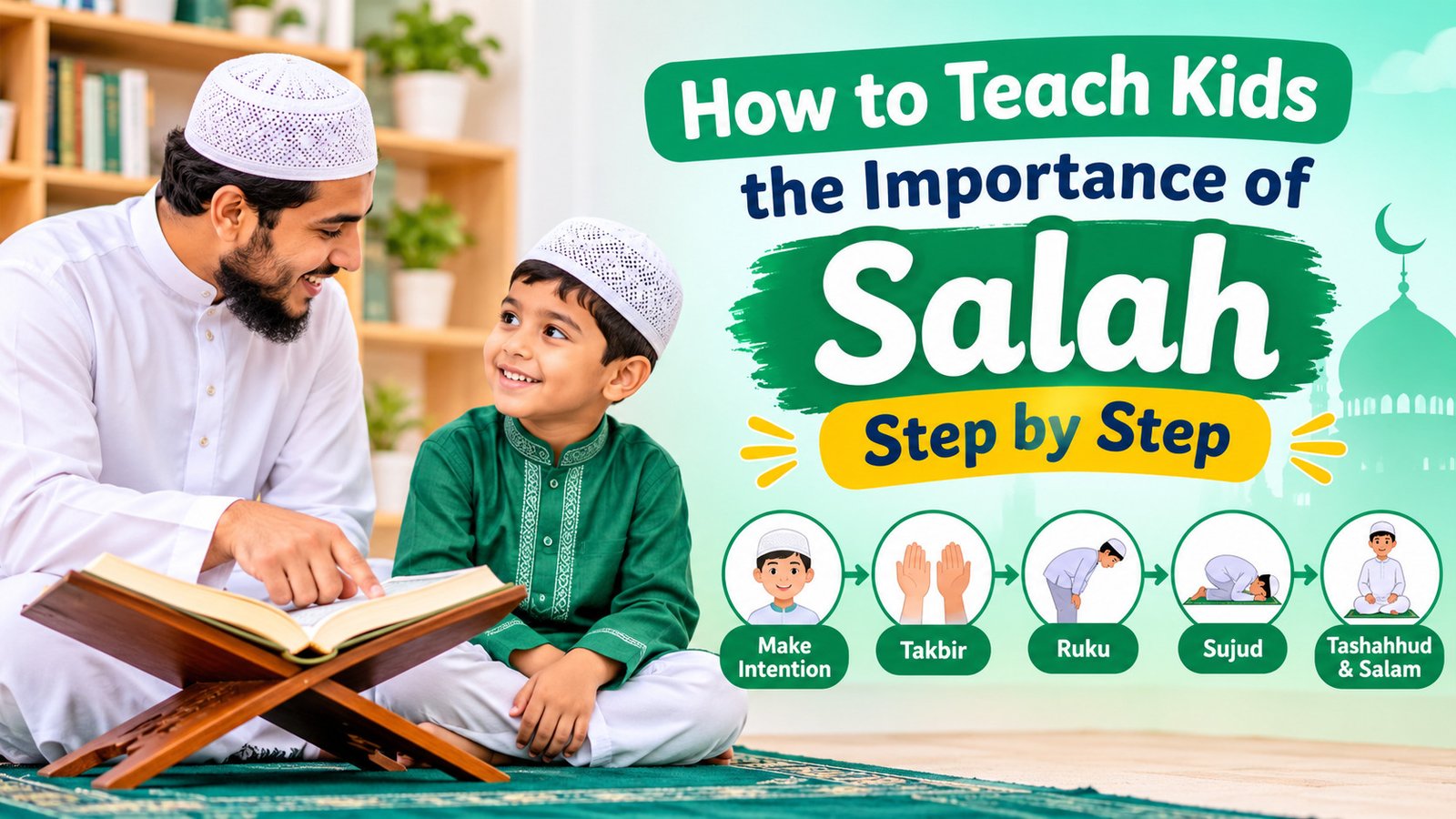
Most Muslim parents know salah matters. The harder part is helping a child feel it. Telling a six-year-old “you must pray” rarely works. Letting them discover why prayer is worth loving usually does.
This guide takes you through teaching salah step by step, from a toddler copying you on the prayer mat to a teenager who prays on their own. It is built on the Quran, the Sunnah and practical parenting. It also draws on what we see in our online classes at Taqi Academy, where we work with children and parents in many time zones.
Quick Summary for Busy Parents
- Start early with example, not rules. Children copy what they see.
- Explain why before how. Meaning drives motivation.
- Follow the Sunnah’s gradual approach: gentleness at first, consistency by age seven, firmer responsibility by ten.
- Pair salah with Quran reading, short surahs and duas so it feels familiar.
- Praise effort, not perfection.
- Ask a qualified teacher to support you if you feel unsure about rulings or pronunciation.
Why Salah Matters in a Child’s Life
Before teaching your child, it helps to be clear on this yourself, because children pick up on your sincerity quickly. Allah says: “And enjoin prayer upon your family and be steadfast therein” (Quran 20:132). The command comes with “be steadfast”, which means parents are expected to model it as well.
When Ibn Masud (may Allah be pleased with him) asked the Prophet ﷺ which deed is most beloved to Allah, the answer was prayer performed at its proper time (Sahih al-Bukhari 527; Sahih Muslim 85). For a child, salah is more than a ritual. It does three things:
- It builds a daily relationship with Allah. A child learns they can talk to their Creator any time.
- It builds discipline and calm. Five short pauses a day give children a rhythm that is rare in a screen-heavy world.
- It shapes character. The Quran says prayer restrains a person from immorality and wrongdoing (Quran 29:45).
When Should Children Start Praying in Islam?
The Prophet ﷺ said: “Command your children to pray when they are seven years old, and discipline them over it when they are ten, and separate them in their beds.” (Sunan Abi Dawud, 495; graded hasan. Numbering can vary by edition.) Scholars understand this as a gradual process:
| Age | What to aim for |
| Under 7 | Exposure, imitation and love. No pressure. |
| Around 7 | Learning to pray properly and regularly, with encouragement. |
| Around 10 | Taking real responsibility for prayer. Parents follow up firmly but kindly. |
| Puberty (bulugh) | Salah becomes an obligation. |
A note on “discipline” at ten. Scholars discuss this carefully, and contemporary guidance stresses that it never means harming or humiliating a child. If you are unsure how to handle a child who resists prayer, speak with a trusted local scholar or an experienced teacher. Gentle follow-up almost always works better than punishment.
Step 1: Pray in Front of Your Child (Ages 2 to 6)
Children learn salah the way they learn language, by watching and absorbing it. The Prophet ﷺ taught: “Pray as you have seen me praying” (Sahih al-Bukhari 631). Teaching by showing is the Sunnah method. What helps:
- Pray at home where your child can see you, not only in a separate room.
- Let them stand beside you, even if they wander or giggle.
- Keep a small child-sized prayer mat ready so they feel they have a place.
- Say “I’m going to pray now, because I love Allah” in plain, warm language.
The Prophet ﷺ himself prayed while carrying his granddaughter Umamah (Sahih al-Bukhari 516), and once shortened a prayer because he heard a child crying (Sahih al-Bukhari 707). Children were part of the prayer space, not shut out of it.
Step 2: Explain Why We Pray, in Their Language
A five-year-old does not need a lecture on obligations. They need a simple, true story.
Try lines like these:
- “Salah is our time to say thank you to Allah for food, family and everything we have.”
- “When we pray, Allah listens to us. We can tell Him anything.”
- “Prayer is how Muslims stay close to Allah, five times a day.”
For Children aged 7 and up, you can add more:
- Salah is the first thing we will be asked about on the Day of Judgment (Sunan al-Tirmidhi).
- Prayer is a gift, not a burden. It is a break from stress, worry and noise.
Let them ask questions, including awkward ones like “Why can’t I pray later?” A calm, honest answer builds trust. Saying “let’s find out together” is always better than shutting the question down.
Step 3: Teach the Basics in Small Pieces
Don’t try to teach the whole prayer in one sitting. Break it down:
- Wudu: Start here, since prayer is not valid without it. Do it together at the sink. Make it playful but respectful.
- The Movements: Standing, ruku, sujood and sitting. Practice slowly, then connect them in order.
- Short Surahs: Begin with Al-Fatihah, then Al-Ikhlas, Al-Falaq and An-Nas.
- Dhikr and Duas Inside Prayer: Add the tasbih in ruku and sujood, and the tashahhud later.
- Full Rak’ah, Then Full Prayers: Start with Fajr (2 rak’ahs), then build up to the others.
Reading the Quran correctly is part of this. A child who struggles with Arabic letters will often feel anxious in prayer. A structured foundation like Our Noorani Qaida course helps children read Arabic letters properly, which makes reciting in salah far easier. Our classes are available for children as young as five.
Step 4: Make Prayer Part of the Family Rhythm
Habits stick when they are predictable. Some ideas:
- Pray at least one salah together daily. Maghrib or Isha is often easiest.
- Use a visual prayer chart where a child can mark each salah they prayed. Keep the focus on effort, not on competing with siblings.
- Link prayer to a pleasant routine, such as dinner, then prayer, then story time.
- Let children call the adhan or lead the family in dua occasionally. Giving them a role builds ownership.
Keep it positive. Praise like “I loved seeing how calmly you stood” does more than “You must try harder.”
Step 5: Deepen Understanding of Meaning
By age 8 to 10, children can start asking what are we actually saying? This is where prayer moves from memorized words to heartfelt worship.
- Explain the meaning of Al-Fatihah line by line.
- Share simple stories of the prophets and how they turned to Allah in prayer.
- Connect surahs to real life. For example, “Al-Ikhlas tells us Allah is One. That’s why we only ask Him.”
A broader Islamic foundation helps here. Our Islamic Studies course covers how to pray salah step by step, memorizing short surahs and duas, and Islamic manners. It is suited to kids, teens and adults. When children understand beliefs, character and worship together, salah makes more sense to them.
As they grow, many families also move toward understanding the Quran itself. Our Quran Translation & Tafseer course is a natural next step for teens who want to know what they are reciting.
Step 6: Perfect the Recitation
Recitation quality gives a child confidence. Many kids avoid prayer simply because they fear making mistakes in front of others. Learning proper pronunciation, even gently, removes that fear. A dedicated Quran Reading with Tajweed course helps children recite with accuracy and fluency. One of its stated outcomes is greater confidence when reciting in prayer. For Children who show a love for memorization, The Complete Hifz Program can build on the same habits. If your family is balancing school and memorization, our guide on Part-Time Hifz vs Full-Time Hifz can help you choose a realistic path.
Step 7: Handle Resistance with Patience
Almost every child will resist at some point. That is normal, not a sign you’ve failed.
If your child says they’re bored: Shorten the prayer, pray right after something they enjoy, and let them pick their prayer mat.
If they only pray when asked: Look at what happens after prayer. Is it praised or ignored? Is it a chore or a shared moment?
If they say they forgot: Set a gentle reminder, such as an adhan app or a family routine, rather than a reprimand.
If they’re a teenager pulling away: Listen first. Ask what feels hard, whether it’s school, friends or doubts. Avoid shaming. Share your own struggles honestly and suggest speaking with a respected teacher or mentor. Never use prayer as a threat. The goal is for your child to want to stand before Allah, not to fear you.
Step 8: Get Qualified Support When You Need It
Many parents feel unsure about rulings, pronunciation or how to teach a child who is hesitant. That is completely understandable. Getting help is part of being a responsible parent.
A live one-to-one class gives your child personal attention and lets the teacher adjust to their pace. At Taqi Academy, our teachers include qualified male and female instructors, and parents can book a free trial class to see if it’s a good fit. You can also read more about our approach and teachers.
If you’re still comparing options, Our Guide to The Best Online Quran Courses in Bangladesh lists what to look for in a quality program. And if you’re weighing home-based learning against a local madrasa, Our Article on Online Madrasa vs Traditional Madrasa walks through the decision.
Common Mistakes Parents Make
- Starting with Fear Instead of love: Children who associate salah with punishment may avoid it later.
- Expecting Perfection Too Soon: Mistakes in wudu or recitation are part of learning.
- Comparing Siblings: This breeds resentment, not motivation.
- Not Praying Yourself: Your example is the most powerful lesson.
- Waiting Too Long To Start: Early familiarity makes the formal stage easier.
Frequently Asked Questions
At what age should I start teaching my child salah?
Start exposing them from a very young age by letting them watch and imitate you. Formal teaching and regular practice begin around age seven, as indicated in the hadith.
What if my child refuses to pray?
Stay patient and look for the cause: boredom, difficulty reading, fear of mistakes or peer influence. Respond with encouragement and support first. If the problem continues, consult a trusted scholar or teacher for guidance suited to your situation.
Do children need to know Arabic before praying?
They need to learn the words of the prayer, but they can start with short surahs and build gradually. Learning to read Arabic properly makes this much smoother.
Can online classes help my child learn salah?
Yes, especially when they are live and one-to-one with qualified teachers. This allows personal feedback on pronunciation and understanding, with a parent nearby.
How can I make salah enjoyable for a young child?
Use a child-sized mat, praise their effort, pray together, link prayer to pleasant routines, and tell simple stories about the Prophets and why we pray.
Final Thoughts
Teaching salah is a long journey, not a single lesson. Pray in front of your child, explain the meaning simply, teach in small steps, stay patient when it’s hard, and celebrate every bit of progress. Do all of this with sincere dua, because guidance ultimately comes from Allah. If you’d like your child to learn salah, Quran reading and Islamic basics with caring, qualified teachers, you’re welcome to explore all our courses or start with a free trial.