
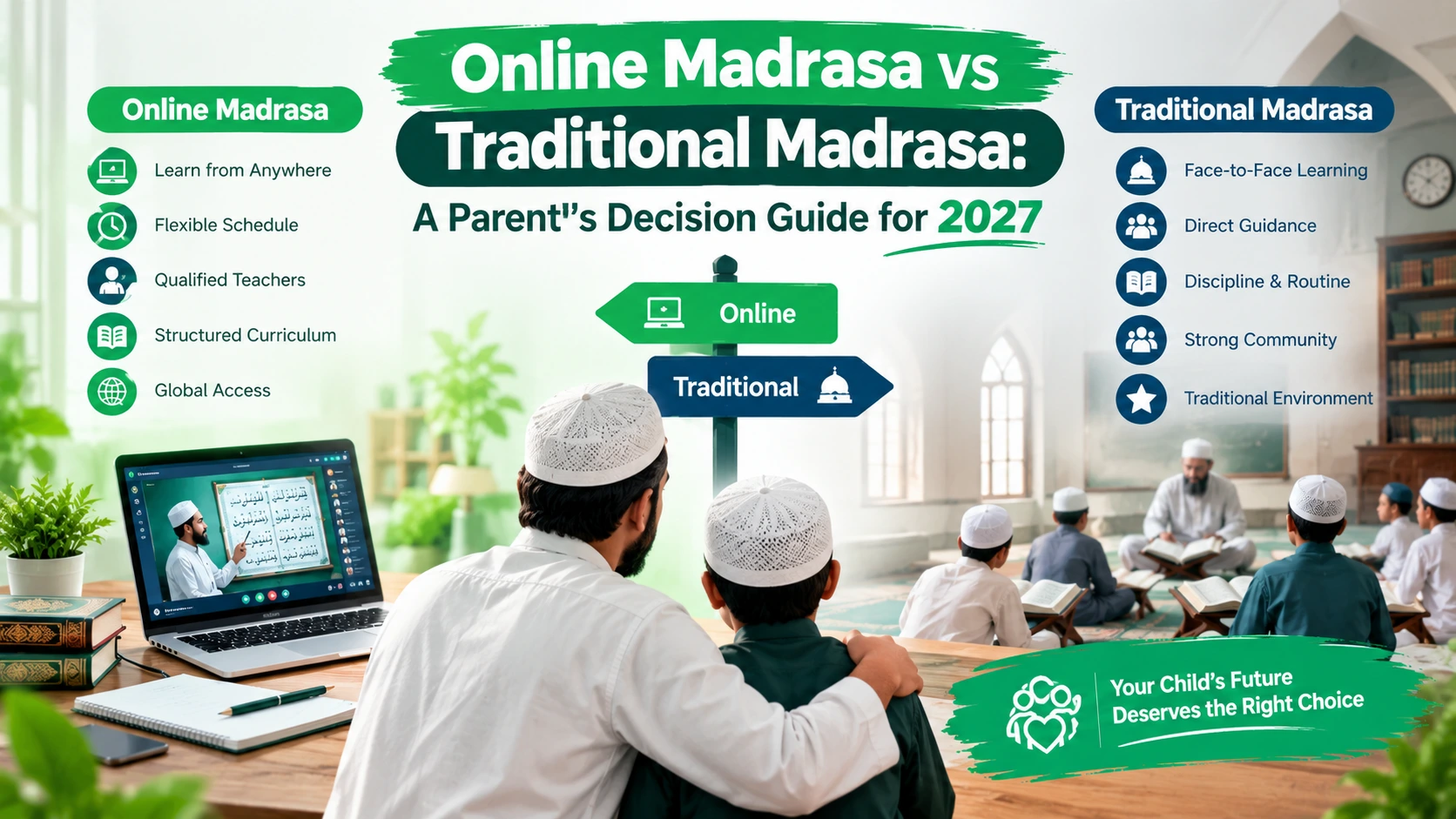
Every year, more Muslim families face the same question: should our child learn at the local madrasa or would an online madrasa actually serve them better? A few years ago this felt like a niche debate. By 2027, it isn’t niche anymore it’s a real choice millions of families make, often more than once as circumstances change. There’s no universal right answer here. But there is a right answer for your family, and it comes from asking the right questions rather than picking whichever option sounds more “modern” or more “traditional.”
What Do We Actually Mean by “Online Madrasa” in 2027?
The term gets used loosely, so it’s worth being precise. A Genuine Online Madrasa isn’t an app full of pre-recorded lectures, and it isn’t a YouTube playlist. It’s a live, teacher-led structure — a real teacher hearing a student recite, correcting Tajweed mistakes the moment they happen, and building a curriculum week over week, the same way a physical madrasa would, just delivered over video instead of in a classroom. That distinction matters more in 2027 than it did a few years ago. Video calling is reliable almost everywhere now, teachers are used to running structured Live Online classes rather than improvising, and established platforms have had time to build real data on what actually helps a student progress — not just theory about what “should” work.
What a Traditional Madrasa Still Offers
None of this makes traditional madrasa education obsolete. A physical madrasa gives children something an online lesson can’t fully replicate: a room full of peers reciting together, the discipline of a fixed daily routine, and the experience of learning inside a mosque or Islamic institution. For many families, especially where a good local madrasa already exists, that in-person, communal atmosphere is worth a great deal.
Online Madrasa vs Traditional Madrasa: A Side-by-Side Look
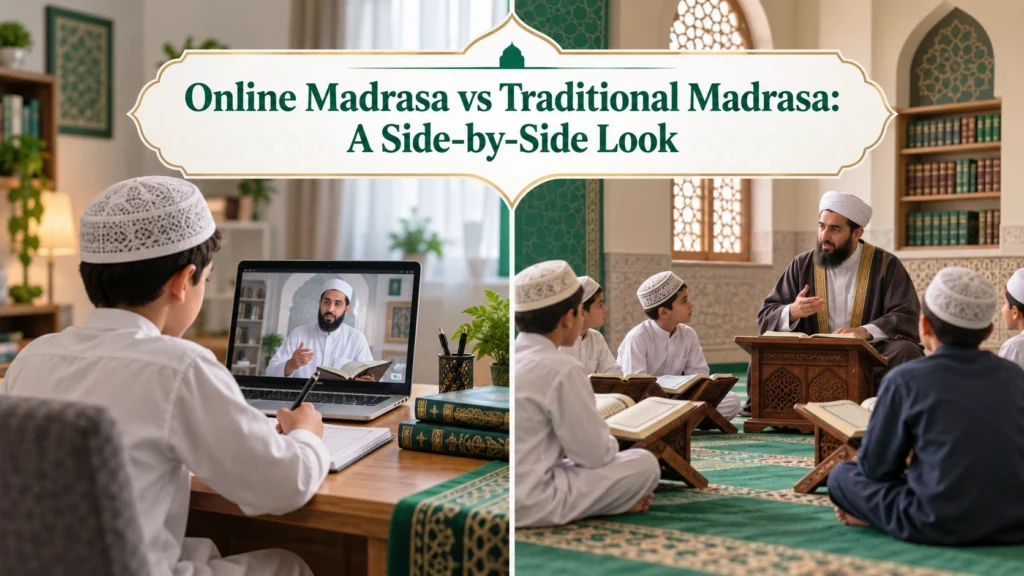
| Factor | Online Madrasa | Traditional Madrasa |
| Teacher attention | Usually one-on-one, real-time correction | Often shared across a group |
| Curriculum breadth | Quran, Tajweed, Hifz, Arabic, and Islamic Studies, chosen individually | Set by the institution, less individual flexibility |
| Scheduling | Built around the family’s routine | Fixed class hours |
| Location dependency | None — works from anywhere | Requires a nearby, reputable madrasa |
| Social/community learning | Limited unless paired with local activities | Strong — peer learning, mosque environment |
| Cost structure | Pay per course/schedule, no transport cost | Tuition plus transport and time |
Neither column is objectively “winning.” It depends entirely on what your family needs right now.
A Practical Decision Framework for 2027
Instead of asking “which is better,” ask these questions:
Is there a genuinely good madrasa within reasonable reach?
If yes, and your child’s schedule allows for it, that’s a real point in favor of traditional learning — proximity to a solid institution isn’t something to give up lightly.
Does your child need more individual correction than a group setting allows?
Many students, especially with Tajweed, progress faster with focused, one-on-one attention than in larger group settings.
Are you an expat or diaspora family?
For Muslim families living outside Muslim-majority countries, a nearby madrasa often simply doesn’t exist. An online madrasa removes that constraint entirely, connecting students with qualified teachers regardless of geography.
Is your goal Quran reading only or a broader Islamic education?
If you want Tajweed, Hifz, Arabic, and Islamic Studies taught as a connected curriculum rather than separate pursuits, look for a program built around that — not just a Quran-reading app.
How much does consistency matter to your household?
No commute means fewer missed or rescheduled sessions, which over a year adds up to meaningfully more actual learning time.
Why More Families Are Leaning Online in 2027
A few real shifts are driving this, not just convenience marketing. Reliable internet is no longer a luxury in most of the world. Teachers themselves are more experienced running live online sessions than they were even two years ago. And platforms have had time to build actual track records at Taqi Academy, for example, students have completed over 6,000 classes across 30+ countries, with the same live, one-on-one structure whether a child is in Dhaka, Toronto, or Sydney.
None of that means online is automatically the right fit for every child. Some students, particularly younger ones, do genuinely better with in-person accountability and peer presence. That’s a fair, individual judgment call for a parent to make not something a blog post can decide for you.
What About Safety and Teacher Quality?
This is a fair concern for any parent putting a child in front of a screen with an unfamiliar adult, even in an educational setting, and it deserves a direct answer rather than a vague reassurance. A properly run online madrasa should let you sit in on the first few sessions, communicate progress updates to you directly rather than only to the child, and let you request a different teacher if the fit isn’t right. Ask about a teacher’s background before committing, request a trial session, and pay attention to how they actually interact with your child during it — not just their stated credentials. The same due diligence applies to a traditional madrasa: ask other parents, visit before enrolling, and don’t assume a physical location is automatically safer or more rigorous just because it’s local.
Cost Is Rarely the Deciding Factor Alone
Online classes typically remove transport costs and the time spent commuting, which matters for busy households, but cost shouldn’t be the only variable you weigh. A cheaper option that doesn’t hold your child’s attention, or a nearby madrasa that’s genuinely excellent, can both be worth more than the sticker price suggests. Treat cost as one input among several, not the tiebreaker.
The Hybrid Option Worth Considering
Some families don’t choose one path exclusively. A child might attend Online Noorani Qaida or Tajweed classes during the week for focused, corrective attention, then join community activities at the local mosque on weekends for the social and spiritual side of learning. This isn’t a compromise — for many households, it’s genuinely the best of both.
Making the Choice for Your Family
If you’re still weighing the decision, start with a trial. Sit in on a class, ask the teacher direct questions, and watch how your child responds before committing to a term or a full curriculum. That single step tells you more than any comparison article can. Book a free trial class with Taqi Academy to see what a live, One-to-One Online Madrasa class actually looks like, or Explore Our Full Course List to find where your child’s current level fits.