
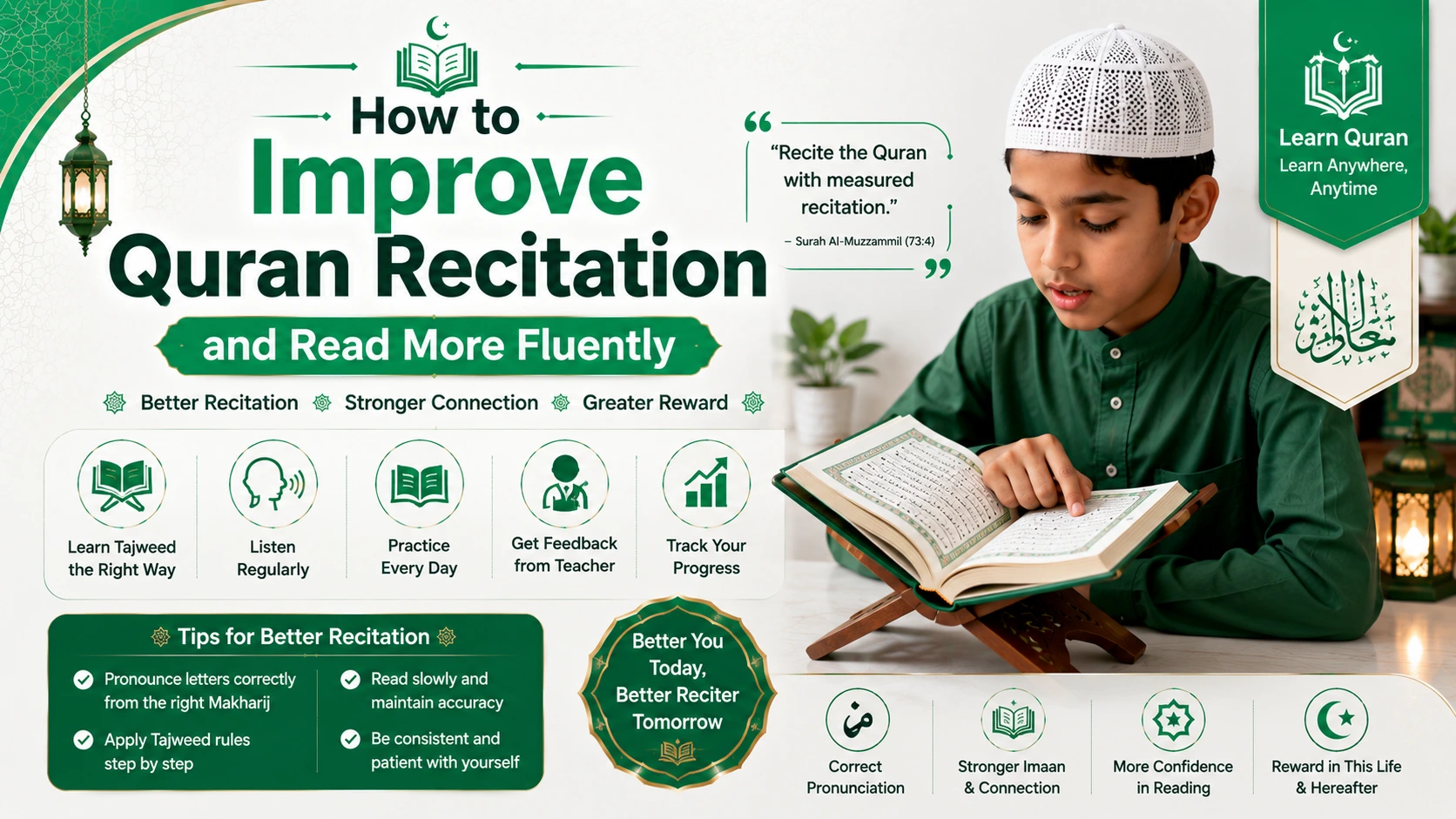
Reading the Quran fluently is a goal for many Muslims. Some people can recognize Arabic letters but struggle to read complete verses smoothly. Others can read the Quran but pause too often, mispronounce certain letters, or find it difficult to apply Tajweed rules while reading. The good news is that Quran reading fluency can improve with the right practice. Fluency does not mean rushing through the Quran. It means reading with better accuracy, confidence, pronunciation, rhythm, and control while following the basic rules of Quran recitation. A simple and consistent practice routine can make a big difference. With guidance from a qualified Quran teacher, learners can also identify mistakes that are difficult to notice on their own.
Taqi Academy’s Quran Reading with Tajweed course focuses on improving accuracy and fluency through practical recitation, Tajweed correction, teacher evaluation, and personalized feedback. In this guide, you will learn practical ways to improve your Quran recitation and become a more fluent Quran reader.
What Does Fluent Quran Recitation Mean?
Fluent Quran recitation does not simply mean reading quickly.
A fluent reader should be able to:
- Recognize Arabic letters and words comfortably
- Pronounce letters correctly
- Apply basic Tajweed rules
- Maintain a steady reading pace
- Stop and continue at appropriate places
- Avoid unnecessary pauses
- Read with confidence
- Correct mistakes through regular practice
A learner who reads slowly but accurately is making better progress than someone who reads quickly while making repeated pronunciation mistakes. The goal should always be accuracy first, then fluency, and finally speed.
Why Do Some People Struggle With Quran Reading Fluency?
There can be several reasons. Some learners never developed a strong foundation in Arabic letters and vowel signs. Others know the letters but have difficulty joining them into words. Some readers understand basic Tajweed but have not practiced enough to apply the rules naturally while reading.
Common problems include:
- Confusing similar Arabic letters
- Forgetting vowel marks
- Stopping too often
- Reading word by word
- Incorrect pronunciation
- Weak understanding of Tajweed
- Reading too quickly
- Not practicing regularly
- Learning without teacher feedback
If you are still struggling with the basics, it may be better to strengthen your foundation before focusing heavily on fluency. Taqi Academy’s Noorani Qaida and Basic Tajweed course starts with Arabic letters, pronunciation, vowel signs, connected words, basic Tajweed, and guided reading practice.
15 Practical Ways to Improve Quran Recitation
1. Start With Correct Arabic Pronunciation
Fluent reading begins with correct pronunciation. If you are unsure about certain Arabic letters, reading faster will not solve the problem. In fact, speed can make pronunciation mistakes harder to notice. Pay special attention to letters that sound similar to beginners.
For example, learners may struggle to distinguish between letters such as:
- س and ص
- ت and ط
- ذ and ز
- ح and ه
- ق and ك
These differences become easier when you learn their articulation points, known as Makharij. Practice difficult letters slowly before using them in complete words. If you want to improve your pronunciation through structured Tajweed lessons, Taqi Academy’s Quran Reading with Tajweed course includes Makharij, Sifaat, pronunciation exercises, and practical recitation correction.
2. Review the Arabic Vowel Signs
Short vowel signs play an important role in Quran reading.
Beginners should be comfortable with:
- Fathah
- Kasrah
- Dammah
- Sukun
- Shaddah
- Tanween
If you often stop to figure out the vowel of every letter, your reading will naturally become slow. Spend a few minutes each day reviewing these signs. Read simple combinations repeatedly until recognizing them becomes easier. The Noorani Qaida course at Taqi Academy teaches these basic vowel signs before moving learners toward connected words and Quranic reading.
3. Practice Reading Whole Words
One common reason for slow Quran reading is looking at each letter separately.
Instead of reading:
letter → letter → letter → word
try to gradually recognize the complete word. This takes practice. Start with short words. Read them several times. Then place them into a short verse. Over time, your eyes will become more comfortable recognizing common Arabic word patterns.
4. Read the Same Passage More Than Once
Repeating the same passage is one of the simplest ways to build fluency. Choose a short section and read it several times. During the first reading, focus on accuracy. During the second reading, focus on smoothness. During the third reading, try to maintain a steady pace without losing pronunciation. Repeated reading helps you become familiar with the words and reduces unnecessary hesitation.
5. Slow Down Before Trying to Read Faster
This may sound surprising, but slowing down can help you become fluent faster.
When you rush:
- Letters may become unclear
- Madd may be shortened
- Tajweed rules may be missed
- Words may be joined incorrectly
- Breathing may become difficult
Instead, use a comfortable pace. Once your pronunciation becomes stable, your reading speed will often improve naturally.
6. Learn Tajweed Step by Step
Tajweed gives structure to Quran recitation. You do not need to memorize every Tajweed rule at once. Start with the rules that appear regularly in your reading.
These may include:
- Noon Sakinah and Tanween
- Meem Sakinah
- Qalqalah
- Idgham
- Ikhfa
- Izhar
- Iqlab
- Madd
- Ghunnah
- Tafkheem
- Tarqeeq
- Waqf and Ibtida
Taqi Academy’s Tajweed program follows a structured progression from basic rules to practical recitation and assessment.
7. Listen to a Reliable Quran Reciter
Listening can train your ear. Choose a reliable Quran recitation and follow along with the Mushaf.
Listen to:
- Letter pronunciation
- Word endings
- Madd
- Ghunnah
- Stopping points
- Reading rhythm
Then read the same passage yourself. Do not focus only on copying the speed or style of the reciter. Your main goal should be to understand and apply the correct pronunciation and Tajweed rules.
8. Record Your Own Recitation
Recording yourself can help you notice mistakes. Choose a short passage and record your recitation. Then listen to it carefully.
Ask yourself:
- Did I pronounce difficult letters correctly?
- Did I rush any words?
- Did I pause unnecessarily?
- Did I apply Madd correctly?
- Did I miss a Tajweed rule?
- Was my reading steady?
Even better, share the recording with a qualified Quran teacher for feedback. Taqi Academy’s Tajweed program includes recorded recitations, oral evaluation, and personalized improvement feedback.
9. Get Regular Teacher Feedback
This is one of the most important steps. You cannot always hear your own mistakes.
A teacher can identify problems with your:
- Makharij
- Sifaat
- Tajweed
- Madd
- Ghunnah
- Waqf
- Reading pace
- Pronunciation
Regular correction also prevents the same mistake from becoming a long-term habit. Taqi Academy uses live one-to-one lessons where teachers can listen to the student’s recitation and provide correction during the lesson. If you are comparing Quran learning providers, read How to Choose the Best Online Quran Academy in Bangladesh. It explains why teacher qualifications, structured courses, interactive teaching, and progress tracking matter when choosing an academy.
10. Practice Difficult Letters Separately
Do not wait until you are reading a complete page to work on a difficult letter.
If you have trouble with a particular sound, isolate it.
For example:
Letter → syllable → word → phrase → verse
This gives you time to focus on the sound without worrying about the entire passage. Once the pronunciation becomes more comfortable, use it in normal reading.
11. Improve Your Breathing and Pausing
Good breathing can make your Quran reading more comfortable. Some learners stop too frequently because they try to read too much in one breath. Others continue reading even when their breathing becomes uncomfortable. Learn to breathe naturally and pay attention to appropriate stopping points. Waqf and Ibtida are important parts of developing mature Quran recitation. Taqi Academy’s Tajweed curriculum includes rules for stopping and starting during recitation.
12. Practice Every Day
Consistency matters more than occasional long sessions. You may not always have an hour available. Even a short daily session can help when you practice with focus.
For example:
10 minutes: Review difficult letters
10 minutes: Practice one Tajweed rule
10 minutes: Read a short Quran passage
5 minutes: Review mistakes
You can adjust this routine according to your schedule and reading level. The key is to make Quran reading part of your regular routine.
13. Read Aloud Instead of Only Reading Silently
Quran recitation is an oral skill. Silent reading can help you recognize words, but speaking the words aloud gives you a chance to practice pronunciation, rhythm, breathing, and Tajweed. When you read aloud, listen to yourself. If a word feels difficult, stop and practice it separately before continuing.
14. Practice With Short Surahs First
If you become frustrated while reading long passages, start with shorter Surahs. Short Surahs allow you to repeat the same material several times without feeling overwhelmed.
You can focus on:
- Correct pronunciation
- Tajweed
- Fluency
- Stopping points
- Confidence
Once you become comfortable, gradually move to longer passages. This is especially helpful for beginners and children.
15. Track Your Progress
It can be difficult to notice small improvements from day to day. Keep a simple record.
For example:
| Week | Main Focus | Progress |
| Week 1 | Arabic pronunciation | Improved difficult letters |
| Week 2 | Vowel signs | Fewer reading pauses |
| Week 3 | Noon Sakinah | Better Tajweed application |
| Week 4 | Fluency | Smoother reading |
Ask your teacher to give you one or two clear goals at a time. This keeps your learning focused.
A Simple 30-Minute Quran Recitation Practice Plan
If you have only 30 minutes each day, try this routine.
First 5 Minutes: Warm-Up
Practice difficult Arabic letters and sounds. Focus on the letters that your teacher has identified as weak areas.
Next 10 Minutes: Tajweed Practice
Choose one Tajweed rule. Review the rule and read several examples. Do not move to another rule until you have practiced it properly.
Next 10 Minutes: Quran Reading
Read a short passage slowly. Focus on pronunciation and Tajweed. Try not to stop after every word unless you need to correct something.
Final 5 Minutes: Review
Think about the mistakes you made. Write down one or two things to improve during your next practice session. This routine is simple enough for beginners but can also be adjusted for more experienced readers.
How Long Does It Take to Improve Quran Reading Fluency?
There is no fixed answer. Every learner starts at a different level. Someone who already knows Arabic letters and basic Tajweed may improve faster than someone who is starting from the beginning.
Your progress can depend on:
- Your current reading level
- Practice frequency
- Teacher feedback
- Understanding of Tajweed
- Pronunciation difficulties
- Consistency
- Time spent reading
Do not compare your progress with another learner. Focus on becoming better than you were last month. Taqi Academy’s Tajweed course lists a typical duration of around 4–5 months depending on the student’s pace, but individual progress can vary.
What If I Cannot Read the Quran Fluently Yet?
Do not feel discouraged. Many learners need to rebuild their foundation before they become comfortable with Quran reading. If you struggle with Arabic letters, vowel signs, joining letters, or simple words, start with Noorani Qaida. Taqi Academy’s Quran Foundation Course is designed for absolute beginners and covers Arabic letters, vowel signs, connected words, basic Tajweed, reading practice, and teacher feedback. Once you have a stronger foundation, you can move into structured Quran reading with Tajweed.
Taqi Academy’s current course pathway also recommends Noorani Qaida for learners who cannot recognize Arabic letters, while learners who can already read but make pronunciation mistakes can move into Quran Reading with Tajweed.
How Can Adults Improve Quran Recitation?
Adults often believe they are too old to improve their Quran reading. That is not true. Adults can improve by using a learning plan that fits their schedule. If you have work or family responsibilities, focus on short but regular practice sessions.
For example:
- Practice 15–20 minutes before work
- Review after Fajr or another suitable time
- Read a short passage every day
- Attend regular one-to-one lessons
- Keep a record of pronunciation mistakes
Taqi Academy offers flexible online Quran lessons for adults and adjusts learning plans according to the student’s current level and goals. For a broader guide, you can also read How to Get Started with Online Quran Learning in 3 Easy Steps, which discusses setting goals, choosing a teacher, starting with Noorani Qaida when needed, focusing on Tajweed, and maintaining regular practice.
How Can Children Improve Quran Reading Fluency?
Children usually need a different learning approach from adults.
Young learners may benefit from:
- Short lessons
- Repetition
- Patient correction
- Simple goals
- Regular encouragement
- Age-appropriate teaching
- One-to-one attention
Parents should focus on steady improvement rather than forcing children to read quickly. Taqi Academy’s Noorani Qaida program is designed for beginners and children, including children as young as five, and includes live one-to-one sessions and regular reading assessment.
Does Memorizing the Quran Improve Recitation?
Memorization involves repeated recitation, so it can give a learner more practice. However, repetition alone does not guarantee correct pronunciation. A student should learn and apply Tajweed while memorizing. Teacher correction is especially important because repeated mistakes can become habits. Taqi Academy’s Complete Hifz Program combines memorization, revision, Tajweed, oral assessment, and teacher feedback. For learners with school or work commitments, the Part-Time Hifz Program focuses on manageable portions, regular revision, and Tajweed application during memorization.
Common Mistakes That Slow Down Quran Recitation
Trying to Read Too Fast
Speed should come after accuracy.
Skipping Tajweed Practice
Knowing that Tajweed is important is not enough. You need to apply it during actual recitation.
Practicing Only During Classes
A class gives you instruction, but personal practice helps turn that instruction into a skill.
Ignoring Pronunciation Problems
If you repeatedly mispronounce a letter, get it corrected instead of continuing to read over it.
Changing Teachers Too Often
A consistent teacher can understand your weaknesses and track your progress over time.
Comparing Yourself With Advanced Reciters
Experienced Qaris have spent years developing their recitation. Compare your current reading with your own previous reading.
A Better Way to Practice Quran Recitation
Use the following four-step method:
Listen
Listen to a reliable recitation while following the text.
Read
Read the same passage aloud at a comfortable pace.
Record
Record yourself when possible.
Correct
Ask a qualified teacher to identify mistakes and give you specific practice goals. Then repeat the process.
This creates a simple learning cycle:
Listen → Read → Review → Correct → Repeat
Over time, this can help you build stronger pronunciation and smoother reading habits.
When Should You Consider a Tajweed Course?
If you can already read Arabic but:
- Make frequent pronunciation mistakes
- Struggle with Makharij
- Forget Tajweed rules
- Read too slowly
- Stop too often
- Want better recitation before Hifz
- Want a teacher to assess your reading
then a structured Tajweed course may be useful. Taqi Academy’s Quran Reading with Tajweed course includes Tajweed lessons, practical Surah recitation, real-time correction, recorded recitations, oral exams, and personalized feedback. If you cannot read Arabic comfortably yet, start with Noorani Qaida instead.
Final Thoughts
Improving Quran recitation is a gradual process. You do not need to become fluent in one week. Start by fixing your pronunciation, review the basic Tajweed rules, read aloud, listen to reliable recitation, and practice every day. Most importantly, get feedback from a qualified Quran teacher.
Remember:
Accuracy comes before speed.
A slow and careful recitation is better for learning than rushing through a page while repeating the same mistakes. Whether you are a complete beginner, an adult returning to Quran learning, a parent helping your child, or a student preparing for Hifz, the right learning path can make Quran reading easier and more enjoyable. Start with the foundation if you need it. Build your Tajweed knowledge step by step. Practice consistently. With patience and proper guidance, your Quran recitation can become more accurate, confident, and fluent.
Frequently Asked Questions
How can I improve my Quran recitation?
Practice every day, focus on correct pronunciation, learn Tajweed step by step, listen to reliable recitation, and get regular feedback from a qualified Quran teacher.
How can I read the Quran more fluently?
Start by reading slowly and accurately. Practice the same passages repeatedly, improve your Arabic word recognition, reduce unnecessary pauses, and gradually increase your reading pace.
Does Tajweed help with Quran reading fluency?
Yes. Tajweed provides rules for pronunciation, letter characteristics, elongation, nasal sounds, and stopping. Applying these rules correctly can make recitation more accurate and controlled. Taqi Academy’s Tajweed course specifically lists improved accuracy and fluency among its learning outcomes.
How many minutes should I practice Quran reading each day?
There is no required amount that works for everyone. A focused 15–30 minute daily practice can be a useful starting point. The most important factor is consistency.
Should I learn Noorani Qaida before Tajweed?
If you cannot recognize Arabic letters or read basic Quranic words comfortably, Noorani Qaida is a suitable starting point. It builds the foundation for correct pronunciation and basic Tajweed.
Can adults improve Quran recitation?
Yes. Adults can improve their recitation at any age by following a structured learning plan, practicing consistently, and receiving teacher feedback. Taqi Academy offers personalized online Quran learning for adults based on their current level and goals.
Can I improve Quran recitation online?
Yes. Live online lessons can allow a teacher to hear your recitation and correct pronunciation and Tajweed mistakes in real time. Taqi Academy uses one-to-one live classes with personalized instruction and feedback.
Is it better to read the Quran fast or slowly?
For learners who are improving their recitation, accuracy should come first. Reading slowly and correctly gives you more control over pronunciation and Tajweed. Speed can be developed gradually as your accuracy improves.