
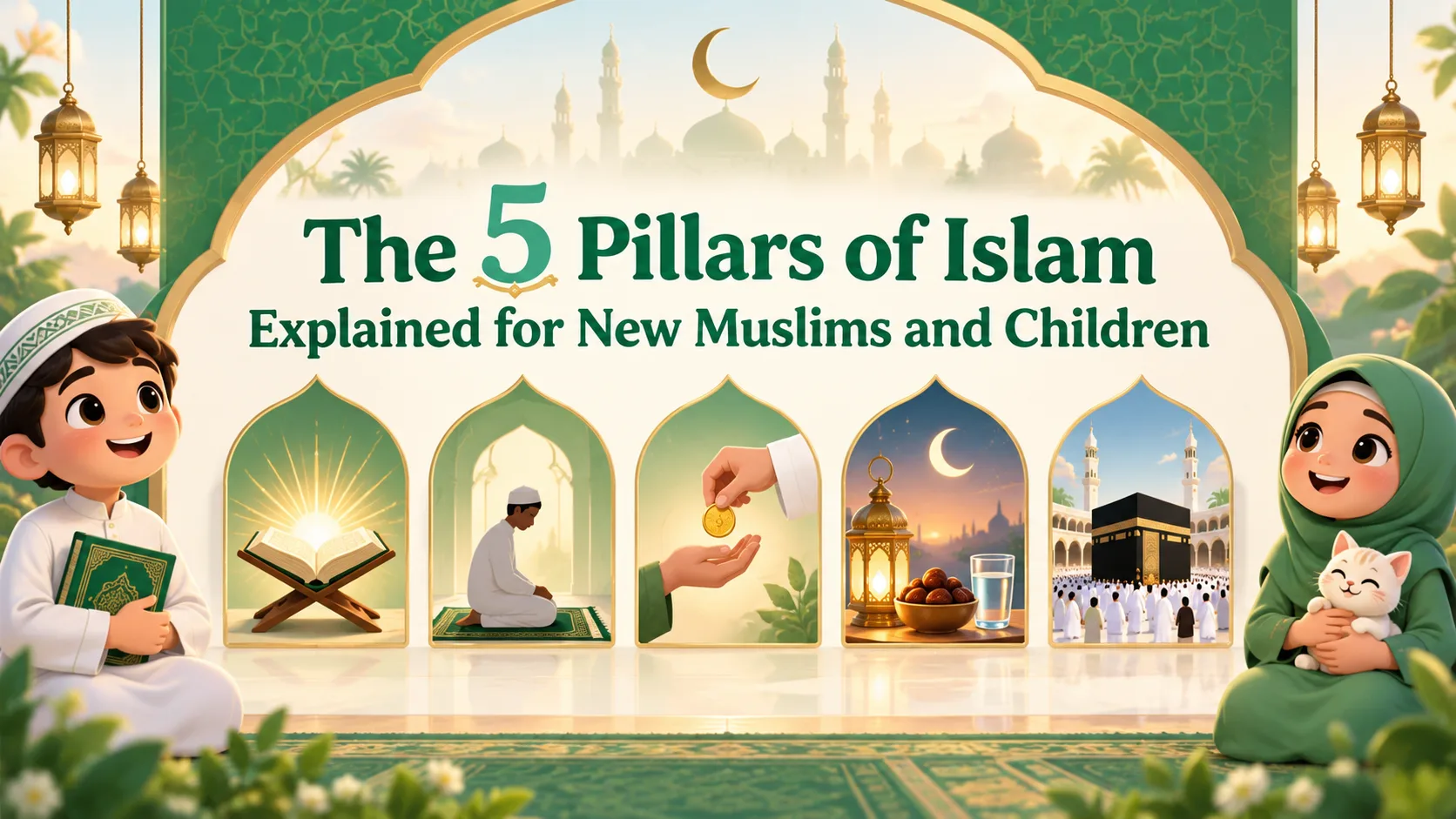
If you’ve recently become Muslim, or you’re raising children who keep asking “why do we do this?”, the five pillars of Islam are the best place to begin. They’re the basic acts of worship that shape a Muslim’s daily life, and once you understand them, so much else starts to make sense. This guide explains each pillar in plain language, for adults who are new to the faith and for parents who want simple ways to explain these ideas to children. You don’t need any background knowledge to follow along.
What are the five pillars of Islam?
The Prophet Muhammad, peace be upon him, described Islam as being built on five foundations. Think of a house: the pillars are what hold the roof up. Without them, the rest of the structure has nothing to stand on. The five pillars are:
- Shahada, the declaration of faith
- Salah, the five daily prayers
- Zakat, giving to those in need
- Sawm, fasting in Ramadan
- Hajj, the pilgrimage to Makkah
Notice that these are all actions. Islam also has core beliefs, such as belief in Allah, the angels, the revealed books, the prophets and the Last Day, but the pillars are what a Muslim actually does to live out that faith.
1. Shahada: the declaration of faith
The Shahada is the first step for anyone entering Islam. It’s a short sentence with a huge meaning: Ash-hadu an la ilaha illallah, wa ash-hadu anna Muhammadan rasulullah. In English, “I bear witness that there is no god but Allah, and I bear witness that Muhammad is the Messenger of Allah.” There are two parts. The first says that Allah alone is worthy of worship. The second says that Muhammad was the final messenger who brought His guidance.
For new Muslims: A person enters Islam by saying the Shahada sincerely and believing it in the heart. You don’t have to have everything figured out on day one. Learning is a lifelong process, and every Muslim is still learning.
For children: Tell them, “We believe in one God, Allah, who made everything, and Muhammad was His special messenger.” Repeat it often, and let them say it with you.
2. Salah: the five daily prayers
Muslims pray five times a day: Fajr (before sunrise), Dhuhr (midday), Asr (afternoon), Maghrib (just after sunset) and Isha (night). Salah is a direct connection between you and Allah, and it keeps the day anchored around remembrance of Him. Prayer is done facing the Kaaba in Makkah, and it involves standing, bowing and prostrating while reciting words from the Quran.
For new Muslims: Learning to pray can feel like a lot at first. Most people start with a few key steps and build up. Learn the essential words in Arabic a little at a time, and ask a teacher to help you with the movements and the words. Learning to read Arabic letters correctly makes this much easier, which is why many beginners begin with our Noorani Qaida course.
For children: Many families start encouraging children to pray around the age of seven, gently and without pressure. Let them stand beside you on the prayer mat. Praise the effort, not the perfection. A child who links prayer with warmth and calm will carry that feeling into adulthood.
3. Zakat: giving to those in need
Zakat is a form of obligatory charity. Muslims who have wealth above a certain minimum for a full year give a fixed portion of it, usually 2.5 percent, to people who need it. It reminds us that what we own is a trust from Allah. Zakat is different from sadaqah, which is voluntary charity that anyone can give at any time, in any amount. A smile, helping a neighbour and sharing food all count as sadaqah.
For new Muslims: If you’re unsure whether zakat applies to you, or how to calculate it, speak to a knowledgeable teacher or scholar. The rules depend on your savings and situation.
For children: Children don’t pay zakat, but they can practise the spirit of it. Give them a small jar for coins and let them choose where the money goes. Explain that sharing makes us thankful for what we have.
4. Sawm: fasting in Ramadan
During the month of Ramadan, adult Muslims who are healthy fast from dawn until sunset. That means no food or drink during the day. Fasting is about more than hunger. It builds self-control, patience and empathy for people who go without every day. Muslims also try to pray more, read the Quran and be kind during this month. The fast is broken at sunset with a meal called iftar, often beginning with dates and water. Families and neighbours often share it together.
For new Muslims: Your first Ramadan can feel overwhelming. Try to focus on the spirit of the month. If you have a medical condition, are pregnant, travelling or otherwise unable to fast, Islam provides guidance for you. Ask a teacher rather than guessing.
For children: Children aren’t required to fast before puberty, but many like to join in. Half-day fasts, or fasting for a few hours, help them feel part of the family. Make it fun with a special suhoor breakfast or a Ramadan calendar.
5. Hajj: the pilgrimage to Makkah
Hajj is the pilgrimage to Makkah, and it’s required once in a lifetime for Muslims who are physically and financially able to make the journey. It takes place in the Islamic month of Dhul Hijjah. Millions of Muslims from all over the world gather in the same simple clothing, which shows that everyone stands equal before Allah, regardless of wealth, nationality or background.
For new Muslims: Hajj is only required if you’re able to do it. Many Muslims spend years preparing and saving for it.
For children: Show them pictures of the Kaaba and explain that Muslims everywhere face it when they pray. Children love hearing that people travel from every country to worship together.
Teaching the pillars to children at home
A few simple habits help more than long lectures:
- Keep it short. A five-minute conversation over dinner works better than an hour of lecturing.
- Lead by example. Children copy what they see. When they see you pray on time and give to others, the pillars become real.
- Be patient. Understanding grows slowly. It’s fine if they ask the same question ten times.
If you’d like your child to learn with a teacher, that can help too. Our post on Online Quran learning vs. The Traditional Madrasa explains how each option works, so you can decide what suits your family. If you prefer a female teacher for your daughter or for yourself, Read About Online Quran Courses for women in Bangladesh.
Learn with Taqi Academy
At Taqi Academy, we teach beginners, children, adults and new Muslims. Our classes are live and one-to-one, taught by qualified male and female teachers from Bangladesh and Egypt who speak English and Bengali. If you’d like a teacher to guide you through the basics of the faith at your own pace, Our Islamic Studies course is a good place to start. You can see all our programmes on the courses page, or learn more about us. Not sure how to begin? Our guide on Getting Started with Online Quran learning in Three Easy Steps will help. And if you’d like to compare options, see our list of the Top Online Quran courses in Bangladesh. Ready to try? Book a free trial class and meet your teacher first.
Frequently Asked Questions
Do I need to practise all five pillars right away as a new Muslim?
The Shahada is the entry point. After that, most people build up gradually, starting with prayer and adding the others as they learn.
What’s the difference between the five pillars and the six articles of faith?
The pillars are actions of worship. The articles of faith are beliefs, such as belief in Allah, the angels, the books, the prophets, the Last Day and divine decree. A Muslim holds both.
At what age do children need to follow the pillars?
Islam holds people responsible for the obligations from puberty onward. Before that, practising is training and habit-building, so keep it gentle and encouraging.