Search for the best Quran app and you’ll find long lists full of star ratings and download counts. Very few of them answer the question that actually matters: will this help me read the Quran correctly? That’s a fair thing to ask, because an app can only do so much. It can show you the text, play a recitation and remind you to practise. What it usually can’t do is hear you make a mistake and stop you on the spot. So the honest answer to “what is the best online Quran teaching app?” is that it depends on what you need help with. Let’s work that out, so you can pick something that really fits you or your child.
The short answer
If you already read well and just want a daily habit, a simple practice app is enough. But if you’re a beginner, if your Tajweed needs work, or if you want to memorise, the best “app” is really a live teacher on a video call with a clear plan behind the lessons. Most people who feel stuck after months of tapping through apps belong in this second group. Why does live correction matter so much? Because Tajweed is about small details: where a letter comes from in the mouth, how long a sound is held, when a sound is softened or merged. These details are very hard to judge on your own. You can listen to a recitation a hundred times and still not notice that your own version is slightly off. A teacher notices in seconds.
Three kinds of Quran learning apps
Practice and reading apps. These give you the Mushaf, translations and audio from well-known reciters, plus reading trackers. They’re great for staying consistent. The limitation is feedback. Nobody is listening to you. Recorded course apps. You watch lessons on Tajweed or Arabic at your own pace. They’re useful for theory, but you’re watching, not being corrected, and it’s easy to fall behind without anyone noticing.
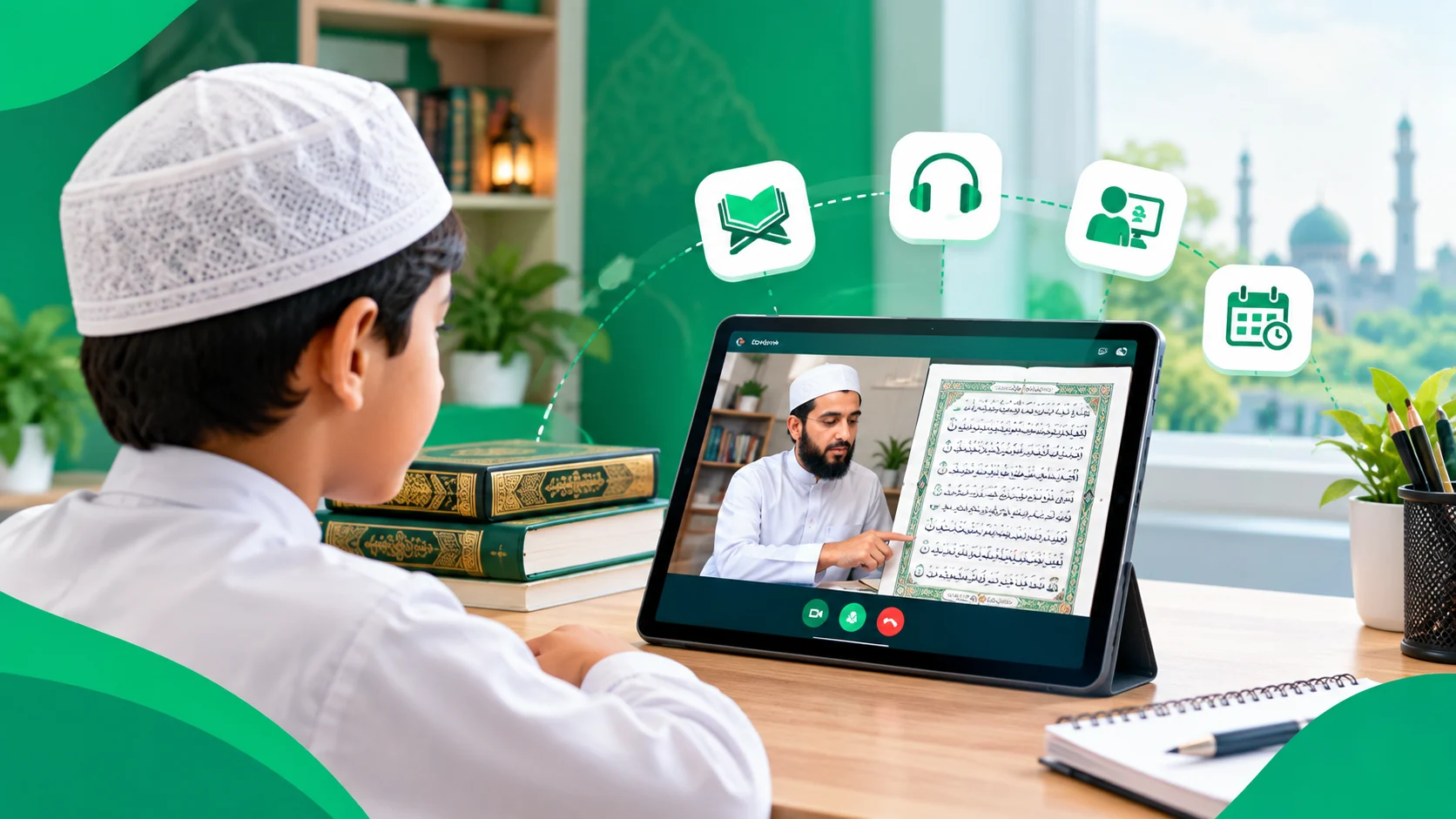
Live tutoring platforms. You meet a qualified teacher over video, recite aloud and get corrected in real time. It’s the closest thing to sitting in front of a teacher at a madrasa, just from your own home. If you’re weighing the two, our comparison of online Quran learning vs. the traditional madrasa goes through the pros and cons honestly. Plenty of learners use both ends of this list: live classes to learn, and a practice app to revise between sessions.
What to look for before you choose
Whatever platform you’re considering, run it through this checklist.
- True one-to-one attention. In a group class, a teacher may hear you recite for two minutes. In a one-to-one class, the whole lesson is yours.
- Qualified teachers who speak your language. Ask who they are and where they trained. Taqi Academy’s teachers come from Bangladesh and Egypt and teach in English and Bengali, so nothing gets lost in translation.
- Real Tajweed correction. “Listen and repeat” isn’t enough. A good teacher points to the exact letter or rule that’s off and shows you how to fix it.
- A clear learning path. Noorani Qaida first, then Tajweed, then Hifz or Tafseer. Random lessons rarely add up to fluent reading.
- Flexible timing. This matters a lot if you live abroad or your child has school. Morning, evening and weekend slots make it easier to stay regular.
- Progress you can see. Ask how the academy tracks improvement. Vague promises aren’t a plan.
- A free trial. One class is usually enough to tell whether the teacher suits you.
- Comfort and privacy. Many women and girls prefer a female teacher. We’ve written about this in Online Quran courses for Women in Bangladesh.
Match the course to the Learner
The right starting point saves months of frustration.
- Complete beginner or young child: Start with the Noorani Qaida Course. It builds letter recognition and correct pronunciation from zero, and most students finish in about two months, depending on their pace.
- Can read, but with mistakes: A Quran Reading with Tajweed course cleans up pronunciation before bad habits set in.
- Want to memorise, but have school or work: The Part-Time Hifz programme is built around one to two hours of daily instruction, covering memorisation, revision and Tajweed. It suits people who can’t commit full-time.
- Want to understand what you recite: Quran Translation & Tafseer helps you connect the words with their meaning, and The Islamic Studies Course covers the wider basics of the faith.
You can see every option on Our courses page.
How Taqi Academy works
We don’t ask you to download a special app. Classes run live, one-to-one, over reliable video conferencing tools, so a phone, tablet or laptop with an internet connection is all you need. Students join from the USA, UK, Canada, Australia, Bangladesh and other countries, and class times are arranged around your routine.
Here’s what that looks like in practice:
- Qualified male and female teachers, so you can choose what you’re comfortable with.
- Live correction during the lesson, not after.
- Progress updates. For example, our Quran Translation & Tafseer course includes weekly and monthly progress reports.
- A certificate when you complete a course.
- Two free trial classes, plus a money-back guarantee if you’re not satisfied. You can learn more about us before you decide.
We’re based in Mohammadpur, Dhaka, and many of our students are Bangladeshi families living abroad who want their children to learn the Quran with teachers who understand their language and culture.
Mistakes people make when choosing
Choosing by download count. A popular app isn’t automatically a good teacher. Popularity tells you about marketing, not about whether your Tajweed will improve. Skipping the basics. Many adults jump straight to advanced lessons and then wonder why the same mistakes keep coming back. Noorani Qaida feels simple, but it fixes the foundation. Starting Hifz on weak recitation. Memorising a verse with a wrong pronunciation means you’ve memorised the mistake. It’s much easier to fix your reading first. Expecting fast results from ten minutes a week. Consistent, shorter sessions beat one long class now and then. Never trying a trial class. You wouldn’t enrol in a school without visiting first. A trial class costs nothing and tells you a lot.
Ready to Start?
If you’re not sure where to begin, our guide on getting started with online Quran learning in three easy steps walks you through it. And if you’d like to compare academies before deciding, Read Our Top Online Quran Courses in Bangladesh guide. The best online Quran teaching app is the one that gets you a real teacher, a clear plan and regular practice. When you’re ready, book a free trial class and see how one-to-one learning feels.
Frequently asked questions
Can a Quran app replace a teacher?
For revision and daily reading, yes, an app helps. For correcting your pronunciation and Tajweed, no. That needs a person who can hear you and respond.
Is online learning suitable for children?
Yes. One-to-one classes keep a child’s full attention on the teacher, and parents can sit nearby during the lesson. Starting with Noorani Qaida works well for kids.
How much time should I set aside each day?
It depends on the course. Part-time Hifz usually involves one to two hours of daily instruction, while beginners can start with shorter sessions and build up.
Can I try a class before paying?
Yes. We offer two free trial classes so you can meet your teacher and see our teaching style first.