
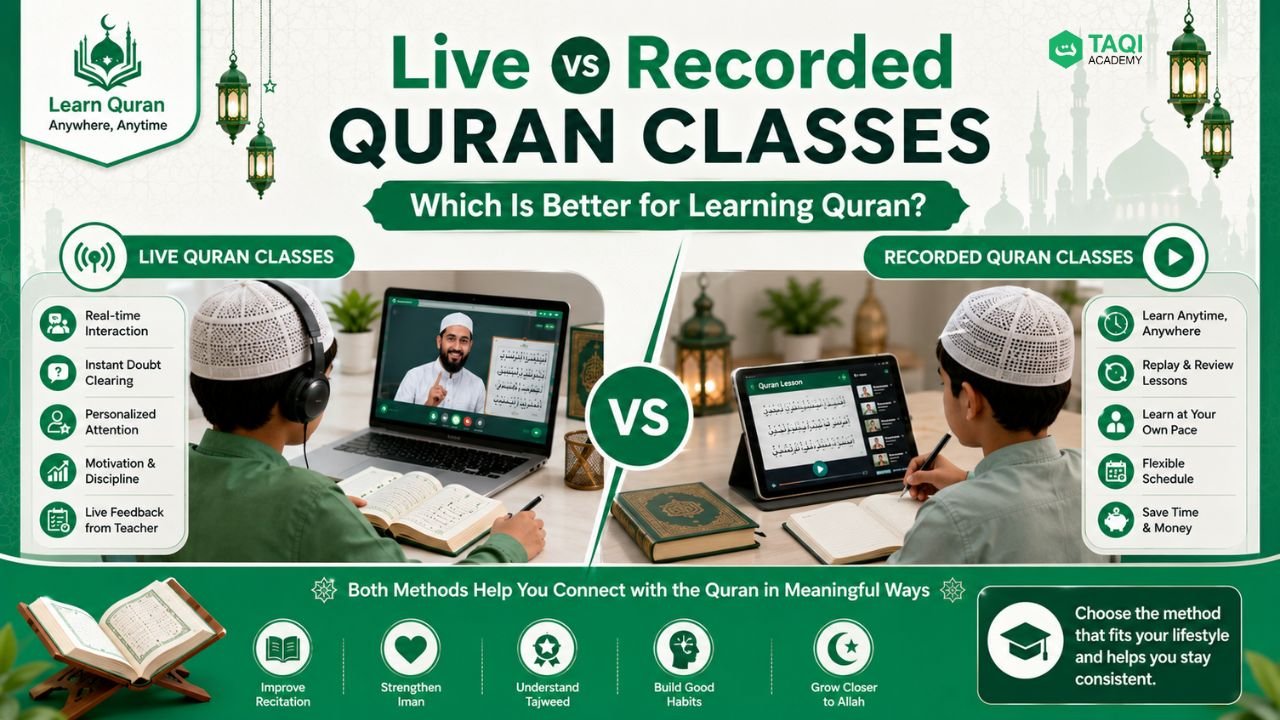
Learning the Quran online has become a convenient option for children, adults, beginners, and Muslims living away from traditional Quran learning centers. But when choosing an online Quran course, one important question often comes up:
Should you learn through live Quran classes with a teacher, or use recorded Quran lessons at your own pace? Both methods have advantages. Recorded lessons can be convenient for reviewing a topic whenever you have time, while live Quran classes allow direct communication with a teacher, real-time correction, and personalized guidance.
For Quran learning, the difference can be especially important because reading the Quran correctly involves pronunciation, Makharij, Tajweed, fluency, and regular practice. A student may understand a rule from a video but still need a teacher to identify and correct mistakes during actual recitation.
So, which method is better?
For learners who need personal guidance and regular feedback, live one-to-one Quran classes are generally the stronger option. Recorded lessons can still be useful as supplementary learning and revision material. In this guide, we will compare live and recorded Quran classes, explain the strengths and limitations of both, and help you decide which learning method is suitable for your needs.
What Are Live Quran Classes?
Live Quran classes are conducted in real time between a student and a Quran teacher through an online platform. The student and teacher attend the lesson at an agreed time. During the class, the student can read the Quran, ask questions, practice pronunciation, and receive immediate feedback from the teacher.
At Taqi Academy, online Quran education is built around live one-to-one classes. The academy states that students receive personalized lesson pacing, real-time Tajweed correction, Makharij guidance, teacher interaction, and progress tracking.
A typical live lesson may include:
- Reviewing the previous lesson
- Quran recitation
- Pronunciation correction
- Tajweed practice
- Guided reading
- A new lesson
- Homework or revision
- Progress tracking
This approach allows the teacher to adapt the lesson according to the student’s current ability.
What Are Recorded Quran Classes?
Recorded Quran classes consist of pre-recorded videos or lessons that students watch independently. Instead of attending at a fixed time, learners can usually access the material whenever they have time. They can pause, replay, slow down, or revisit a lesson as needed. Recorded lessons can be useful for:
- Reviewing previously learned material
- Revising Tajweed rules
- Listening to Quran recitation
- Reviewing Arabic vocabulary
- Refreshing memorization
- Studying when a live teacher is unavailable
However, recorded learning has one important limitation: the lesson is delivered to the learner regardless of whether the learner has understood or correctly applied the material. If you pronounce a word incorrectly while watching a recorded lesson, the video cannot hear your recitation and correct you. That difference becomes important when learning practical Quran recitation.
Live vs Recorded Quran Classes: Quick Comparison
| Learning Factor | Live Quran Classes | Recorded Quran Classes |
|---|---|---|
| Teacher interaction | Real-time | Usually unavailable |
| Pronunciation correction | Immediate | Student must self-correct |
| Tajweed feedback | Personalized | General explanation |
| Questions | Answered during class | Must rely on available material |
| Learning pace | Adjusted by teacher | Controlled by student |
| Schedule | Requires class time | Highly flexible |
| Accountability | Regular teacher follow-up | Mostly self-directed |
| Progress tracking | Can be personalized | Usually self-managed |
| Hifz support | Teacher can listen and correct | Mainly self-practice |
| Revision | Teacher-guided | Easy to replay |
| Best use | Structured learning | Review and supplementary practice |
The right choice depends on the learner’s goals, discipline, current Quran reading ability, and need for feedback.
1. Live Classes Provide Real-Time Quran Recitation Correction
One of the biggest differences between live and recorded Quran learning is feedback. Suppose you are learning a new Surah and repeatedly pronounce a letter incorrectly. With a recorded video, you may hear the correct pronunciation, but you still have to determine whether your own pronunciation matches the example. In a live class, you can read the same word or verse to your teacher. The teacher can listen and identify the problem immediately.
The teacher may then:
- Demonstrate the correct pronunciation.
- Explain where the sound comes from.
- Ask you to repeat it.
- Correct the remaining mistake.
- Let you practice it in the verse.
This type of feedback is particularly useful for beginners and students working on Tajweed. Taqi Academy’s Quran Reading with Tajweed Course focuses on improving Quran reading, Makharij, pronunciation, and Tajweed through live one-to-one instruction.
2. Recorded Lessons Give You More Scheduling Freedom
Recorded Quran lessons have a clear advantage when it comes to flexibility. If you work long hours, travel frequently, or have an unpredictable schedule, you can watch a recorded lesson whenever you have free time.
You can also:
- Pause a lesson.
- Replay difficult sections.
- Review an earlier lesson.
- Study early in the morning.
- Study late at night.
- Repeat a lesson several times.
This can make recorded content useful for revision. However, flexibility can also create a problem: there is less external accountability. A student may plan to watch a lesson every day but eventually postpone it because there is no teacher waiting for the scheduled class. For learners who struggle with consistency, a scheduled live class can provide useful structure.
3. Which Is Better for Beginners?
For someone who cannot yet read Arabic, learning with direct teacher guidance can be especially helpful. A beginner may need to learn:
- Arabic letters
- Letter shapes
- Letter sounds
- Harakat
- Connecting letters
- Basic Quranic words
- Pronunciation
- Reading fluency
- Basic Tajweed
Small mistakes at the beginning can become habits if they are not corrected. This is why beginners often benefit from having a teacher listen to their reading instead of relying exclusively on videos.
Taqi Academy’s Noorani Qaida – Quran Foundation Course is designed for learners who need to develop foundational Arabic reading and pronunciation skills before progressing to more advanced Quran reading. For a broader beginner guide, you can also read How to Learn Quran Online.
4. Which Is Better for Tajweed?
Tajweed is not only about memorizing rules. A student needs to apply those rules correctly while reciting. For example, understanding a Tajweed rule from a video does not automatically mean that the learner will apply it correctly in every verse. Live instruction allows the teacher to hear the student’s recitation and identify specific areas that need improvement.
A teacher can help with:
- Makharij
- Letter pronunciation
- Madd
- Ghunnah
- Qalqalah
- Noon Sakinah and Tanween
- Meem Sakinah
- Rules of stopping and starting
- Recitation fluency
Recorded lessons can still be valuable for explaining these rules and providing examples, but live feedback adds another layer of learning. For students specifically looking to improve Tajweed, a structured Quran Reading with Tajweed course can provide a more personalized learning path.
5. Live Classes Can Be More Useful for Quran Hifz
Quran memorization requires consistent practice, revision, and accurate recitation. A student memorizing the Quran needs to know not only whether they remember the verses but also whether they are reciting them correctly. During a live Hifz lesson, a teacher can listen to the student’s memorization and identify mistakes.
The teacher can also help the student maintain a balance between:
- New memorization
- Previous revision
- Daily recitation
- Mistake correction
- Long-term retention
Taqi Academy offers both a Complete Quran Hifz Program and a Part-Time Hifz Program. The complete program focuses on structured memorization with personalized guidance and revision, while the part-time option is designed for learners balancing Hifz with school, work, or family commitments. Recorded recitation can be helpful during Hifz revision, but it does not replace a teacher listening to the student’s own memorization.
6. Live Quran Classes Allow Students to Ask Questions
Another important advantage of live learning is interaction. Students can ask questions such as:
- “Why is this letter pronounced this way?”
- “Did I apply this Tajweed rule correctly?”
- “Can you explain this verse?”
- “Can I repeat this lesson?”
- “How should I revise this Surah?”
- “What should I practice before the next class?”
The teacher can answer according to the student’s specific situation. A recorded lesson can only answer questions that the course creator anticipated when producing the video. This makes live classes particularly useful for learners who prefer interactive learning rather than simply watching lessons.
7. Recorded Lessons Are Useful for Revision
It would be unfair to describe recorded Quran lessons as useless. They can be very valuable when used correctly. For example, after attending a live Tajweed class, a student may use recorded material to review the rule again. A student learning Arabic can replay vocabulary lessons. Someone memorizing the Quran can listen to a recitation repeatedly while revising. Recorded resources are therefore often most useful as supporting material rather than the only source of instruction. The strongest learning routine for many students can combine teacher-led lessons with independent practice and revision.
8. Which Method Is Better for Children?
Parents should consider the child’s age, attention span, current Quran reading ability, and learning habits. Recorded lessons may work for children who can study independently and remain focused without supervision. However, younger children often need encouragement and interaction. A live teacher can notice when a child is struggling, becoming distracted, or misunderstanding a lesson. Taqi Academy’s live one-to-one model is designed to give children individual teacher attention, personalized pacing, step-by-step instruction, and progress updates for parents where applicable. For parents comparing different learning options, our article on The Best Online Quran courses in Bangladesh for kids and adults can provide additional guidance.
9. Which Method Is Better for Adults?
Adults often have different learning requirements. Someone may have learned Quran as a child but forgotten many rules. Another person may be starting from the Arabic alphabet. A working professional may want to improve Tajweed but only have limited free time. Recorded lessons provide flexibility, but live classes offer something equally valuable: personalization. A teacher can start from the learner’s actual level instead of making the student follow a fixed sequence designed for a general audience.
Taqi Academy provides flexible live classes for adults and states that lessons can be adapted to individual learning goals and schedules. If you are an adult considering online Quran learning, you may also find our step-by-step guide to learning Quran online in Bangladesh useful.
10. What About Quran Translation and Tafseer?
If your objective is to understand the Quran rather than simply improve recitation, both live and recorded resources can play a role. Recorded lectures can be convenient for revisiting explanations and listening to a topic more than once. However, live lessons allow students to ask questions and clarify concepts according to their level of understanding. Taqi Academy offers a dedicated Quran Translation & Tafseer Course for students who want to study Quranic meanings, context, and practical lessons. For subjects involving interpretation and Islamic knowledge, students should also consider the teacher’s qualifications and the reliability of the educational material rather than choosing a course solely because it is convenient.
11. What About Learning Arabic Alongside the Quran?
Arabic knowledge can help students develop a deeper understanding of Quranic vocabulary and language. A recorded Arabic course may allow learners to review vocabulary and grammar repeatedly. A live teacher, however, can listen to pronunciation, explain grammar questions, and adjust explanations according to the learner’s level. Taqi Academy provides an Arabic Language Course covering areas such as Quranic Arabic, vocabulary, and grammar. Students who want structured Islamic education can also explore the Islamic Studies Course.
12. Live vs Recorded Quran Classes for Non-Arabic Speakers
Non-Arabic speakers may face additional challenges when learning Quranic pronunciation. They may not immediately understand how Arabic letters differ from sounds in their native language. Recorded examples can demonstrate correct pronunciation, but learners still need to know whether they are reproducing the sound accurately. A live teacher can listen to the student’s recitation and provide individualized correction.
This can be especially helpful when learning:
- Arabic letters
- Makharij
- Basic Tajweed
- Quran reading
- Quranic vocabulary
Taqi Academy states that its classes welcome beginners and non-Arabic speakers and provide step-by-step guidance from the student’s current level.
13. Live Classes Provide Accountability
Consistency is one of the biggest factors in Quran learning. A student may have access to hundreds of recorded lessons but still make little progress if they rarely study. Scheduled live classes create a routine. When students know that they have a class at a particular time, they are more likely to prepare, attend, practice, and continue their learning. A teacher can also track lesson progress and identify areas requiring additional practice. At Taqi Academy, the stated learning process includes recording lesson progress, homework, and areas for improvement after classes.
14. What Are the Disadvantages of Recorded Quran Classes?
Recorded learning is convenient, but students should understand its limitations.
Limited Personal Feedback
A video cannot listen to your recitation and tell you exactly where you are making a mistake.
Less Accountability
You are responsible for deciding when to study and whether to complete the lessons.
Fixed Teaching Style
The lesson is already recorded and cannot be changed according to your specific learning difficulty.
Questions May Remain Unanswered
If you have a question that is not covered in the recording, you may need another resource to find the answer.
Self-Assessment Can Be Difficult
A learner may believe their pronunciation is correct simply because it sounds similar to the example. These limitations do not make recorded lessons bad. They simply mean that learners should understand what recorded learning can and cannot provide.
15. What Are the Disadvantages of Live Quran Classes?
Live classes also have some practical limitations.
You Need to Attend at a Scheduled Time
Unlike recorded lessons, you cannot usually study whenever you want.
Internet Connection Matters
A stable internet connection is important for clear communication between the student and teacher.
Teacher Availability
Your preferred class time depends on teacher availability.
Cost May Be Higher
Personalized teacher-led instruction can cost more than accessing a collection of recorded videos. For some learners, however, the additional guidance may justify the investment. The right decision should depend on your learning goals and available resources.
Is Live Quran Learning Better Than Recorded Learning?
For learning Quran correctly from a teacher, live instruction has several important advantages. It allows:
- Direct teacher-student communication
- Immediate recitation correction
- Personalized Tajweed guidance
- Individual pacing
- Questions and answers
- Progress monitoring
- Structured learning
- Accountability
Recorded lessons are most valuable when used for revision, repetition, listening practice, and supplementary study. Therefore, the question is not necessarily whether recorded lessons are “bad.” The more useful question is:
Do you need a teacher to listen to your recitation and guide your learning?
If the answer is yes, live Quran classes are likely to be the better primary learning method.
Live vs Recorded Quran Classes: Which One Should You Choose?
Consider your situation before making a decision.
Choose Live Quran Classes If:
- You are a complete beginner.
- You need help with Arabic pronunciation.
- You want to improve Tajweed.
- You want someone to listen to your recitation.
- You are learning Quran Hifz.
- You need a personalized learning pace.
- You have questions during lessons.
- You want regular accountability.
- Your child needs individual attention.
- You want a structured Quran learning plan.
Recorded Quran Lessons May Suit You If:
- You already have strong Quran reading skills.
- You mainly need revision material.
- You prefer self-paced study.
- Your schedule makes live attendance difficult.
- You want to review a lesson repeatedly.
- You are using videos as supplementary learning.
The Best Approach for Some Learners: Use Both
You do not necessarily have to choose only one.
A practical approach can be:
Live class → Teacher correction → Independent practice → Recorded review → Next live class
For example, a student can learn a Tajweed rule during a live lesson, practice it independently, and use recorded recitation or educational material for additional review. This combines the structure of teacher-led learning with the flexibility of self-study.
How to Choose a Good Live Online Quran Academy
If you decide that live Quran learning is right for you, do not choose an academy based only on price.
Consider these factors:
Teacher Qualifications
Find out who will teach you and whether the teacher has appropriate Quranic knowledge and teaching experience.
Course Structure
The academy should have a clear learning pathway rather than simply offering random lessons.
Individual Attention
Ask whether the teacher will have enough time to listen to your recitation and correct mistakes.
Progress Tracking
Regular progress reviews can help students understand what they have learned and what needs more practice.
Flexible Scheduling
Choose a schedule that you can realistically maintain.
Trial Class
A trial class allows you to experience the teacher’s communication style before committing.
Course Options
If your goals change, it is useful if the academy offers related courses such as Tajweed, Hifz, Translation & Tafseer, Arabic, and Islamic Studies. Our Detailed Guide on How to choose the best online Quran academy in Bangladesh covers these considerations in greater detail.
Why Taqi Academy Uses Live One-to-One Quran Classes
Taqi Academy’s current teaching model is centered on live one-to-one Quran classes rather than relying primarily on recorded lessons. According to the academy, students receive:
- Individual teacher attention
- Real-time Tajweed correction
- Makharij guidance
- Personalized lesson pacing
- Questions and answers
- Progress tracking
- Flexible scheduling
- Male and female teacher options, subject to availability
The academy currently offers courses covering foundational Quran reading, Tajweed, Hifz, Translation & Tafseer, Arabic Language, and Islamic Studies. Students can also attend a free trial class to meet a teacher, experience the teaching approach, and receive an initial learning assessment before enrolling.
Frequently Asked Questions
Are live Quran classes better than recorded Quran classes?
For students who need teacher feedback, pronunciation correction, Tajweed guidance, and structured learning, live Quran classes are generally more suitable. Recorded lessons can be useful for revision and supplementary practice.
Can I learn Quran from recorded videos?
Yes. Recorded lessons can help with basic concepts, revision, listening, and independent practice. However, students should consider how they will receive feedback on their own Quran recitation.
Are live Quran classes suitable for beginners?
Yes. Live classes can be particularly helpful for beginners because a teacher can guide them through Arabic letters, pronunciation, reading, and basic Tajweed while correcting mistakes during the lesson.
Which is better for learning Tajweed: live or recorded classes?
Both can be useful, but live instruction provides an important advantage: the teacher can listen to your actual recitation and correct your Tajweed mistakes in real time.
Are live Quran classes good for Hifz?
Yes. A live teacher can listen to memorized portions, correct mistakes, guide revision, and help establish a structured memorization routine.
Can children learn Quran through recorded lessons?
Yes, but suitability depends on the child’s age, independence, and ability to stay focused. Younger children may benefit more from interactive teacher-led instruction.
Can adults learn Quran through live online classes?
Yes. Adults can begin from their current level and choose a schedule that fits their responsibilities. Personalized instruction can be useful for adults returning to Quran learning after a long break.
Can non-Arabic speakers learn Quran online?
Yes. Beginners who do not speak Arabic can start with foundational lessons and gradually develop Arabic pronunciation, Quran reading, and Tajweed skills.
Can recorded Quran lessons replace a Quran teacher?
Recorded lessons can provide useful educational material, but they cannot listen to your recitation or provide personalized correction. For learners who need direct guidance, a teacher remains valuable.
How can I choose the right Quran course?
Start by identifying your current Quran reading level and learning goal. Beginners may start with Noorani Qaida, while students who can already read may benefit from Tajweed. Hifz, Translation & Tafseer, Arabic, and Islamic Studies are suitable for different learning objectives.
Final Verdict: Live or Recorded Quran Classes?
Both live and recorded Quran learning have a place in online education. Recorded lessons are convenient for revision, repetition, listening practice, and self-paced study. Live Quran classes are generally more suitable when you need personalized instruction, real-time pronunciation correction, Tajweed guidance, accountability, and a teacher who can adapt lessons to your progress. For beginners, children, Hifz students, and learners working seriously on Quran recitation, direct teacher feedback can be particularly valuable. A practical learning routine can also combine the two: use live classes as your main instruction and recorded resources for additional practice and revision.
If you prefer learning directly with a teacher, Taqi Academy provides live one-to-one online Quran classes for children, adults, beginners, and reverts, with courses ranging from Noorani Qaida and Tajweed to Hifz, Translation & Tafseer, Arabic, and Islamic Studies. Explore the Online Quran Courses at Taqi Academy and choose a learning path based on your current level, goals, and schedule.
Related Quran Learning Resources
If you are researching online Quran education, these guides may also help:
- Online Quran Classes vs Private Quran Tutors
- How to Learn Quran Online
- Step-by-Step Guide to Learning Online Quran in Bangladesh
- How to Choose the Right Online Islamic Course in Bangladesh
- Online Quran Learning vs Traditional Madrasa
- How to Get Started With Online Quran Learning in 3 Easy Steps
- Top Online Quran Courses in Bangladesh
- Online Quran Courses for Women in Bangladesh