
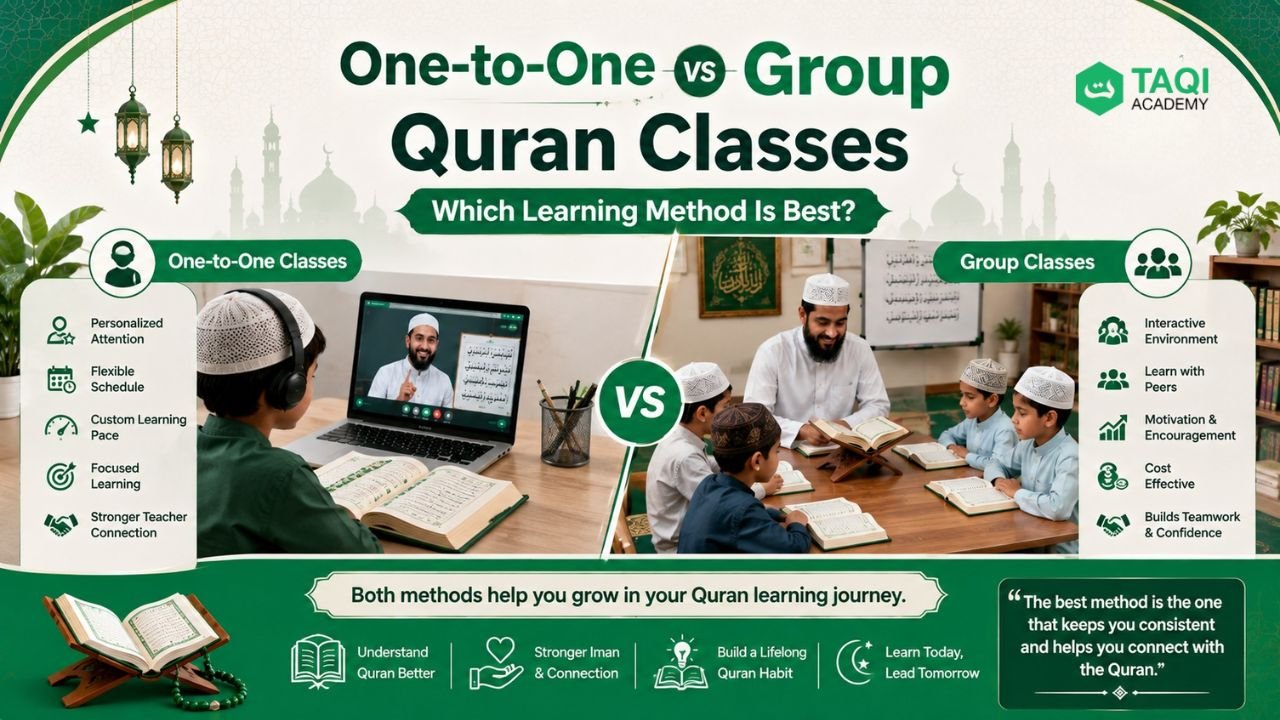
Choosing the right way to learn the Quran can make a significant difference in a student’s progress. Some learners prefer studying with a dedicated teacher who focuses entirely on their needs, while others enjoy learning with classmates in a group environment. So, which option is better: one-to-one Quran classes or group Quran classes? The answer depends on several factors, including the student’s current Quran reading level, learning goals, age, schedule, confidence, and the amount of individual guidance they need.
For beginners who need help with Arabic letters and pronunciation, a personalized class can make it easier to identify and correct mistakes. Students working on Tajweed may also benefit from immediate feedback. On the other hand, group classes can provide interaction with other learners and may suit students who enjoy a shared classroom environment. In this guide, we will compare both learning methods, explain their advantages and limitations, and help you decide which approach may be most suitable for you or your child.
What Are One-to-One Quran Classes?
In a one-to-one Quran class, one student learns directly with one Quran teacher during a live lesson. The teacher can focus on that student’s reading ability, pronunciation, Tajweed mistakes, memorization goals, and learning pace without having to divide attention among several students.
For example, a beginner who struggles to pronounce certain Arabic letters may need repeated practice and correction. In an individual lesson, the teacher can spend more time on those specific letters instead of moving ahead because other students are ready for the next lesson.
At Taqi Academy, live one-to-one lessons are a central part of the learning model. Students can learn through personalized courses with qualified male and female teachers, flexible schedules, and progress-focused instruction. If you are completely new to Quran reading, you can start with the Quran Foundation Course – Noorani Qaida & Basic Tajweed, which is designed to build foundational reading and pronunciation skills.
What Are Group Quran Classes?
In a group Quran class, multiple students learn together under the guidance of one teacher. The number of students can vary depending on the academy or teacher. In a traditional setting, several learners may sit together and take turns reading or practicing. Online group classes follow a similar concept through a virtual classroom.
Group learning can work well for students who enjoy interaction and feel motivated when learning alongside others. It can also create a classroom atmosphere where students listen to different recitations and learn from common mistakes.
However, the teacher has to divide attention between students. If one student needs considerably more time to correct a pronunciation problem, the lesson may not be able to stop for that student indefinitely. That difference is one of the most important factors to consider when comparing group and individual Quran learning.
One-to-One vs Group Quran Classes: Quick Comparison
| Factor | One-to-One Quran Classes | Group Quran Classes |
|---|---|---|
| Teacher attention | Dedicated to one student | Shared among students |
| Learning pace | Highly personalized | Usually follows group pace |
| Pronunciation correction | Immediate and individual | Depends on available class time |
| Tajweed practice | Personalized | Shared practice |
| Schedule | Usually more flexible | Often follows fixed times |
| Student interaction | Mainly student and teacher | Students learn with classmates |
| Suitable for beginners | Excellent for personalized guidance | Can work depending on class size |
| Hifz learning | Personalized memorization plan | May follow a common structure |
| Confidence | Comfortable for shy learners | Helpful for students who enjoy groups |
| Progress tracking | Easier to personalize | Usually based on group curriculum |
Neither format is automatically right for every learner. The better choice depends on what the student needs from the learning experience.
1. Individual Attention and Immediate Correction
One of the biggest advantages of one-to-one Quran learning is individual attention. When a student reads the Quran, the teacher can listen carefully to pronunciation, articulation, Tajweed application, fluency, and common reading errors. This is particularly important for beginners. Suppose a student repeatedly mispronounces an Arabic letter. In a one-to-one class, the teacher can stop, demonstrate the correct pronunciation, ask the student to repeat it, and continue practicing until the student improves.
In a group, the teacher has to balance that correction with the needs of other learners. This does not mean group classes cannot provide effective correction. A skilled teacher can still identify mistakes. The difference is that individual classes generally provide more time for student-specific correction.
2. Learning at Your Own Pace
Every Quran learner progresses differently. One student may quickly understand Arabic letters, while another may need several lessons to become comfortable with them. Similarly, one student may understand Tajweed rules quickly but require more practice applying them during recitation. A personalized class allows the teacher to adjust the lesson according to the student’s progress.
For example:
- A beginner can spend more time on Noorani Qaida.
- An intermediate learner can focus on Tajweed correction.
- A student preparing for Hifz can follow a structured memorization and revision routine.
- An advanced learner can focus on improving recitation quality.
This type of flexibility is especially useful for children and adults who have different learning abilities. Our Quran Reading with Tajweed course is suitable for learners who want to improve their recitation, pronunciation, Makharij, and application of Tajweed rules.
3. One-to-One Classes Can Be Helpful for Hifz
Quran memorization requires more than learning a new portion every day. A student also needs regular revision, accurate recitation, consistency, and correction of mistakes. If a mistake becomes part of the memorized portion, correcting it later can become more difficult. This makes individual teacher attention particularly valuable during Hifz. A teacher can listen to the student’s memorization, identify mistakes, review previous portions, and adjust the workload according to the learner’s ability. Students with busy schedules may also prefer a flexible approach.
Taqi Academy offers both a Complete Quran Hifz Program and a Part-Time Hifz Program, allowing learners to choose an approach that better matches their goals and daily responsibilities.
4. Group Classes Encourage Social Learning
One advantage of group Quran classes is the opportunity to learn alongside other students. Some learners feel motivated when they see classmates progressing. Children, in particular, may enjoy the sense of being part of a classroom. Group learning can also help students:
- Listen to other students’ recitation.
- Participate in shared activities.
- Develop classroom discipline.
- Learn through common questions.
- Feel part of a learning community.
For students who naturally enjoy social learning, these benefits should not be overlooked. The important consideration is whether the group size allows the teacher to give every learner enough time for recitation and correction.
5. Which Is Better for Children?
There is no universal answer because children have different personalities and learning needs. A confident child who enjoys learning with others may enjoy a small group class. However, a child who becomes distracted easily or needs frequent pronunciation correction may benefit more from one-to-one instruction.
Parents should consider:
- The child’s attention span.
- Current Quran reading ability.
- Pronunciation difficulties.
- Learning speed.
- Previous Quran learning experience.
- Preferred class time.
- Whether the child needs frequent encouragement.
- Whether the teacher provides progress updates.
A personalized one-to-one class can be particularly useful for beginners because the teacher can focus on the child’s exact level instead of following the pace of several learners. For a broader discussion of choosing suitable Quran education for children and adults, see our guide to The best online Quran courses in Bangladesh for kids and adults.
6. Which Is Better for Adults?
Adults often have different challenges from children. A working professional may only have a limited amount of free time. A parent may need lessons around family responsibilities. Someone who has not studied the Quran for many years may also feel uncomfortable learning in front of other students. For these learners, one-to-one classes can provide a more private and flexible environment.
An adult can start from the level they actually need rather than feeling pressured to match a group. For example, someone may already know how to read Arabic but want to improve Tajweed. Another person may need to start from Noorani Qaida. A third learner may want to understand Quranic meanings rather than focus primarily on reading. The learning path should reflect those differences. Our guide on how to learn the Quran online explains the basic process for learners who are considering online Quran education.
7. Which Method is Better for Tajweed?
Tajweed involves rules related to Quranic pronunciation and recitation. Learning the rules is important, but applying them correctly while reading is equally important. A student may understand a Tajweed rule theoretically but still make mistakes while reciting. This is where direct teacher feedback becomes valuable. In a one-to-one class, the teacher can listen closely and immediately point out the specific mistake. The student can then repeat the word or verse and practice the correction.
For students who are serious about improving pronunciation and recitation accuracy, personalized Tajweed instruction can therefore be a strong option. However, the quality of the teacher remains more important than simply choosing one format. A poorly structured one-to-one class may not be effective, while a well-managed small group class can provide excellent instruction.
8. What About Quran Translation and Tafseer?
Not every Quran learner wants to focus only on recitation. Some students want to understand the meanings of the verses, learn Quranic vocabulary, study Tafseer, and connect Quranic guidance with everyday life. For those learners, class interaction can sometimes be useful because they may have questions and want to discuss different concepts. At the same time, one-to-one instruction allows the teacher to adjust explanations according to the learner’s existing knowledge. Taqi Academy provides a dedicated Quran Translation & Tafseer Course for learners who want to go beyond recitation and develop a deeper understanding of Quranic meanings.
9. What About Islamic Studies and Arabic?
Your Quran learning goal may eventually extend beyond recitation. For example, you may want to understand Arabic so that Quranic vocabulary becomes more familiar. Or you may want structured Islamic education alongside Quran study. In that case, choosing an academy with multiple related learning paths can be convenient. Taqi Academy also offers an Online Arabic Language Course and an Online Islamic Studies Course. Having access to different courses can allow students to progress from foundational Quran reading to more advanced areas of Islamic learning according to their individual goals.
10. Is One-to-One Quran Learning More Effective?
For many students, one-to-one learning can be more effective because it provides personalized instruction, direct feedback, and flexible pacing. But it would be inaccurate to say that one-to-one classes are automatically better for everyone. The quality of Quran education depends on several factors:
Teacher qualification: The teacher should have appropriate Quranic and Islamic education and be capable of teaching the student’s level.
Curriculum: Lessons should follow a logical progression rather than being random or repetitive.
Practice: Quran learning requires regular recitation and revision, not simply attending classes.
Feedback: Students should know what they are doing correctly and what needs improvement.
Consistency: Regular classes and practice are essential for meaningful progress.
Student-teacher compatibility: A teacher’s communication style should suit the learner.
These factors matter regardless of whether the class is individual or group-based.
One-to-One vs Group Quran Classes: Which Should You Choose?
A simple way to decide is to start with your learning needs.
Choose One-to-One Quran Classes If:
- You are a complete beginner.
- You need help with Arabic pronunciation.
- You want personalized Tajweed correction.
- You want to learn at your own pace.
- You have a busy or unpredictable schedule.
- You are preparing for Quran Hifz.
- You prefer learning privately.
- Your child needs individual attention.
- You want a learning plan based on your current ability.
Consider Group Quran Classes If:
- You enjoy learning with other students.
- You are motivated by classroom interaction.
- You prefer a traditional classroom atmosphere.
- You learn well at a shared pace.
- The group is small enough for meaningful teacher interaction.
- You enjoy listening to and learning from other students.
The key is not to choose a format simply because someone else recommends it. Choose the learning environment in which you are most likely to attend consistently, practice regularly, and improve your Quran reading.
How to Choose the Right Online Quran Learning Method
Before enrolling, ask a few practical questions.
1. What Is Your Current Level?
Can you recognize Arabic letters? Can you read Quranic words? Do you already know basic Tajweed?
Your answer can determine whether you should begin with Noorani Qaida, move into Tajweed, or start another course. Our article on How to choose the best online Quran academy in Bangladesh provides additional factors to consider when evaluating an academy.
2. What Is Your Main Goal?
Your goal might be:
- Learning Quran from the beginning.
- Improving Quran reading.
- Correcting Tajweed.
- Memorizing the Quran.
- Understanding Quranic meanings.
- Learning Arabic.
- Studying Islamic knowledge.
A clear goal makes it easier to select the appropriate course.
3. How Much Time Can You Commit?
Be realistic.
A class schedule that looks ideal on paper will not help if you cannot attend consistently. Consider your school, work, family responsibilities, and daily routine before selecting a schedule.
Our guide on Getting started with online Quran learning in three easy steps can help beginners understand the process before enrolling.
4. Does the Academy Offer a Trial Class?
A trial class gives you an opportunity to understand how the teacher communicates, how the class is structured, and whether the learning environment feels comfortable. Taqi Academy currently offers free trial classes so prospective students can experience the teaching approach before making a decision.
Why Teacher Quality Matters More Than Class Format
It is easy to become focused on the question of one-to-one vs group classes, but the teacher may have a greater influence on the learning experience.
A good Quran teacher should be able to:
- Explain concepts clearly.
- Demonstrate correct pronunciation.
- Identify recitation mistakes.
- Encourage the student without unnecessary pressure.
- Adapt lessons to the learner’s level.
- Maintain appropriate Islamic etiquette.
- Track progress.
- Provide useful feedback.
Students should also have an opportunity to ask questions and receive corrections.
When choosing an online Quran academy, do not evaluate it only by price or promotional claims. Look at teacher qualifications, curriculum, class structure, student support, reviews, trial options, and how the academy handles progress. For more guidance, read How to choose the right online Islamic course in Bangladesh.
How Taqi Academy Approaches One-to-One Quran Learning
Taqi Academy is built around live, personalized Quran learning rather than recorded lessons alone. The academy states that its classes provide real-time Tajweed correction, Makharij guidance, individualized pacing, questions and answers, and progress tracking.
The academy offers learning paths for different stages, including:
- Noorani Qaida & Basic Tajweed
- Quran Reading with Tajweed
- Complete Quran Hifz
- Part-Time Quran Hifz
- Quran Translation & Tafseer
- Islamic Studies
- Arabic Language
This makes it possible for a learner to choose a course according to their current ability and learning objective rather than following one curriculum regardless of their needs.
Frequently Asked Questions
Are one-to-one Quran classes better than group classes?
One-to-one Quran classes can be more suitable for learners who need personalized attention, flexible pacing, or frequent pronunciation and Tajweed correction. However, group classes can also work well for students who enjoy social learning and classroom interaction.
Are group Quran classes good for children?
Yes. Group classes can be suitable for children who enjoy learning with other students. However, children who need more individual attention or frequently struggle with pronunciation may benefit from one-to-one instruction.
Is one-to-one Quran learning suitable for beginners?
Yes. Beginners can benefit from individual instruction because the teacher can start from their current level and spend additional time on Arabic letters, pronunciation, and basic reading skills.
Which is better for Quran Hifz: one-to-one or group classes?
Both formats can support Hifz. However, one-to-one instruction allows the teacher to personalize memorization targets, listen closely to recitation, correct mistakes, and adjust revision according to the student’s progress.
Can adults learn Quran online?
Yes. Adults can begin Quran learning at any age. An online class can be particularly convenient for adults who need flexible scheduling around work and family responsibilities.
Can I learn Tajweed through one-to-one online classes?
Yes. Live one-to-one classes can provide direct feedback while you recite, allowing the teacher to identify and correct pronunciation and Tajweed mistakes during the lesson.
What if I do not know Arabic?
You do not necessarily need prior Arabic knowledge to begin learning the Quran. Beginners can start with foundational lessons such as Noorani Qaida before progressing to Quran reading and Tajweed.
How do I know which Quran course is right for me?
Start by identifying your current reading ability and main goal. A beginner may need Noorani Qaida, while someone who already reads Quran may benefit from Tajweed. Students interested in memorization can consider Hifz, while those who want deeper understanding may choose Translation & Tafseer.
Final Verdict: One-to-One or Group Quran Classes?
There is no single learning method that is perfect for every Quran student. One-to-one Quran classes are generally a strong choice for learners who need personalized attention, flexible pacing, individual Tajweed correction, or a customized Hifz plan. Group Quran classes can be a good option for students who enjoy classroom interaction, shared learning, and studying alongside other learners. The most important thing is to find a qualified teacher, a structured curriculum, a suitable learning schedule, and an environment that encourages consistent Quran study.
If personalized guidance is your priority, a live one-to-one class may be the better fit. Taqi Academy provides live online Quran learning for beginners, children, adults, and learners at different stages, with courses covering Quran reading, Tajweed, Hifz, Translation & Tafseer, Arabic, and Islamic Studies. You can start by exploring the available Online Quran Courses at Taqi Academy and choosing a course that matches your current level and learning goals.
Related Quran Learning Guides
If you are still deciding how to begin, these guides may help:
- Online Quran Classes vs Private Quran Tutors
- How to Learn Quran Online
- Step-by-Step Guide to Learning Online Quran in Bangladesh
- Online Quran Learning vs Traditional Madrasa
- Top Online Quran Courses in Bangladesh
- Online Quran Courses for Women in Bangladesh
Start your Quran learning journey with a course that matches your level, your goals, and your schedule—not simply the most popular format.