
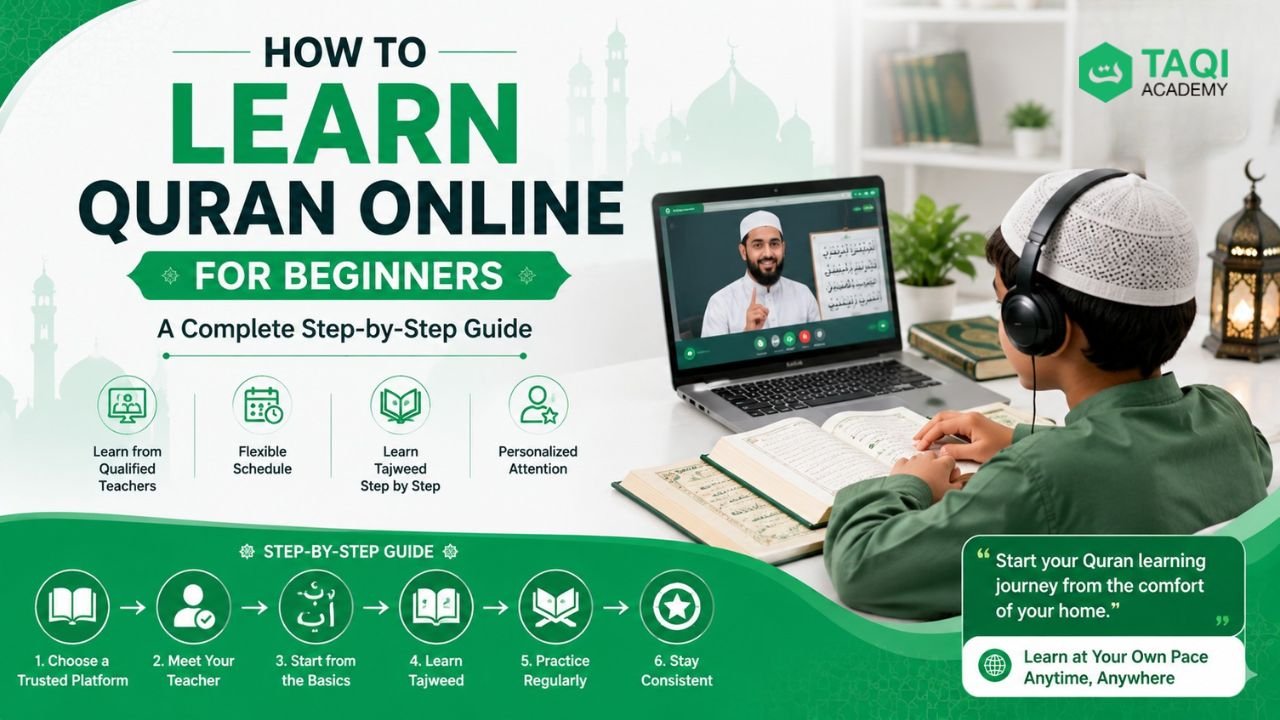
Learning the Quran is a meaningful journey, but getting started can feel difficult if you do not know Arabic, have never studied Tajweed, or have a busy daily schedule. Fortunately, online learning has made it easier for beginners to study the Quran from home with guidance from a qualified teacher. Whether you are an adult starting from the Arabic alphabet, a parent looking for Quran classes for your child, or someone who wants to improve Quran reading, the right learning plan can make a significant difference.
In this guide, we will explain how to learn Quran online step by step, how to choose a suitable teacher and course, and how an Online Quran Academy such as Taqi Academy can support your learning journey.
1. Start by Understanding Your Current Level
Before choosing a Quran course, first understand where you are starting. Some beginners cannot recognize Arabic letters at all. Others know the letters but struggle to connect them into words. Some people can read the Quran but make frequent pronunciation or Tajweed mistakes. Your starting point determines which course will be most useful.
For example:
- If you are completely new to Arabic letters, start with Noorani Qaida.
- If you can read basic Quranic words but need better pronunciation, a Quran reading course may be appropriate.
- If you can already read but want to improve your recitation, consider Tajweed.
- If your goal is Quran memorization, a structured Hifz program may be more suitable.
- If you want to understand the Quran, consider Translation and Tafseer after developing an appropriate reading foundation.
This level-based approach prevents beginners from choosing a course that is either too difficult or too basic.
2. Begin With a Quran Foundation Course
For a complete beginner, building a strong foundation should come before trying to read long Quranic passages. A Quran Foundation Course in Bangladesh based on Noorani Qaida can introduce the Arabic alphabet, vowel signs, pronunciation and basic reading skills in a structured way. At Taqi Academy, the Noorani Qaida course is designed for beginners and covers Arabic letters, vowel marks, connected letters, pronunciation, basic Tajweed rules, reading practice and assessment. The course is available for children and adults, with one-to-one live lessons and male and female teachers.
The goal at this stage is not to rush. It is to develop accurate pronunciation and confidence before moving to more advanced Quran reading.
3. Choose a Qualified Online Quran Teacher
The teacher you learn from can have a major impact on your progress. Quran pronunciation is not something that should be learned entirely through reading articles or watching random videos. A teacher needs to hear your recitation, identify mistakes and show you how to correct them.
When choosing an Online Quran Academy, look for:
- Qualified and experienced Quran teachers
- Knowledge of Tajweed and Makharij
- Experience teaching beginners
- Clear communication
- One-to-one or personalized instruction
- Flexible class schedules
- Regular progress assessment
- A suitable learning environment
It is also reasonable to ask about the teacher’s education, teaching experience and specialization before enrolling. Taqi Academy lists male and female teachers with backgrounds in Quran, Tajweed, Hifz, Arabic and Islamic Studies. The academy also allows students to request a teacher according to their learning needs and preferences, subject to availability.
4. Take a Trial Class Before Enrolling
A trial class is one of the easiest ways to determine whether an online Quran program is suitable for you. During a trial session, pay attention to how the teacher communicates, explains pronunciation and responds to mistakes. Parents should also observe whether their child feels comfortable participating in the lesson.
A good trial class should help answer practical questions such as:
- Is the teacher easy to understand?
- Does the teacher correct pronunciation?
- Is the lesson suitable for the student’s level?
- Is the class interactive?
- Can the schedule work with your routine?
- Does the student feel comfortable asking questions?
Taqi Academy offers a free trial class where students can meet a teacher and understand the learning approach before making an enrollment decision. Book Free Trial Quran Class
5. Create a Realistic Quran Learning Schedule
Consistency is more important than trying to study for long hours once or twice a week. A beginner may benefit from short, regular sessions that allow enough time for reading practice between classes. Your exact schedule should depend on your age, current level, goals and daily responsibilities.
For example, a student might arrange Quran learning:
- Before school
- After school
- After work
- During the evening
- On weekends
- Around prayer and family routines
If you live outside Bangladesh, choose an academy that can accommodate your local time zone. Taqi Academy provides flexible scheduling for students in different countries and offers live one-to-one Quran lessons.
6. Learn Arabic Letters and Pronunciation Correctly
If you are a complete beginner, your first major goal should be recognizing and pronouncing Arabic letters correctly. Do not feel embarrassed if this takes time. Arabic contains sounds that may be unfamiliar to English or Bengali speakers. Your teacher can help you understand:
- Arabic letter shapes
- Connected letters
- Harakat
- Sukun
- Shaddah
- Tanween
- Madd
- Correct articulation points
This foundation becomes important when you begin reading actual Quranic words. A small pronunciation mistake repeated for months can become a difficult habit to correct. Learning slowly and receiving immediate feedback is therefore valuable.
7. Move From Noorani Qaida to Quran Reading
Once you become comfortable with the basic Arabic reading system, you can gradually move toward Quranic text. At this stage, your teacher should continue checking pronunciation rather than simply asking you to read faster. The progression may look like this:
Arabic letters → vowel signs → connected letters → words → short passages → Quran reading → Tajweed
The exact pace will vary from student to student. There is no need to compare your progress with another learner. For many beginners, a strong foundation is more valuable than completing a course quickly.
8. Learn Quran With Tajweed
After developing basic reading skills, the next step is improving recitation through Tajweed. Tajweed teaches the rules used to pronounce Quranic letters and sounds correctly. Topics may include Makharij, Sifaat, Noon Sakinah, Meem Sakinah, Qalqalah, Madd, Ghunnah, Waqf and other rules.
Taqi Academy’s Quran Reading with Tajweed course covers these areas through structured lessons and practical recitation exercises. For beginners, learning Tajweed with live feedback can be particularly helpful because the teacher can hear your recitation and correct mistakes immediately.
9. Practice Between Your Online Quran Classes
Your progress should not stop when the live lesson ends. Set aside time for revision between classes. Read the portion your teacher assigned, repeat difficult words and practice the pronunciation that was corrected during the lesson. You can also listen to reliable Quran recitations while following the text. However, listening should support—not replace—teacher-guided learning when you are still developing basic pronunciation. Keeping a simple record of what you learned can also help you see your progress over time.
10. Move to Hifz or Quran Understanding When You Are Ready
Once your reading foundation is strong, you may want to pursue a more specific goal. Some students want to memorize the Quran. Others want to understand its meaning or study Islamic subjects alongside Quran learning. Taqi Academy provides structured options for these goals, including Complete Hifz, Part-Time Hifz, Quran Translation & Tafseer, Arabic Language and Islamic Studies.The important point is to choose the next stage according to your current ability rather than trying to do everything at once.
11. How to Choose the Right Online Quran Academy
There are many online Quran learning platforms, so beginners should compare them carefully. Before enrolling, check:
- Who teaches the classes?
- Are teachers qualified for the course?
- Are lessons live or pre-recorded?
- Is one-to-one learning available?
- Can you choose a suitable schedule?
- Is there a trial class?
- How is student progress monitored?
- Are courses available for your age and learning level?
- Can parents receive progress updates for children?
- Is there a clear way to contact the academy?
Do not choose an academy simply because it has the lowest price. Quran education requires accuracy, consistency and appropriate teacher guidance.
Why Choose Taqi Academy for Learning Quran Online?
Taqi Academy is an international Online Quran Academy providing live one-to-one Quran classes for children, adults, beginners, reverts and non-Arabic speakers. The academy currently offers courses including Noorani Qaida, Quran Reading with Tajweed, Complete Hifz, Part-Time Hifz, Quran Translation & Tafseer, Arabic Language and Islamic Studies. Students can also learn with male or female teachers and arrange flexible class schedules according to availability. For complete beginners, the Quran Foundation Course in Bangladesh can provide the basic reading foundation needed before progressing to more advanced Quran studies.
Final Thoughts
Learning Quran online can be a practical option for beginners who need flexible scheduling and personalized teacher support. The most important thing is to begin at the right level and build your skills gradually. Start by assessing your current ability. If you are completely new, begin with the Arabic alphabet and Noorani Qaida. Once your foundation improves, move into Quran reading and Tajweed. With consistent practice and guidance from a qualified teacher, you can continue toward Hifz, Quran understanding or other areas of Islamic education. If you are unsure which course is right for you, taking a trial class can be a sensible first step. The journey does not have to be rushed. Learn carefully, practice consistently, ask questions when you are unsure, and focus on improving your recitation one step at a time.